










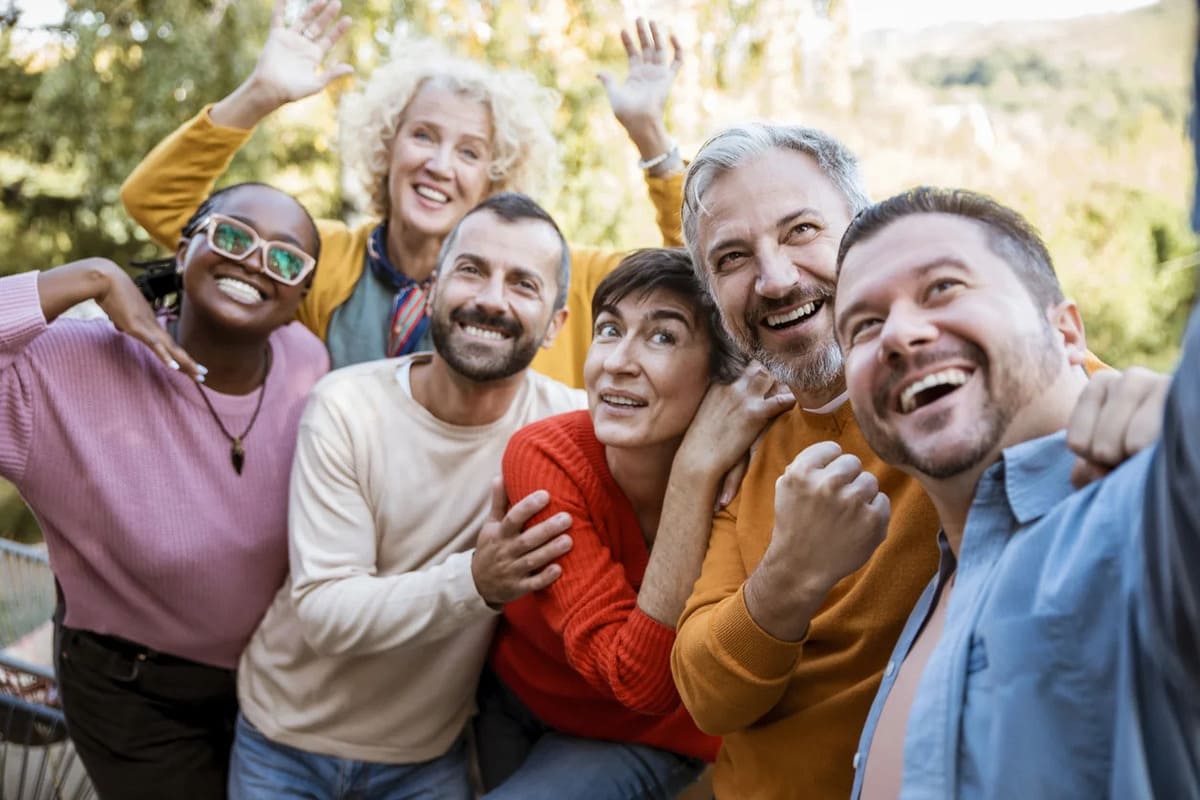
Think about the people you call your closest friends. Chances are, most of them are roughly your age – they went to the same schools, hit the same milestones around the same time and share the same cultural references. We tend to gravitate toward people who mirror our own life stage, and it feels natural. But what if that instinct is actually shrinking your world? Science suggests that the most enriching friendships you could cultivate might involve someone born in an entirely different decade than you.
Why we stick to our own age group – and what we lose
More than half of U.S. adults report frequently feeling isolated or lacking companionship, according to a 2025 survey by the American Psychological Association. Loneliness is everywhere, and yet most of us keep fishing for connection in the same narrow pond: people who look like us, earn like us and, crucially, were born around the same year. Developmental psychologist Abby Stephan, PhD, whose research centers on intergenerational relationships, points out that same-age friendships often draw on a limited range of experiences, perspectives and skill sets. Cross-generational bonds, by contrast, tap into a much wider pool.
Marc Schulz, PhD, associate director of the Harvard Study of Adult Development – one of the longest-running studies of human happiness and health, spanning more than eight decades – puts it simply: relationships keep us happier and physically healthier throughout our entire lifespan, and it does not make sense to restrict ourselves to only certain kinds of people. So why do we keep doing it?
What the research actually says about age-gap friendships
A 2023 study published in the Journal of Aging Studies found cognitive, physical and psychosocial benefits for both younger and older adults who regularly interact across generational lines. For younger adults, these friendships were associated with greater confidence, higher self-esteem and a stronger sense of long-term perspective – what Stephan describes as an understanding of the grand scheme beyond the present moment. For older adults, the payoffs included a greater sense of purpose and meaning, reduced loneliness and diminished ageist attitudes.
A separate 2020 systematic review published in Social Science & Medicine reinforced those findings. Older adults engaged in program-based intergenerational interactions showed positive associations with both physical and mental health, including reduced depression. They also experienced improved cognitive function, stronger social relationships and higher quality of life, with cross-generational connections linked to increased physical and social activities.
Younger adults benefit, too. According to the same 2023 study, those who maintained friendships with older people demonstrated decreased ageism and more positive attitudes about growing older themselves. Schulz notes that older friends have accumulated life experiences a younger person simply has not, and that perspective helps younger adults understand the kinds of challenges they face and what tends to matter most over time.
How to actually build a friendship across generations
The foundation is the same as any lasting friendship: shared interests and consistent presence. Stephan emphasizes that, just like same-age friendships, intergenerational bonds thrive when they are built on a shared interest, commitment or goal. That could mean community theater, volunteering, a faith group, a recreational sports team or a recurring gathering like a choir, book club or game night – any space where people keep showing up.
A 2021 article in the Canadian Journal on Aging frames this through what researchers call the homophily principle – the simple idea that birds of a feather flock together. What matters most in cross-generational friendships is not chronological age but what the study terms a homophily of doing-and-being: people connecting as friends in action, bonding over common interests and relating to one another in similar ways. What holds people together is not being born in the same decade but sharing values, curiosities and rhythms of life.
There are practical considerations, though. Friends from different generations may occupy different life stages, which can affect priorities, energy levels and communication styles. Stephan recommends having a casual conversation about communication preferences – things like preferred method of contact, frequency and time of day. Small adjustments go a long way.
There is also the risk of slipping into an unintended parent-child or mentor-mentee dynamic. Experts suggest resisting the urge to guide unless asked, and when friction arises, avoiding age-based assumptions. Stephan encourages focusing on who your friend is as an individual and treating challenges as opportunities for honest conversation and creative empathy. The variation within any generation, she notes, is greater than the variation between them. Schulz agrees, adding that one of the greatest rewards of a cross-generational bond is recognizing that there are probably more similarities than differences among us at our core.
The bottom line
Friendships with people decades older or younger than you are not just charming anecdotes – they are linked to measurable improvements in confidence, cognitive function, mental health and even physical well-being. The research from the Harvard Study of Adult Development, the Journal of Aging Studies and Social Science & Medicine all point in the same direction: connection across age lines makes both sides healthier and happier. You do not need to overhaul your social life. You just need to stop filtering out potential friends based on the year on their driver’s license – and start showing up where people of all ages already gather.


