







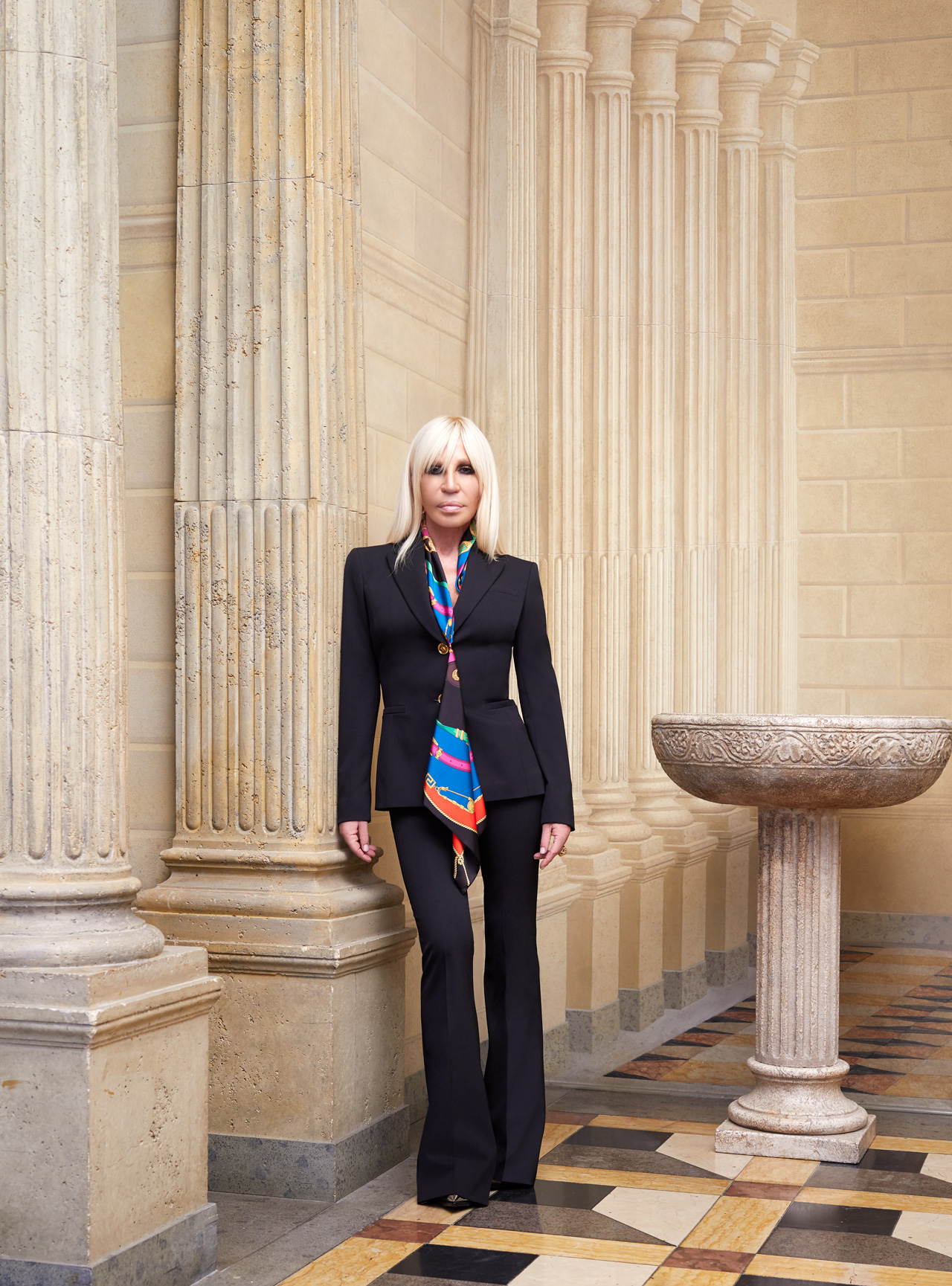
“To me, Versace represents empowerment,” Jennifer Lopez once said of Versace. No word better represents the Italian luxury house. And no better word describes its matriarch, Donatella Versace.
In an exclusive essay penned by Versace for GRAZIA in 2017, Versace surmised the “feeling” of Versace in these six words: “Strength. Power. Fearlessness. Passion. Bravery. Femininity.” Indeed, it is these qualities that have come to define the brand, the pillars on which the House was built by Gianni, and today, that House not only survives – but thrives – because of his sister. Donatella is the personification of the brand, the most pure extension of all Versace stands for: she is female empowerment.
Here, while in lockdown in her Milanese home, GRAZIA talks exclusively to Donatella Versace about how she’s battling her hyperactivity while in isolation, why it’s time to put the self aside for others and what the future of fashion really looks like.
You decided to spend the lockdown in
your Milan home making a concrete contribution to the fight
against the virus. Together with your
daughter Allegra, you donated 200 thousand (EURO) to the
intensive care unit of San
Raffaele hospital. You have also announced that you are going to
give up your salary for the fiscal
year 2021. How important do you think it is for each of us today to
do our part?
I think it is fundamental. After months of fighting this virus, I
think everyone; individuals and governments, understand this is a
battle we can only win if we remain united, help each other and
follow the rules. There are no shortcuts and there are no tricks
that work: we are fighting an enemy who does not look anyone in the
eye and has overcome all possible and imaginable barriers.
Providing help is the least that can be done and honestly, it does
not matter what kind of contribution we make, everyone does what
they can. It is essential to follow the rules that have been
imposed on us, not only for our health, but above all for the
respect we owe to all those who are fighting this virus on the
front line. Those who expose themselves and their families to the
risk of contagion, so that we can all have food on our tables,
adequate medicines and treatments. This goes beyond those examples
that make it into a “newspaper headline,” all the small gestures
that each of us can and must do will in the long run be what will
allow us to win this challenge.
“It’s time to put the self aside for
others,” you have declared. Can this crisis be an important moment
of self-reflection for each of us?
Absolutely. We are forced to stay home and cannot go outside,
however we can look inside of us ourselves. I am proud to be part
of a community that has joined forces in a long-distance embrace
and that has been able to bring out a sensitivity, generosity and
altruism that I have only ever noticed on a few occasions. I
believe that this imposed social distancing has made us realize how
many important things from our daily life we took for granted.
Nobody could have imagined an apocalyptic scenario like this, in
which we were deprived of all the basic forms of freedom and in
which a gesture of love, like a hug and a kiss, could be
transformed into an instrument of death. But this confinement has
also brought out something that had perhaps been dormant in the
hearts of us all: national identity. I am thinking of the songs
sang on the balconies across the country or the flags displayed on
many houses in Italy, which I have seen in newspapers and on social
media. We have rediscovered ourselves as fellow countrymen, proud
to be so and united in wanting to overcome this moment so that our
country will shine again in the eyes of the whole world.
What has struck you the most in these
difficult weeks?
People, and the spontaneous gestures of solidarity that have been
born from the understanding that we are only strong when we team
up, when we are united and do not discriminate. Then I saw the true
strength of us Italians, which lies in being a nation that stands
united in times of need and which has been an example for everyone
else. I was also struck by the way we are facing these painful
moments; many people have lost someone dear in the past few weeks,
without even being able to give them one final goodbye. The
composure with which they have managed to face the greatest pain
there could be while having the eyes of the world set on them,
touched me and moved me deeply. I know what it means to lose
someone you love and I know how much greater the pain is when you
see them on the newspaper’s front pages.
How has your daily life
changed?
For a hyperactive person like me, being confined to the house is
really difficult. I know very well that I am more fortunate than
some in many ways, but this does not take away the fact that we are
all deprived of the most basic freedoms in the exact same way.
Having said that, I have tried to build a new routine, different
from before. I continue to work and create, not only because it is
my job, but because I also have a responsibility towards all the
small companies that depend on Versace to be able to start again. I
work, of course, remotely thanks to video conferences, but I must
admit that it does not feel the same for me. I love working with
different groups of people. I like having people next to me who do
not necessarily think like me, because I believe that only from the
combination of cultures new ideas arise. Right now, I really like
the aesthetics of young Japanese and South Koreans, their way of
mixing colors and fabrics that I find very innovative. Now, if I
were to find a positive thing about this forced new reality, is
that I finally have the time to do some research like I used to do
at the beginning. To take time to reflect on what to do instead of
following the tight rhythms imposed by today’s fashion market. I
spend time with Audrey, reading and watching my favorite TV series
or on the internet discovering new music groups.
What is your first thought in the
morning and the last one before going to bed?
It depends on how the day went. I obviously think of my children
who are not here with me, and my friends. Then I wonder what our
society will look like when we are finally ready to start again. I
am a positive person by nature, who always sees the glass half
full. So, I think, that for the first time in a long time, we have
the opportunity to create a new society, to start again, but to do
so by first asking ourselves what we would like to keep from the
‘old world’ and what can now be changed and improved. These are all
questions that are difficult to answer as a single individual, but
I hope we will be able to ask ourselves this because I see this
crisis as our chance to make up for the many mistakes we have
made.
What do you miss the most of the
‘normal life’
Real contact with people and traveling.
What is the hardest sacrifice during
this time?
To be self-isolating and unable to see my children.
In the era of Coronavirus, is there
anything you have discovered or rediscovered in everyday
life?
The beauty of spending time on my sofa reading with Audrey next to
me keeping me company.
Do you ever feel lonely these
days?
Like everyone else I would imagine. Luckily my job keeps me busy
and at least I get to speak to many people on a daily basis.
Do you virtually meet your friends?
How do you manage to stay close, to care for each other,
to
embrace virtually? And with your
children?
Yes, of course. Apps like Face Time or HouseParty and others are
used daily. It is the presence, albeit virtual, that keeps us
together, that reassures us and that manages to transmit, even just
by looking at the smile of my children, that affection that for now
we cannot physically demonstrate.
Does spending time with Audrey, your
dog, give you peace of mind?
Audrey is always with me, even before this crisis. I believe it is
true that our animals take a little bit of our character because I
see that sometimes she quivers from the desire to go outside (which
of course she can do but in a very limited way …) or to come in the
office with me. For the time being, she has to settle with being on
the sofa reading or watching TV with me, or watching me while I
work.
Optimistic or pessimistic about the
future?
Optimistic, always!
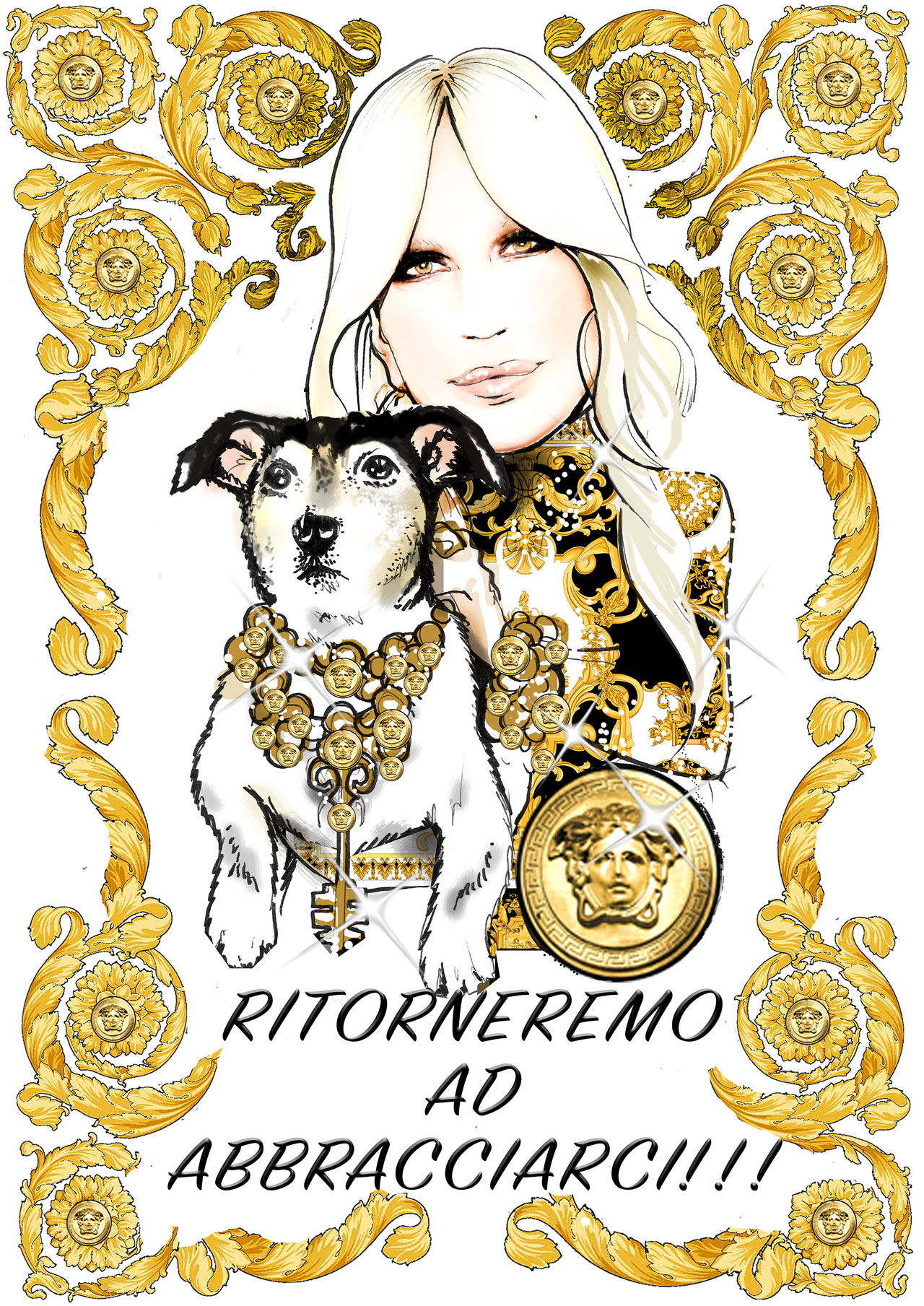
Do you think that, once the emergency
is over, the fashion business will have changed? Do you
think
shows will take place in
September?
I think that the whole world, not just fashion, will have changed.
We will have to rethink many things starting from seasonality. Due
to the fact that stores have been closed for months now, the Spring
Summer collection will be the first available to purchase once we
reopen while, in what could be defined as the ‘traditional
calendar’ we were ready to deliver the new collection (Pre Fall).
Honestly, I don’t mind the fact that for the first time we will
have light weight dresses and swimsuits in the shop windows in
Summer, while it is hot outside. As designers, we have complained
for years about the tight rhythms imposed by the market. Now, for
reasons beyond our control, we can and we should find a way to get
back to work in a different manner, to have warm sweaters in Winter
and light dresses in Summer. I honestly do not know if there will
be a fashion show in September. I hope so, because the show for us
designers is not only a moment of work, but also the means by which
we make people dream, we get them inspired. Maybe, even in this
case, different formulas will have to be found, I don’t know. It is
difficult to give certain answers to these questions because there
are so many variables in the current state of things, and there are
no certainties anymore.
This experience, this global
emergency, what inner lesson does it leave us with?
It will leave me even more convinced of the importance of being
united, of tolerance and acceptance of diversity. For me, there is
only one way to be united, and that is to be able to live in a
society that not only allows you to be yourself, but that supports
you in your individuality.
How do you think Italy will come out
of this health crisis?
Recognizing that our health system – as well as the entire
operations network related to basic necessities, such as
supermarkets and pharmacies – must be protected, supported and
valued. During these past months, companies and citizens have
contributed to the emergency firsthand, donating sums of money to
support the crisis, but no one can – or should – replace the state.
We will be able to come out of this crisis only by funding.
Research, building structures capable of dealing with emergencies,
with a suitable number of staff, trained and properly paid for the
responsibility they have on their shoulders: our lives. I don’t
want to do petty demagoguery or politics, but if there is one thing
we have understood from this crisis it is that we are not well
enough equipped to sustain emergencies of this scale. Our doctors
and nurses, but also those who work in supermarkets and pharmacies,
have paid a high price for this inefficiency. I have seen
heartbreaking images and unacceptable situations for a State that
defines itself as modern. In conclusion, I do not think it is
acceptable or possible to ask them to pay with their lives for the
structural lacking of a system that evidently needs major
improvements.
This interview was originally conducted for GRAZIA Italy.


