










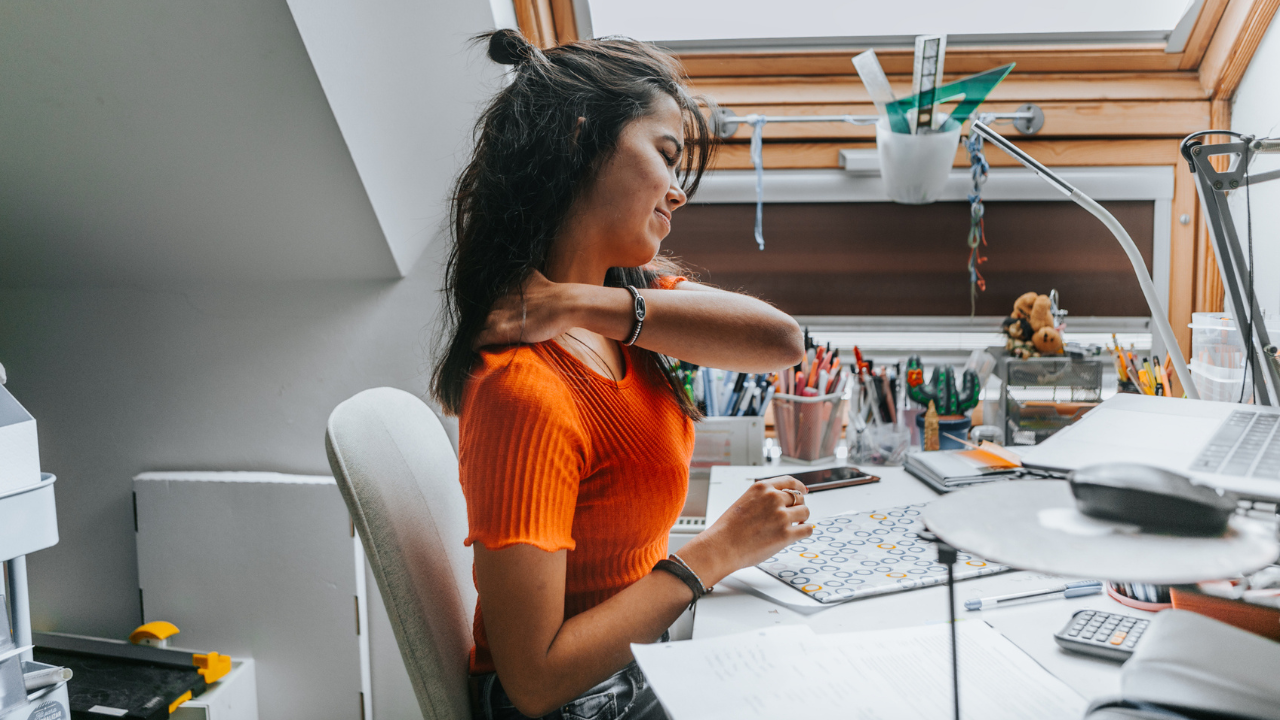
Who in this day and age doesn’t struggle with back pain here and there?
Many of us are sitting at desks all day long, glued to our chairs (ergonomic or otherwise) and by the time the day is done, we’re stiff and sore all over.
For millennia, humans have been hunter gatherers, out in the fields and in various manual jobs. And our bodies haven’t quite adapted to sitting in a chair up to a desk all day.
So it’s no wonder every Tom, Dick and Harry struggle with stiffness, tightness, soreness and so on.
But it doesn’t have to be that way — UK-based osteopath, Alex Pattenden says that we should keep the body moving to prevent pain when possible. She suggests that even going for a short walk 20 minutes before your day starts can be an underrated move to support your back health.
And while you’re sitting at your desk, there are several moves that can be carried out in a quick sequence throughout the day (even if you’re in the office) to limit the likelihood of pain…
1. Figure of eight
“Start in a seated position and interlace your fingers behind your neck,” Pattenden says. If you can’t get your hands behind your neck, just have them behind your neck one on top of the other.
“You want your elbows to be in front of you underneath your chin, as close to touching as possible and use your elbows as a ‘pen’ to draw a figure of eight in the air.”
Start off with a nice big shape and gradually get smaller to hone in on all your vertebrae. This should move your whole back. Once you’ve drawn the shape one way, go back in the opposite direction and do so for around 30 seconds.
2. Shoulder rotations
Next in the sequence, Pattenden suggests shoulder rotations.
“Start with your fingertips touching the front of your shoulders,” she explains. “Really slowly, roll the shoulders back and down. This will really nicely open up the chest.” You want big shoulder circles with elbows coming up past your face, trying to get your shoulders to go as close to your ears as possible.
“This will really help office workers,” Pattenden says. Typically, the muscles in your anterior chain shorten from sitting at desks all day long and our shoulders can hunch forward as a result. This exercise will support better posture.

3. Pelvic tilts
Next, you’re working into the pelvis. Sit nice and tall as if there’s a piece of string connecting your head to the ceiling and sit with your back slightly away from the chair.
Put your hands on your hip joints, tuck your pelvis under and push your glutes forward, tucking your tailbone underneath and allowing your back to round. Then reverse the other way and stick your butt out, allowing your back to arch for about 30 seconds or until you feel ease.
4. Figure four
Place your left leg on the thigh of your right leg in a ‘4’ shape. From here, put your hands behind your neck and slowly, while keeping your back straight, hinge forward from the hips. Then switch and do so on the other side.
This is really great for hip mobility, Pattenden says. “You’ll find a nice stretch in the glutes. This is really important because a lot of peoples’ glutes won’t be active when they’re sitting so much.”
While these exercises can help reduce stiffness and soreness, Pattenden points out that regular pain should get checked out. Speak to an osteopath or another specialist who can take a look at your body and provide advice that works for you.


