


Newsfeed


The world feels awfully heavy lately. As wars unfold in real time on our phones, political absurdities become background noise, and artificial intelligence blurs the line between truth and theatre, the collective mood is one of ever-present unease. Every scroll delivers another crisis, another outrage, another demand to react. In moments like this, hardening up is instinctive – emotionally, psychologically, aesthetically. Armour feels sensible when everything feels under threat. And yet, as we continue to observe these collapses of safety systems, something else is happening: a counter-movement towards something slower, softer, more intentional. Not as denial, or distraction, but as resistance.
Softness, once dismissed as naïveté or weakness, is being reclaimed as a survival strategy. As a cultural language for those who don’t wish to fade into nihilism, and remain defiantly human in a world that often rewards the opposite. In fashion, in how we work, in how we rest, and in how we define success itself, the hard edges are beginning to blur.
For decades, hustle culture held the microphone. Girlbossing propaganda promised meaning and happiness through relentless effort: early mornings, late nights, inboxes that never emptied, productivity measured by exhaustion. “Rise and grind” became a mantra, amplified by social media’s relentless performance of success. Sleep was indulgent. Breathable clothing is relegated to the home. Rest for the privileged. Softness suspect.
But the cost of this ideology has become impossible to ignore. The World Health Organization now classifies burnout as an “occupational phenomenon”, with Stanford researchers finding that productivity actually drops sharply after 50 hours of work per week, and beyond 55 hours, additional effort yields virtually no return. Deloitte reports that nearly half of Gen Z feel stressed most of the time because of work, and even job listings have changed tone – roles advertising “work-life balance” have seen a surge in applications.
The pandemic acted as a collective pause. A rupture in the performance of constant optimisation. It forced a reckoning with the toll of productivity-as-identity. People began to ask what all the striving was for, and whether a life built on depletion and denial could ever be aspirational.
At the same time, the world outside work has grown more volatile. Political upheaval, social fragmentation, environmental anxiety – these are not abstract forces, but daily realities absorbed through screens that never let us rest. In such conditions, the instinct to harden makes sense. But history suggests that hardness, left unchecked, calcifies into cynicism.
Audre Lorde famously wrote, “Caring for myself is not self-indulgence, it is self-preservation, and that is an act of political warfare.” In a system that thrives on the extraction of labour, attention, and emotion, choosing softness becomes quietly radical. It is not ignorance of reality, but refusal to let brutality dictate our inner lives.
This cultural pivot toward gentleness is perhaps nowhere more visible than in fashion.
Fashion, after all, has always moved like a pendulum. Periods of austerity give way to ease; rigidity loosens; silhouettes soften. In the 1970s, amid political unrest and economic instability, clothing grew freer, more fluid, more expressive. Bohemia replaced uniformity. Comfort became political. The body reclaimed space and yearned for tactility. Today’s shift feels similarly charged.
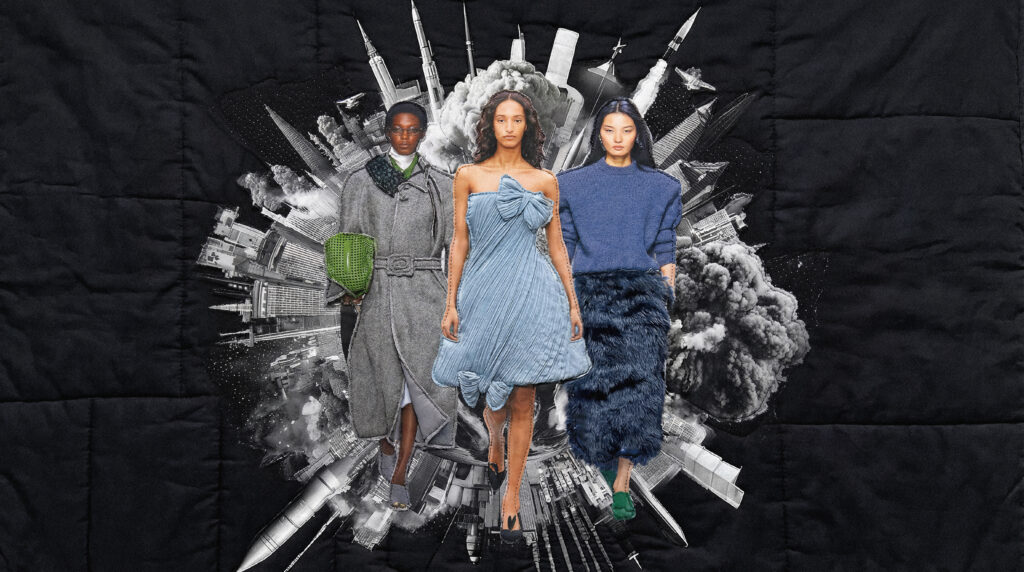
Across the Spring/Summer 2026 runways, designers collectively exhaled. Precision gave way to generosity, with clothes not performing dominance or prescription, but offering shelter.
At Chanel, Matthieu Blazy’s debut chapter reimagined the house’s storied codes through a lighter, more emotional lens. Tweeds softened, silhouettes elongated and loosened. Trailing sleeves and sheer layers floated rather than clung, allowing the body room to exist rather than impress. Even the most recognisable structures were rendered permeable. Here, clothing wasn’t just armour, but atmosphere. Then there was Jonathan Anderson’s first womenswear collection for Dior, which honoured heritage without entrenchment. The Bar jacket, once a symbol of cinched perfection, appeared in conversation with draped fabrics and relaxed, contemporary forms. Structure remained, as did impeccable tailoring, but it breathed with an emotional intelligence. Bodies didn’t have something to prove, but were celebrated as they are.
Elsewhere, Louise Trotter’s Bottega Veneta leaned into tactility as a language of care. Fringed nappa, brushed surfaces, and hand-worked textures invited touch, honing a relationship between the material and the wearer. These were clothes designed to be lived in and loved long after they appeared on your feed.
But it was Miuccia Prada who probed this sentiment most acutely at Miu Miu, where a continuation of her interrogation of workwear concluded in an unexpected tenderness. With apron-like silhouettes and utilitarian references nodding to labour, the collection asked a gentler question: what if fashion honoured effort rather than erased it? What if function could still feel kind?
Across Paris, Milan and beyond, clothes became emotionally generous.
This runway shift mirrors a broader visual language emerging online. On TikTok and Instagram, “low-energy dressing”, a moment defined by quiet colours, unfussy silhouettes and soft shapes, has taken hold. It looks effortless, but it is deeply intentional and goes well beyond aesthetics. More than a fleeting trend, it reflects a growing refusal to perform. A way of living unapologetically in one’s emotional energy when faced with an overstimulating world.
Kate Nightingale, consumer psychologist and founder of Humanising Brands, sees it as a response to constant existential threat. “Our psychological needs for safety and belonging are challenged multiple times a day,” she noted in an interview. “Simplicity becomes a coping mechanism. Even refusing to conform becomes a form of control.”
There is also, she notes, a cognitive benefit. Fewer decisions free up some mental bandwidth. Where we’ve generally been sold theories on how dressing up can become a self-fulfilling mantra, comfort now influences confidence. This is enclothed cognition in action: when clothes feel safe, the wearer feels steadier. Perhaps, when the world is unstable, restrictive fashions lose their appeal.
Historically, softness in fashion has been gendered and diminutised, often associated with frivolity, sappy sentimentality, or weakness. Power dressing always took cues from menswear – sharp tailoring, hard lines, visual authority. But today, softness is deliberate. It signals boundaries and self-awareness. On TikTok alone, the search for #AlwaysStaySoft garnered a staggering 39 million posts, most serving as a quiet battle cry for empathy – both for others and oneself. It’s a rejection of the performative nonchalance of the Brat era, and a celebration of finding ways to keep the spirit intact.
This recalibration extends beyond clothes. Emotional intelligence is increasingly valued over brute ambition. Even in dating, women report emotional quotient (EQ) as a much more alluring quality in a suitor than a hefty salary. A 2023 human nature study published in Scientific Reports that spanned 147 countries found “kindness-supportiveness” to be the most valued trait in a long-term partner, with emotional stability and empathy ranked higher than physical attractiveness or financial wealth. Also notable, women showed no preference for traits tied to stoicism or dominance. In a culture once obsessed with optimisation, side hustles and ‘lookmaxxing’, the new social currency is wearing one’s heart on their sleeve.
To soften is not to deny reality, or stick one’s head in the sand, but to grapple with hard truths without surrendering emotional investment – to the world, to ourselves, and beyond. Even when it feels like the news cycle is delivering a fresh batch of hellish updates on the house, it’s when we resist cynicism that we reclaim something vital and powerful.
Fashion, in this sense, is not merely decorative. It is a language through which we articulate what we value. And right now, resilience is manifesting in care.
As the world continues to fracture and reform, the pendulum will inevitably swing again. Trends will harden, sharpen, and accelerate. But this moment, this collective leaning toward softness, feels less like a fad than a cultural correction.
Because at its core, softness is resilience. And fashion, at its best, has always been a vehicle for revolution.


