










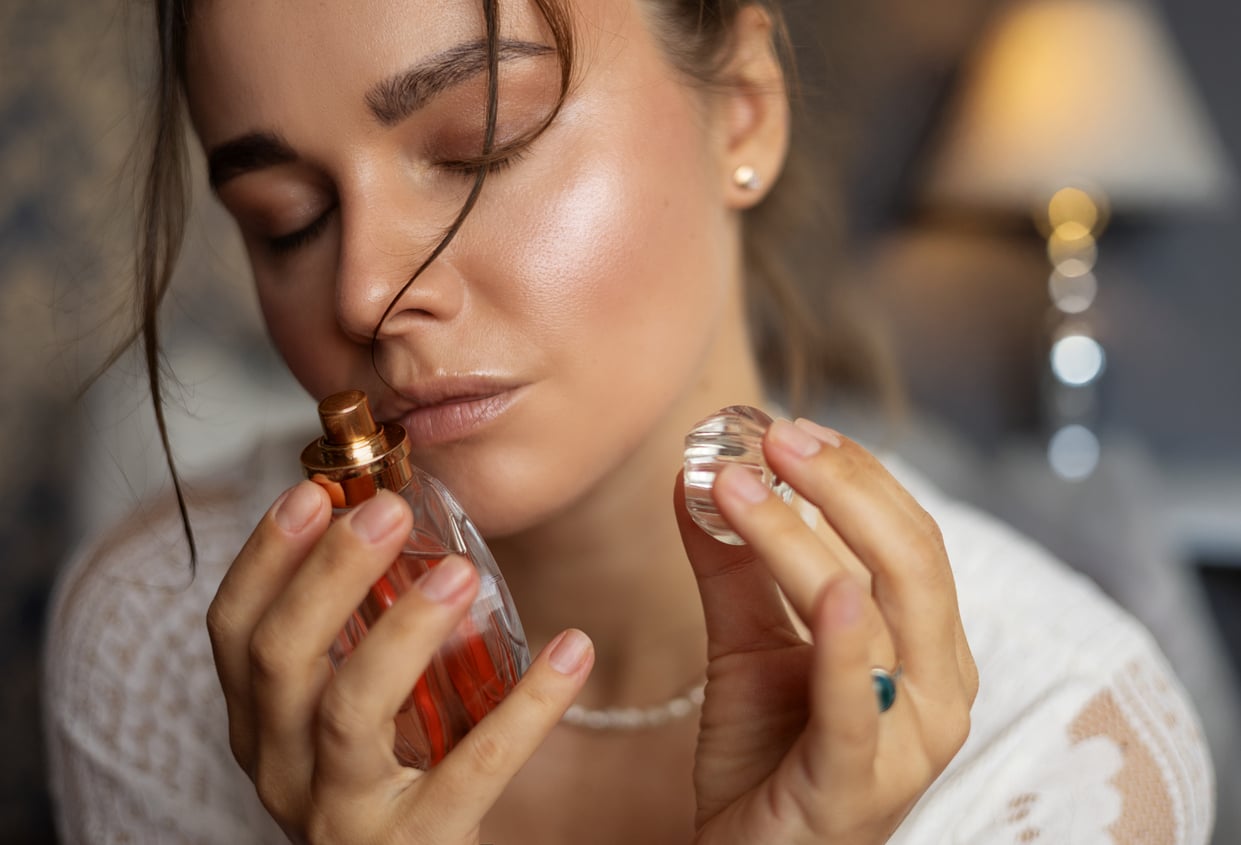
We choose perfume for how it makes us feel and how it makes us remembered. Almost nobody chooses it for their brain. But a study from Japan suggests that one scent in particular, worn every day for a month, may do something no fragrance ad has ever promised: change the structure of the brain itself. The researchers found measurable growth in gray matter, the tissue where the brain does much of its processing, and specifically in a region tied to memory. The scent in question is one of the oldest and most beloved notes in perfumery. You may already be wearing it.
The experiment: a rose scent, worn for a month
Researchers from Kyoto University and the University of Tsukuba recruited 50 healthy women. Twenty-eight of them were asked to apply rose essential oil to their clothing every day for a month, so that the scent was with them continuously in the background. The other 22 applied plain water instead, as a control. Everyone had an MRI brain scan before and after. The results, published in the journal Brain Research Bulletin, showed an increase in overall gray matter volume in the women who wore the rose scent, with no comparable change in the control group.
Where the change happened
The most striking detail is where the growth appeared. You might expect a scent to affect the parts of the brain most directly involved in smell and emotion, such as the amygdala or the orbitofrontal cortex, which processes pleasant odors. Those changed very little. The biggest increase was in the posterior cingulate cortex, a region associated with memory and with forming associations. The researchers wrote that continuous inhalation of rose essential oil may help prevent brain atrophy and could one day play a role in reducing the risk of dementia.
Why that region? The team offered a theory. When a scent is always present, the brain’s alarm system stops flagging it, but other areas keep processing it and linking it to memories, and that steady work may be what builds tissue. They also raised a second possibility: that the brain may register the constant scent as mildly unwelcome, and that the emotional regulation needed to manage it is what makes the region work harder. Scent and memory, in other words, may be more intertwined in the brain than we realize.
What it does not prove, yet
This is a small study, 50 women over a single month, and the researchers were clear that much larger and longer trials are needed. It is not yet known whether the changes last, whether other scents have the same effect, whether it applies to men, or whether more gray matter in this region translates into better memory or a lower dementia risk in real life. It is a promising first finding, not a prescription.
Rose, perfumery’s oldest love affair
If the result feels oddly fitting, it is because rose has been at the heart of perfume for centuries. Rose oil remains one of the most widely used essential oils in perfumery despite its extraordinary cost, since it takes an enormous quantity of petals to produce a tiny amount. It sits at the center of countless classic fragrances, and it is part of why so many of the scents we return to over decades, the icons that never seem to age, feel so much like memory in a bottle.
How to wear it the way the study did
The women in the trial did not wear rose perfume in the usual sense. They applied a diluted rose essential oil to their clothes, so the scent stayed faint and constant throughout the day rather than strong for an hour and gone by lunch. If you want to try something similar, a drop or two of diluted rose oil on a scarf or the collar of a sweater gets closer to the study than a spritz at the pulse points. Never apply undiluted essential oil to skin, and patch-test anything new if your skin is sensitive. And if you prefer your scent in the air rather than on your clothes, the same idea of a gentle, all-day background fragrance is what makes a simmering spice pot so appealing.
The takeaway
A month of wearing rose scent on their clothes was linked to more gray matter in a memory-related part of the brain in a small Japanese study. It is too early to call rose a brain treatment. But it is a lovely reason to give the oldest note in perfumery a place in your everyday routine, and a reminder that scent and memory may be connected more deeply than we ever thought.


