










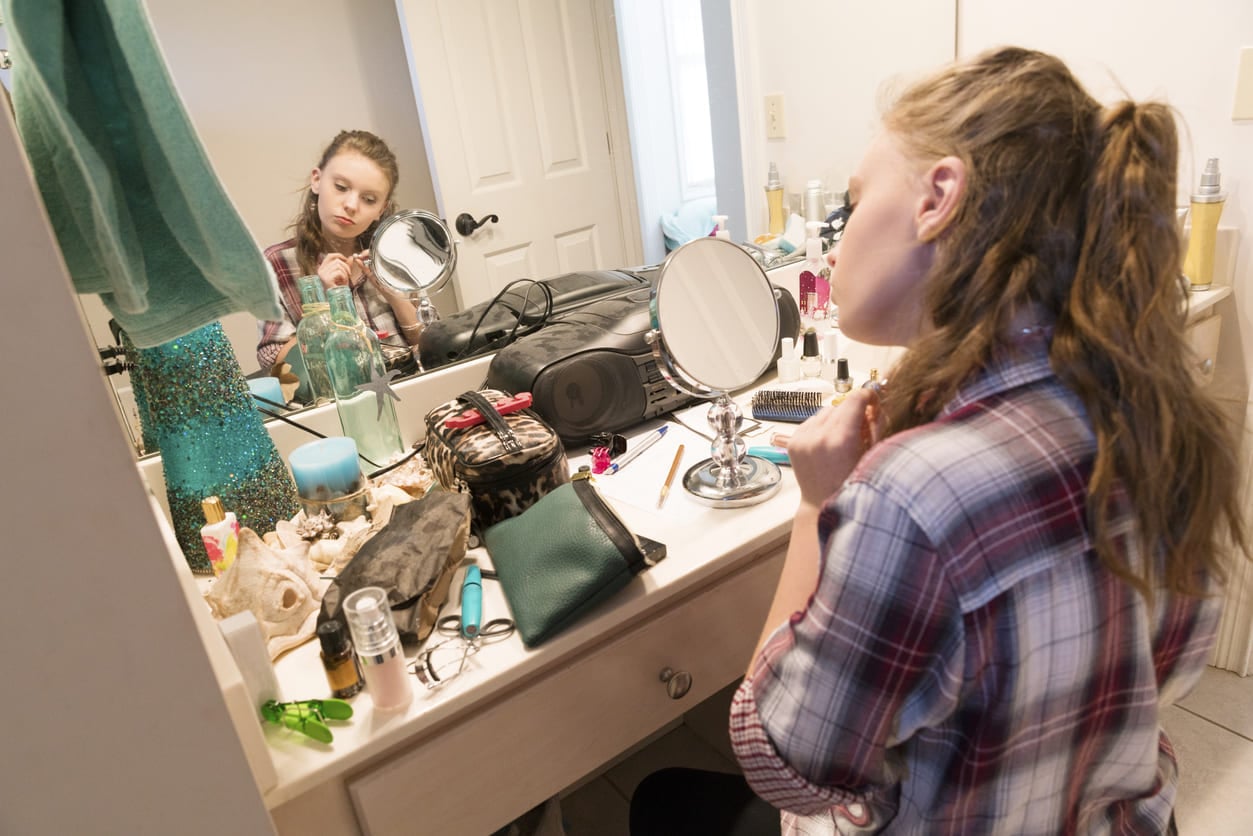
You probably don’t think twice when your teenager locks the bathroom door for an hour, emerging with dewy skin, perfectly styled hair, and a cloud of fragrance trailing behind them. It feels harmless – maybe even endearing. They’re experimenting, finding their style, doing what teens do. But a growing body of research suggests that the sheer volume of products landing on young skin every single day may carry consequences we hadn’t fully considered. And the force driving that volume? It might be sitting right in their pocket, autoplaying the next tutorial.
How social media is quietly reshaping your teen’s bathroom shelf
A study published in the Journal of Exposure Science & Environmental Epidemiology set out to understand the relationship between social media habits and personal care product use among adolescents. Researchers affiliated with Rutgers School of Public Health, Wellesley College, the University of Connecticut, and Princeton High School surveyed 143 high school students, asking them to detail every product they had applied in the previous 24 hours – everything from shampoo and deodorant to skin care, fragrance, and makeup.
What they found was striking. Students who followed social media influencers with their own product lines reported using 30% more personal care products within that 24-hour window compared with peers who did not. And those who watched hair or beauty tutorials? They used 40% more. That gap is significant when you consider how many products we’re already talking about.
So what does a typical day actually look like for these students? Girls in the study reported using a median of 14 products a day, which is roughly twice as many as boys. And overall, the high schoolers’ product use was on par with the levels previously documented in adults. In other words, teenagers are already consuming personal care products at grown-up rates – and social media appears to be accelerating that pattern even further.
Why more products could mean more risk during adolescence
The concern isn’t simply about cluttered countertops or drained allowances. It’s about what’s inside those bottles and tubes. Researchers noted that some personal care products contain chemicals such as phthalates, parabens, and phenols – substances that have been linked to hormone disruption and an increased risk of cancer. Each additional product a teen layers on potentially adds another source of exposure to these compounds.
And timing matters. The lead author of the study explained that adolescents are undergoing rapid changes, including in their hormone systems. That biological reality makes the teenage years a particularly sensitive window for chemical exposure. A compound that an adult body might process with minimal effect could, in theory, carry greater weight during a period of intense hormonal development.
Think of it this way: we wouldn’t hand a teenager an adult dose of most medications without pausing to consider their developmental stage. Yet we rarely apply that same caution to the cocktail of ingredients they smooth, spray, and rinse onto their bodies every morning and night. The study suggests it might be time to start paying closer attention.
The ingredient-list gap and what comes next
Perhaps the most telling detail from the research is this: while some students expressed concern about what their products contained, only 19% said they regularly read ingredient lists. That disconnect – worry without action – reflects a broader reality. Labels on personal care products can be dense, technical, and easy to ignore, especially when the product itself was recommended by a trusted influencer in an engaging, polished video.
Awareness alone isn’t a solution, but it is a starting point. Knowing that phthalates are plasticizing chemicals often found in fragrances, that parabens are preservatives used to extend shelf life, and that phenols are compounds present in various cosmetic formulations gives you a practical vocabulary to scan those tiny-print panels a little faster. You don’t need a chemistry degree – just a willingness to glance before you lather.
Researchers behind the study noted that future investigations could use urine tests to measure teens’ actual chemical exposure, moving beyond self-reported product counts to biological data. That next step would help clarify whether higher product use truly translates into higher chemical burden in the body, or whether certain products and certain ingredients are the primary drivers.
What you can take away from this
Here is the picture that emerges: social media beauty content is not just shaping aesthetic preferences among teenagers. It is measurably increasing the number of products they use, and each additional product is a potential vehicle for chemicals linked to hormonal interference. Adolescents are already matching adult-level product use, during a life stage when their bodies may be especially vulnerable to endocrine-active substances. And yet fewer than one in five teens bother to check what they are putting on their skin.
None of this means you need to confiscate every serum in the house. But encouraging a habit as simple as scanning an ingredient list – the same way we learn to glance at nutrition labels – could be one of the most practical, empowering moves a young person makes for their own health.


