










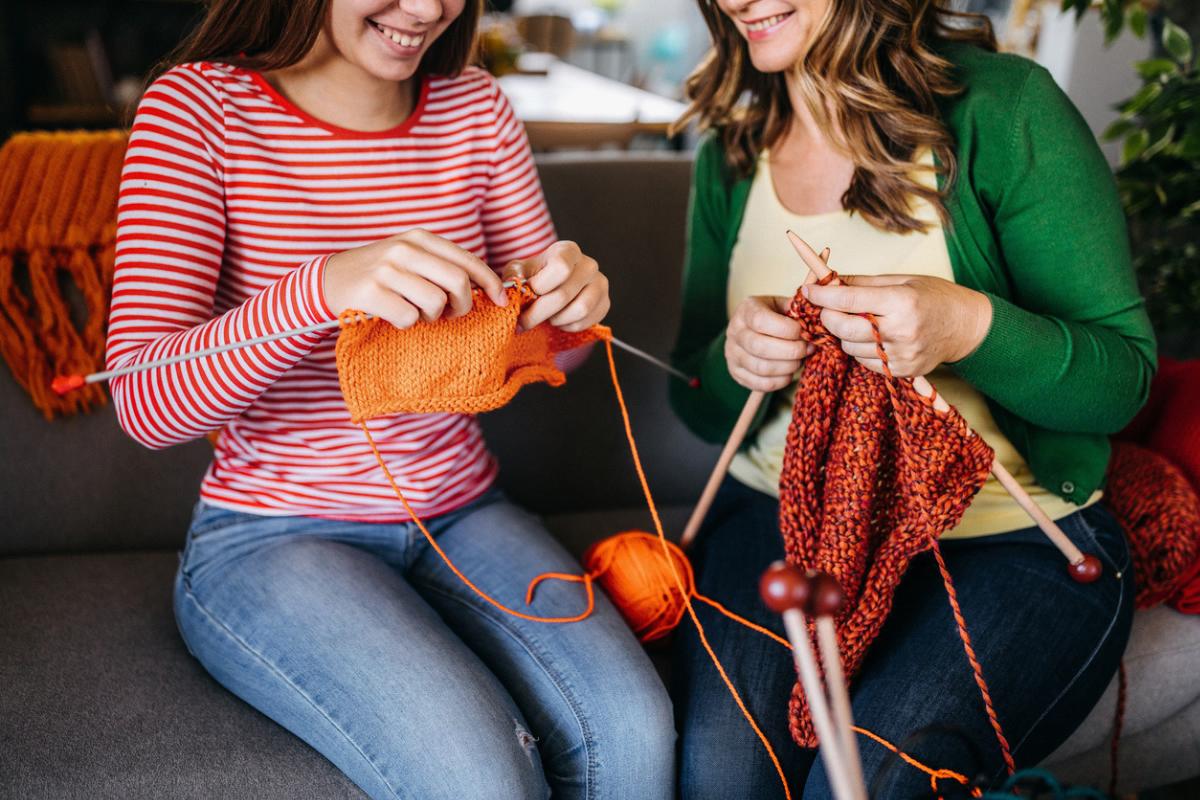
Needles, yarn and a quiet hour: research suggests this cozy habit does more for the mind than we think. When the days get short and cold, some people reach for the remote. Others reach for a ball of yarn. A half-finished scarf on the sofa, a pattern open on the table, needles clicking through an evening show: for many women, knitting is simply part of winter.
It turns out they may be onto something. In 2013, Jill Riley, Betsan Corkhill and Clare Morris published an international survey of knitters in the British Journal of Occupational Therapy. It received more than 3,500 responses from 39 countries in just under two weeks.
What the Knitting Survey Found
The results showed “a significant relationship between knitting frequency and feeling calm and happy.” In other words, the more often people knitted, the calmer and happier they reported feeling. More frequent knitters also reported higher cognitive functioning.
Most respondents said they knitted for relaxation, stress relief and creativity. And knitting with others mattered too: knitting in a group was linked to greater happiness and better social contact. The authors concluded that knitting has significant psychological and social benefits, with therapeutic potential that deserves further research.
Crafting and the Aging Brain
A separate study looked at older adults. As part of the Mayo Clinic Study of Aging, researchers led by neuropsychiatrist Yonas Geda studied 1,321 people aged 70 to 89 in Olmsted County, Minnesota, 197 of whom had mild cognitive impairment. Published in 2011, the study found that craft activities such as knitting and quilting in later life were associated with lower odds of mild cognitive impairment, as were reading books, playing games and computer activities.
The study was a snapshot rather than a long-term trial, so it shows a link, not proof of cause. Still, Geda saw it as encouraging. “This study is exciting because it demonstrates that aging does not need to be a passive process,” he said.
How to Make Knitting a Winter Habit
If you have not knitted in years, start small: a simple scarf or a dishcloth in a soft, chunky yarn on large needles. Set aside a regular time, after dinner or on Sunday afternoons, so it becomes a ritual. Join a knitting group at a local yarn shop, library or community center, since the survey found the social side matters. If knitting feels hard on your hands, try crochet, or take short breaks to stretch your fingers. And do not worry about mistakes: the calm comes from the rhythm, not perfection. Crafting is one of many mentally stimulating hobbies that keep the mind engaged. And research shows that kindness grows stronger with age, so consider knitting for charity, too. The lesson worth borrowing is that a slow, repetitive craft can be one of the best ways to unwind.
The Bottom Line
People who still knit through the winter are onto something. A survey of more than 3,500 knitters linked knitting more often to feeling calmer and happier, and a Mayo Clinic study tied later-life crafting to lower odds of mild cognitive impairment.


