










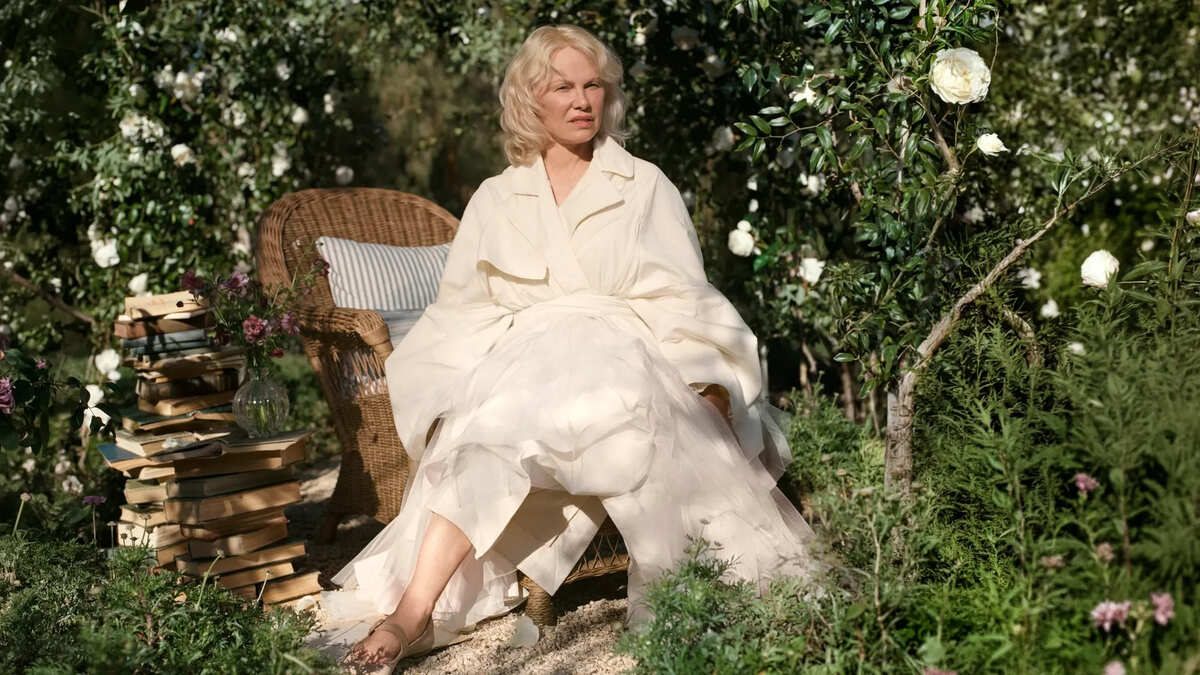
You have probably scrolled past a dozen outdoor-entertaining guides this month alone, each one insisting you need a statement pergola, matching dinnerware, or a six-figure landscape overhaul to host well. But the most inviting backyards rarely look curated at all. They look lived in – a little rumpled, a little sun-faded, and full of things that were clearly chosen by hand over many years. That tension between what we think an outdoor space should look like and what actually makes people want to stay is exactly what Pamela Anderson has been quietly working through for decades, first on her grandmother’s waterfront Vancouver Island farm and later in the markets of the South of France.
A grandmother’s garden and the art of beautiful imperfection
Anderson‘s relationship with outdoor living stretches back further than most people realize. She purchased her grandmother’s farm at the end of the 1990s – a waterfront property on Vancouver Island that she has spent years thoughtfully restoring following her grandmother’s passing in 2005. The landscape there still bears her grandmother’s fingerprints: coral geraniums and quince roses climbing freely across the buildings, untamed and unedited. Anderson describes her grandmother as having a bit of a wild taste, and that unmanicured sensibility clearly made an impression.
Over time, Anderson layered her own aesthetic on top of that foundation, shaped by a lifetime of travel and, in particular, by years spent living in the South of France. There, she sourced wicker, ironstone, and oil paintings at local markets – the kind of pieces that carry a story without demanding attention. That accumulated eye for the quietly beautiful eventually led to her outdoor furniture collaboration with Olive Ateliers, a collection she describes not as a reinvention but as a refinement of the way she has always lived. So what does that way of living actually look like when you sit down at her table?
Edible centerpieces, wrinkled linen, and the power of imperfection
If Anderson has a signature entertaining move, it is her approach to the table itself. Rather than arranging flowers or investing in sculptural décor, she builds her centerpieces from crudité – whole cauliflowers, bunches of carrots – drawing inspiration from the effortless, slightly undone tables she encountered in the South of France. Everything on the table is abundant, unfussy, and entirely edible.
The underlying philosophy is worth noting because it flips the usual hosting anxiety on its head. A table that already looks a bit lived-in, with linen slightly wrinkled and flowers loosely gathered, sets a far more inviting tone than anything too pristine. You do not need to iron the napkins or arrange each stem symmetrically. In fact, the less arranged it all feels, the better. That slight dishevelment signals warmth – it tells your guests that the evening is about them, not the tablescape.
And when it comes to furniture, Anderson returns to one material above all others: wicker. She treats it less as a design statement and more as a way of life, something meant to be dragged inside and outside, positioned under trees, and brought along for picnics in the vegetable garden. Wicker softens a space instantly, adding warmth without formality. Most importantly, it is meant to be used, and it only gets better with time – a quality that aligns perfectly with Anderson’s embrace of imperfection.
Lighting, flow, and why boundaries between indoors and out should disappear
For Anderson, the mood of an outdoor gathering hinges on light. She is less concerned with illumination and more interested in atmosphere – a soft diffusion that settles over a table as the evening unfolds, something she compares to the feeling at Club 55 in St. Tropez. Candles and twinkling lights create a glow that feels almost accidental, casting just enough warmth to draw people closer. It is that subtle shift from day to dusk that turns a casual dinner into something chic and memorable.
Equally important is the seamlessness between her indoor and outdoor spaces. Anderson’s kitchen – lined with French cutting boards, copper pots, and well-worn wooden tools – never feels separate from her outdoor life but rather functions as a natural extension of it. The home moves fluidly between inside and out without ever announcing the transition. Even her furniture carries that philosophy. She still has the picnic table her parents used as their dining table in a tiny cabin down the beach, and it directly inspired the Greenhouse Extendable Teak table she designed with Olive Ateliers. Nothing in the collection feels confined to a single setting, because in Anderson’s world, nothing ever is.
The bottom line
The real takeaway here is that an inviting outdoor space has almost nothing to do with budget and almost everything to do with attitude. Wrinkled linen beats ironed linen. Vegetables make better centerpieces than formal arrangements. Wicker chairs belong wherever you drag them. If you let your backyard look a little untamed – coral geraniums climbing where they please, candles flickering unevenly as the sun drops – you are already closer to the South of France than any catalog purchase could get you. The most stylish thing you can do this summer is stop trying so hard.


