










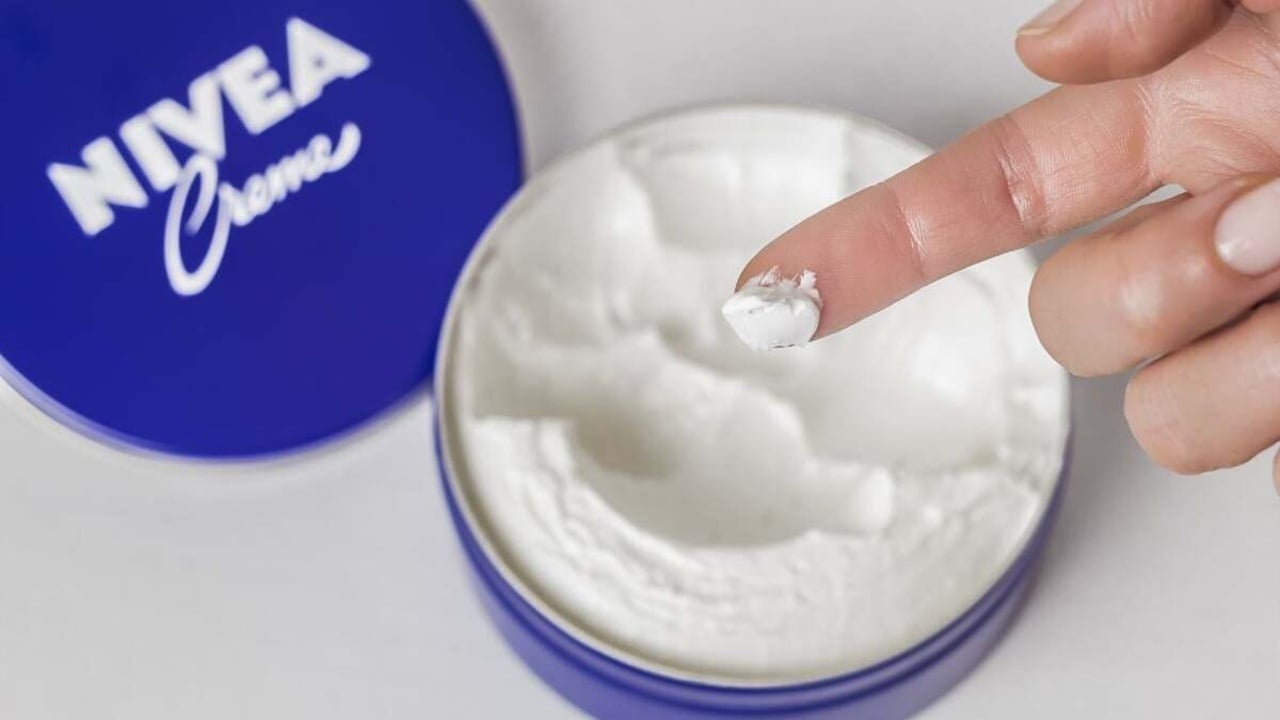
It has been sitting in bathroom cabinets for more than a century, in the same round blue tin your grandmother probably kept by her bed. Nivea Creme was made for skin: hands, elbows, faces chapped by winter. But this fall, the cream is having an unexpected second life far from where Beiersdorf ever intended it to go, and hairdressers have very different opinions about it.
Why is everyone putting Nivea Creme in their hair?
The idea has been circulating for months on social media, and it has now reached the beauty pages. In Spain, El Economista reported on October 19 that hair-health experts describe the cream as a nourishing mask for the hair once it is combined with coconut oil. Other versions online add heat, or leave the mixture on overnight.
It belongs to the same family of pantry tricks as mixing white vinegar and coffee grounds: two cheap, familiar products, each doing one job. The question is whether those jobs actually suit your hair.
What each ingredient actually does
Nivea Creme is a rich, occlusive formula built largely on mineral oil, microcrystalline wax and lanolin alcohol. Pharmacist Helena Rodero, who specializes in dermocosmetics, points out that this kind of formula seals in moisture rather than nourishing the hair fiber, as reported by Compradiccion. In other words, it coats.
Coconut oil works differently. In a study published in the Journal of Cosmetic Science in 2003, researchers A.S. Rele and R.B. Mohile compared mineral oil, sunflower oil and coconut oil on hair. Only coconut oil reduced protein loss, on both damaged and undamaged hair, when used before washing. The researchers linked this to its main fatty acid, lauric acid, which has a high affinity for hair proteins and is small enough to penetrate the hair shaft. Mineral oil, the main ingredient in many rich creams, did not have that effect. That is the logic behind the mix: one product that penetrates, one that seals.
Who can it work for?
According to hair-health expert Ariel Medeiro, quoted by Compradiccion, the cream can hydrate dry or very dry hair well, on one condition: it goes only on the mid-lengths and ends, never on the roots. Thick, coarse hair that tends to look dull and straw-like in winter is the best candidate.
Who should skip it
Fine hair, oily hair and sensitive scalps are on the other side of the line. Medeiro warns that very fine hair gets greasy and dirty quickly with the cream. Curly-hair specialist and hairdresser Conchi Arias notes that a body cream is formulated for skin, not hair, and that any shine or softness tends to disappear with the next wash. Rodero adds that its waxy, petroleum-derived ingredients can build up on the hair, weigh it down and sometimes require a stronger shampoo to remove, which is the opposite of what fragile hair needs.
How to try it, if your hair is a candidate
- Keep it small. Warm a small amount of Nivea Creme, about a teaspoon, between your palms with roughly the same amount of coconut oil until it melts into a smooth balm.
- Ends only. Work it through the mid-lengths and ends of dry hair, and stay several inches away from the scalp.
- Short, not overnight. Leave it on for 20 to 30 minutes, then shampoo, twice if needed, so nothing is left behind.
- Once a week, at most. If your hair feels heavy or flat afterward, it is telling you it does not need this.
- Test first. Try it on a small section, especially if your scalp reacts easily.
If your real problem this season is frizz rather than dryness, a styling fix may serve you better than a mask, as we explained in why hair gets frizzier in fall.
The bottom line
Nivea Creme and coconut oil can make sense together: the oil gets into the hair, the cream holds moisture in. For thick, dry ends, it is a cheap winter treatment worth a try. For fine, oily or curly hair, the experts are clear that the blue tin belongs on your hands, not in your hair.


