









For a century, the grammar of haute couture has been written in silk. Gazar, faille, duchesse satin, Chantilly lace worked by hands that inherited their gestures from other hands: the ateliers of Paris have always drawn their legitimacy from the pedigree of their materials, from fibers with lineages as documented as those of the clients who wear them. Latex never belonged to that aristocracy. Industrial, synthetic, vaguely illicit, it was the stuff of fetish clubs and hospital gloves, everything couture defined itself against. Which is precisely why its triumphant arrival on the Fall/Winter 2026 runways feels less like a trend and more like a small revolution: this season, latex was handled not as provocation but as clay. A ductile, plastic matter through which two designers, in radically different ways, reshaped an entire imaginary.
Schiaparelli: The Abyss Wears Latex
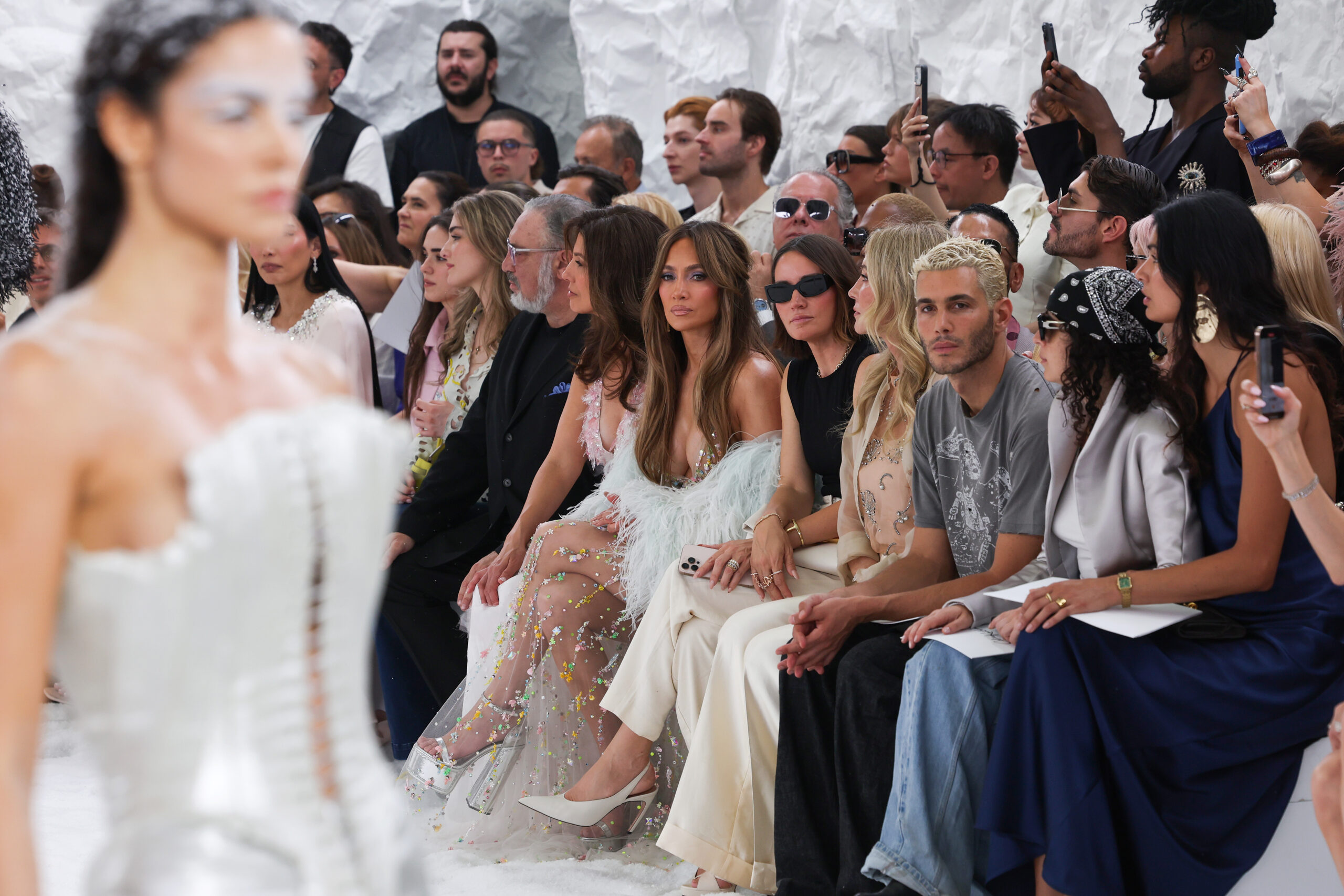
Daniel Roseberry titled his Schiaparelli collection The Call of the Void (l’appel du vide) and staged it as a descent into deep water on a mirrored runway at the Petit Palais. What surfaced from that dive belonged as much to cinema and contemporary art as to fashion: latex jackets sprouting inflatable tentacles, flesh-toned silicone gills tracing a model’s spine, bustiers embedded with tiny LEDs so that light pulsed through the material like the bioluminescence of deep-sea creatures. It was impossible not to think of Guillermo del Toro‘s aquatic prosthetics, the amphibian god of The Shape of Water reincarnated as a Place Vendôme client, and Roseberry made the art-world debt explicit himself: his palette was drawn from the unsettling imagery of Matthew Barney‘s Cremaster Cycle, while the techniques were developed with a Parisian workshop that specializes in hyperrealistic silicone babies for the film industry.
But the most eloquent gesture may have been the choice of material itself. Because there is something quietly devastating in the fact that when Couture finally imagines the creatures of the abyss, it renders them in synthetics. The deepest trenches of our oceans, places no sunlight has ever reached, now contain microplastics; the void has already been colonized by our waste. Roseberry’s latex leviathans, glowing and tentacled, are thus not fantasy but reportage: portraits of a sea that is becoming, molecule by molecule, as artificial as the garments that mimic it. In an age of ecological anxiety, couture’s most precious material turned out to be the most compromised one, plastic holding up a mirror to a plasticized world. That a house founded on Surrealism should deliver this reflection is fitting: the Surrealists, too, knew that the monstrous is never elsewhere. It is us, refracted.
Robert Wun: Such Stuff as Dreams Are Made On
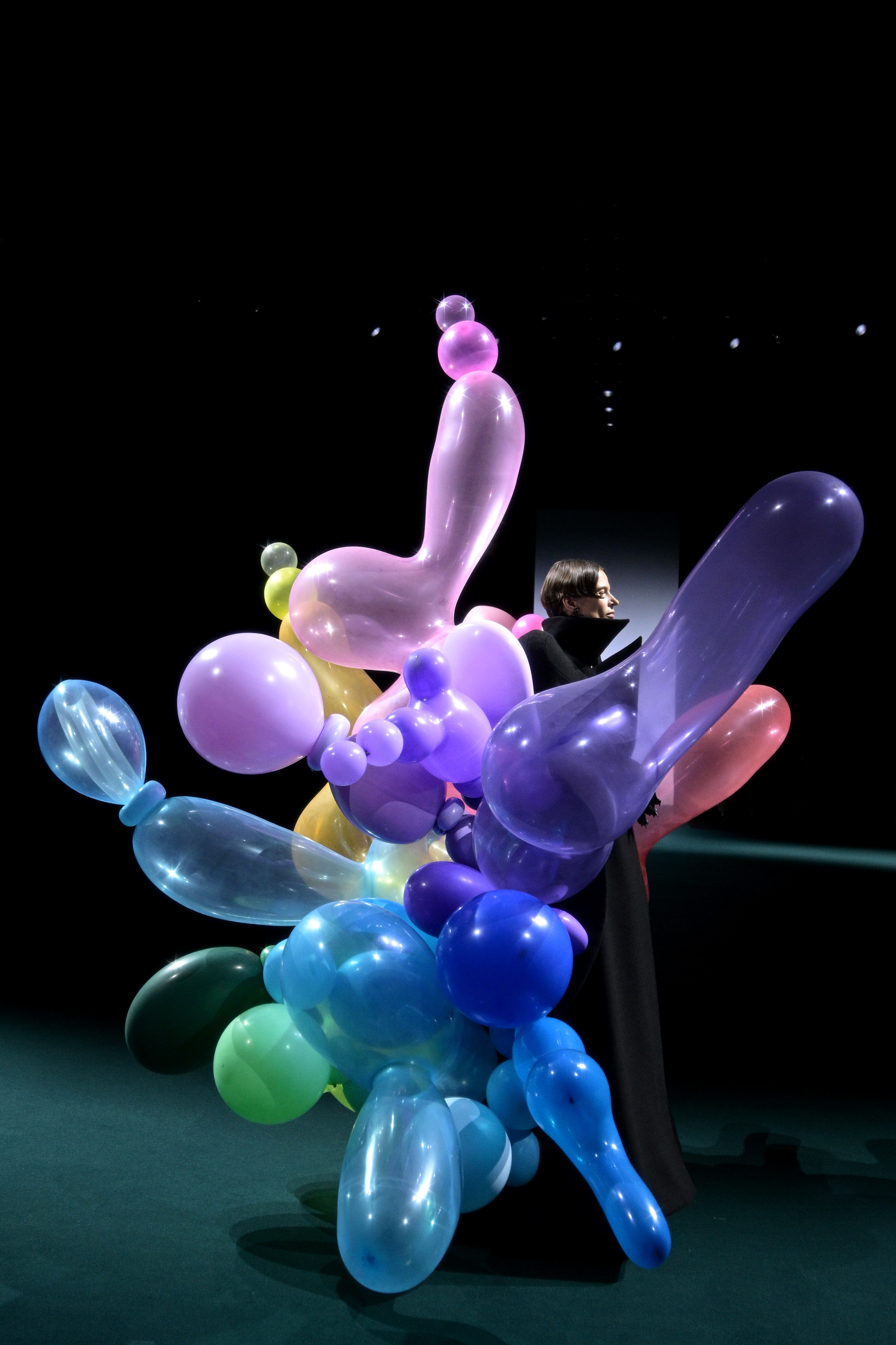
If Roseberry’s latex belonged to the depths, Robert Wun‘s floated. His collection, pointedly titled Childsplay, reached for the most democratic latex object in existence, the party balloon, and elevated it to couture’s final word. Glossy, balloon-inspired dresses in saturated primaries evoked building blocks and wooden toys; models traversed the runway in transparent bubble helmets, one cradling a single rose like a snow globe of memory; and in the finale, tailored jackets literally erupted with real balloons bursting from sleeves, lapels and backs: birthday parties, as one critic put it, refusing to stay in the past. Wun cited Hayao Miyazaki alongside Charles Perrault and the Brothers Grimm, and that genealogy tells you everything: this was childhood nostalgia remembered by an adult, which is to say childhood with its latent creepiness intact. The uncanny doll, the too-still teddy bear, the skeleton embroidered on a perfectly cut coat. Wun understands that every nursery has a shadow, and that a balloon, in the right lighting, is one exhale away from Pennywise.
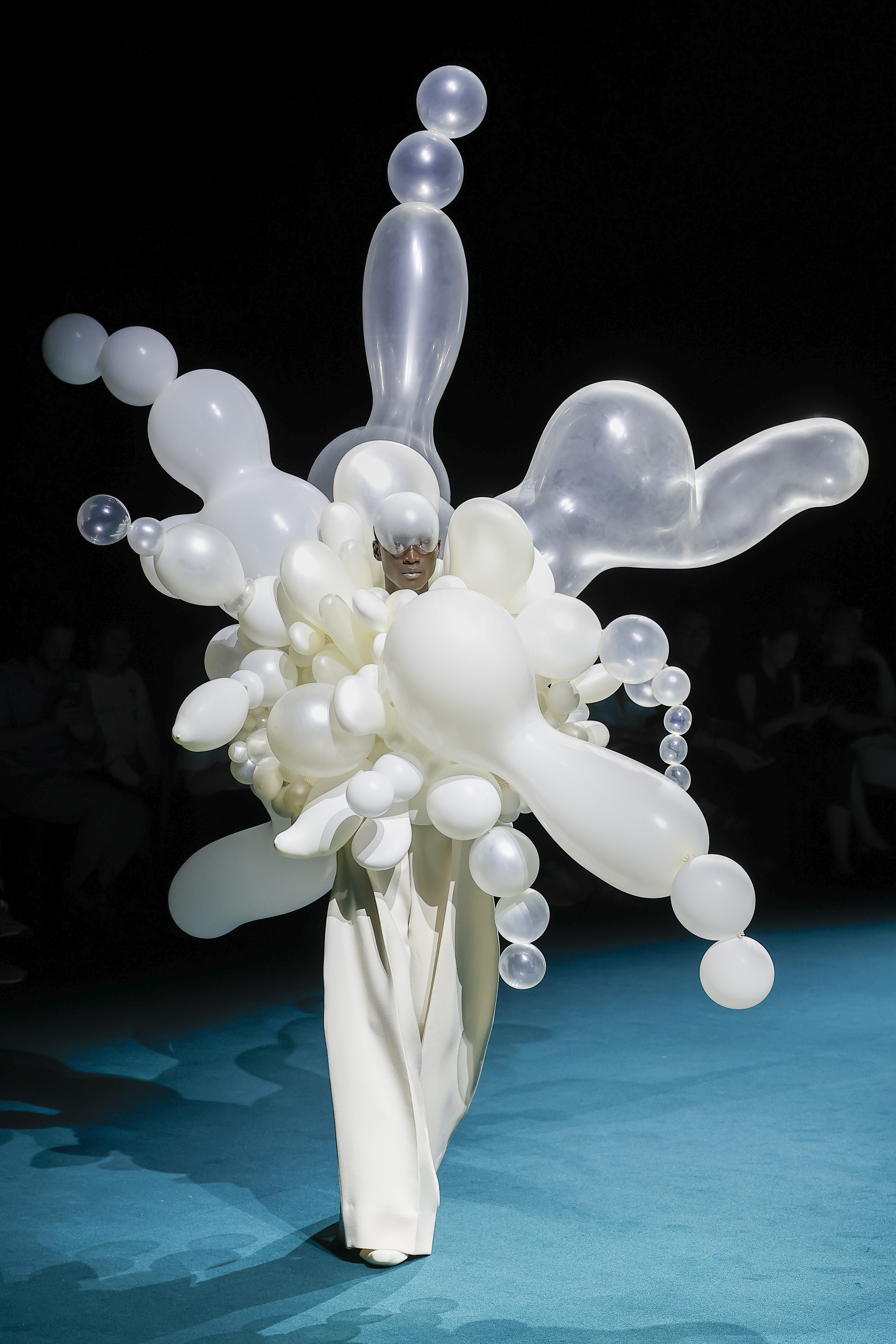
Yet the deeper argument of Childsplay was addressed not to children but to couture itself. In a season when much of the establishment recycled its own signatures with the weariness of an industry in crisis, Wun’s latex was a manifesto: the courage to create, his show insisted, must outweigh the desire to consume. Play (real play, unsupervised and slightly dangerous) is the origin of all invention, and haute couture, which alone in fashion is freed from commercial gravity, has no excuse for forgetting how. That the reminder came wrapped in rubber, the least noble material of all, only sharpens the point. The ateliers spent a hundred years protecting their silks. This season proved that what needed protecting was the imagination, and that sometimes it comes back to us inflated, gleaming, and tied with a string.


