









Somewhere in the collective imagination, drinking tea properly involves a raised little finger, a delicate swirl of the spoon and a vague sense of being watched. It turns out almost all of that is wrong. Grant Harrold spent seven years as butler to the man who is now King Charles III, and he has spent the years since teaching etiquette to people who want to know how the royal household actually does things. His verdict on how most of us hold a teacup is blunt. And the correct way, he says, is far simpler than the version we have been imitating for a century.
The man who served tea at Highgrove
From 2004 to 2011, Harrold worked as a butler to the then Prince of Wales and Camilla at Highgrove, their country home in the Cotswolds, and to Prince William and Prince Harry, who were living in the same household at the time. He has described knowing the family’s habits, schedules and preferences the way you know your own relatives’. Today he runs an etiquette and butler school, co-founded The Royal School of Butlers with Blenheim Palace in 2014, and has written a memoir, The Royal Butler. Afternoon tea is his specialty, and the teacup is where he says most people go wrong.
The pinky myth
Start with the little finger. It is the gesture everyone reaches for when they want to look refined, and it is the one thing the royal family never does. “Remember, we never stick our pinkies up,” Harrold has said. “After all, we are not testing the wind direction, now, are we?” The late Queen, he and other etiquette experts note, kept hers tucked in. One popular theory holds that the raised finger is a leftover from the days when tea was drunk from small handleless bowls, held in both hands, so the smaller fingers naturally flicked out; whatever its origin, it has no place at a royal table.
How the royals actually hold the cup
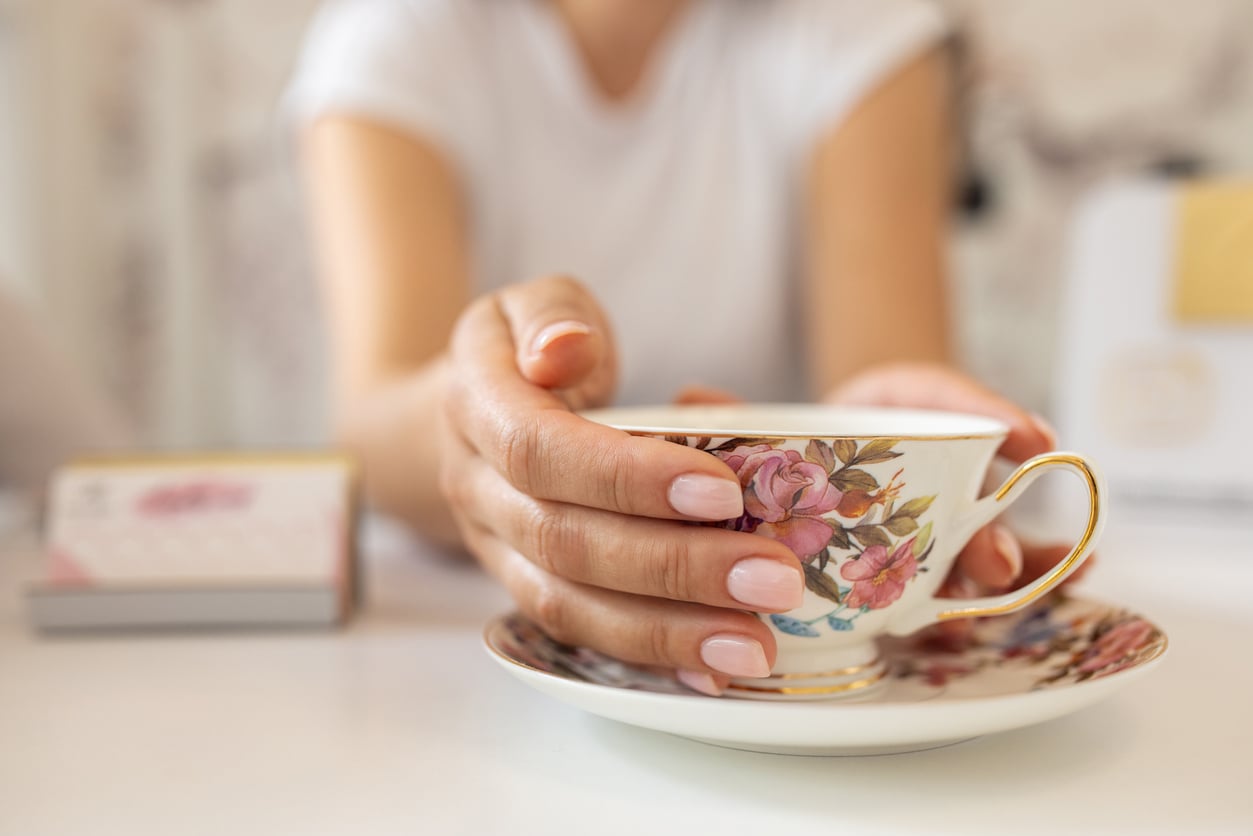
The correct grip is almost disappointingly practical. You don’t hook a finger through the handle as you would with a coffee mug. You pinch it. The etiquette coach Myka Meier, who trained under a former member of the Queen’s household, describes it precisely: thumb and index finger pinch the top of the handle, the middle finger supports it from underneath, and the remaining fingers stay relaxed and tucked in. When the cup is at rest on its saucer, the handle points toward three o’clock, so it is ready to be picked up with the right hand.
The saucer, meanwhile, stays on the table if you are seated at one, acting as a coaster. It only travels with the cup if you are standing, or sitting somewhere without a table in front of you, in which case you hold the saucer in your left hand at waist height and lift only the cup.
The stirring rule almost everyone breaks
If the teacup grip is the mistake people make most often, stirring is the one they make most loudly. The instinct is to swirl the spoon in circles. Harrold’s instruction is the opposite: a gentle back-and-forth motion, from six o’clock to twelve o’clock on the rim, without the spoon ever touching the sides. “If we stir in a circular motion we can create a storm in a tea cup and see the tea coming over the sides, which we should never allow,” he has explained. “If the spoon touches the sides it makes a clinking sound and we don’t want that at the afternoon tea table.” When you are done, the spoon rests on the saucer behind the cup, pointing toward six o’clock, never left standing in the tea.
A few other points complete the picture. Tea should be sipped quietly, not slurped. Small cakes at afternoon tea can be eaten with your fingers, Harrold says, which surprises almost everyone who has ever wrestled with a tiny fork. And if you are wearing lipstick, drink from the same spot on the rim each time, so the cup doesn’t end up ringed in red.
Why it’s simpler than it looks
Strip away the folklore and what is left is not a set of arbitrary rules but a single principle: don’t draw attention to yourself. No flourish with the little finger, no clinking spoon, no whirlpool in the cup. Every correct gesture is the quietest possible version of the thing you were going to do anyway. That is, fittingly, the same logic behind the understated style the royal women have always favored: polish that doesn’t announce itself.
And if the cup you are holding happens to be a piece of family china that has spent twenty years in a cabinet, all the more reason to take it out. As we noted in why fine china is quietly disappearing from American homes, the best way to honor it is to use it.
The takeaway
Pinch the handle, tuck your fingers, keep the saucer on the table and stir back and forth without a sound. That is the whole of it. It takes about ten seconds to learn, and according to the man who served tea to the future King for seven years, it is the difference between looking like you are performing good manners and simply having them.


