










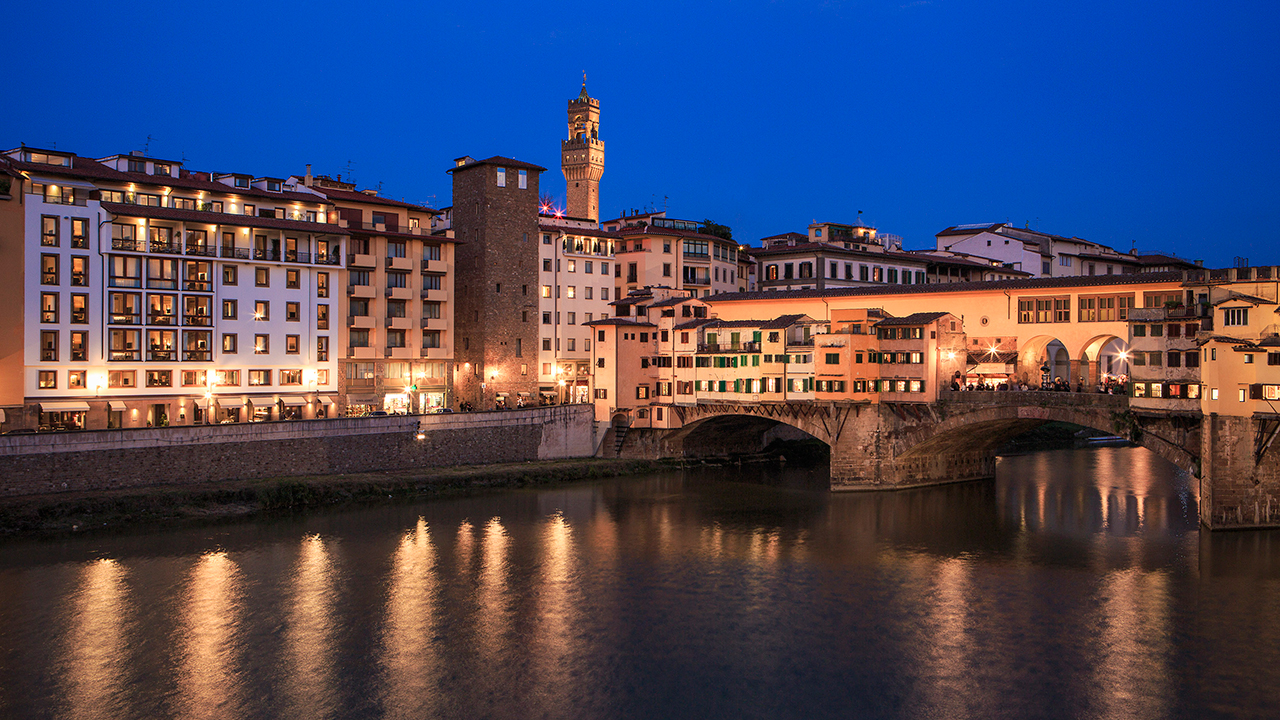
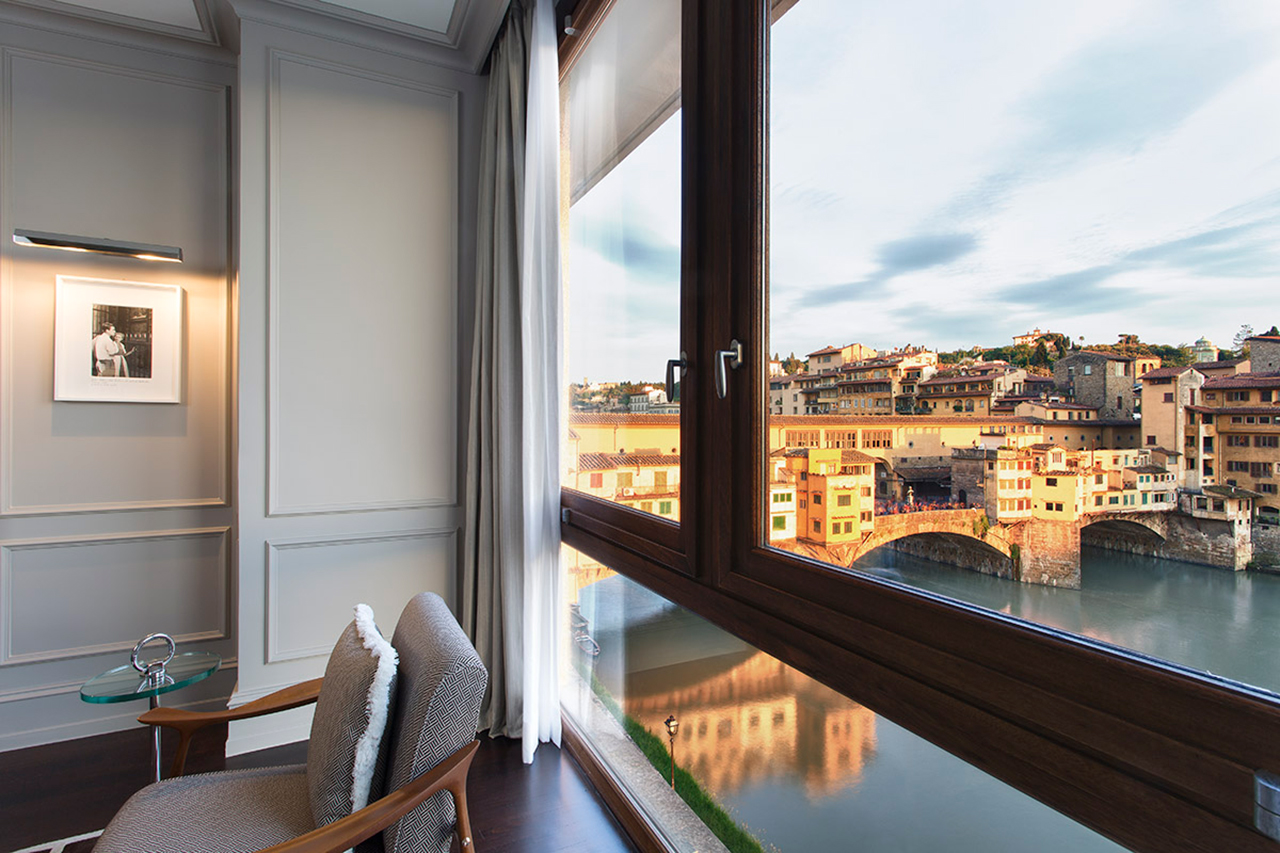
Portrait Firenze, just steps from Ponte Vecchio, expresses itself less through formality than through a sense of intimacy. The Arno moves past the windows; midcentury furnishings and archival photographs recall Florence’s glamorous postwar years; and service is crafted around the individual. The atmosphere feels closer to an exceptionally well-appointed Florentine residence — a quality that gets to the heart of what the Ferragamo family has spent more than three decades building in hospitality.
Portrait is the high-end hospitality brand within the Lungarno Collection, the hospitality company founded by the Ferragamo family in Florence in 1995 that literally translates to “along the Arno”. What began with Hotel Lungarno, on the south bank of the Arno overlooking Ponte Vecchio, has grown into a tightly edited portfolio of hotels, residences, restaurants, and bars in Florence, Rome, and Milan.
Distinct from the fashion house that made the family name synonymous with Italian luxury, the Lungarno Collection has developed its own identity over the last three decades. Within that world, Portrait occupies a distinct place. The brand currently has just three hotels — Portrait Roma, Portrait Firenze, and Portrait Milano — built around the idea of highly personalized, residential-style hospitality. If Lungarno Collection is the larger universe, Portrait is its most intimate: fewer addresses, exceptionally privileged locations, and a service philosophy that borrows something fundamental from the Ferragamo legacy — the idea of designing around the individual.
Leonardo Ferragamo, one of Salvatore Ferragamo’s six children and president of Lungarno Collection, traces the family’s move into hospitality to precisely that connection. “The choice for my family to enter the hospitality world and therefore creation of the Lungarno Collection is thanks to our cultural heredity,” Ferragamo tells GRAZIA USA. “Hospitality was and is in our DNA, inspired by the strength of my father’s heritage and approach to clients, creating a product and service unique to each guest, transforming a shoe made to measure into a luxury hotel experience, or better, a lifestyle experience.”
Salvatore Ferragamo became famous for an intensely individual approach to his clients, studying anatomy and fit and creating shoes around the person who would wear them. But the hotels were never intended to become fashion showrooms. Instead, the family built a hospitality identity around principles it knew well: craftsmanship, detail, Italian style, and personalization. The Ferragamo connection is unmistakable but deliberately understated.
The story began on Borgo San Jacopo in Florence with Hotel Lungarno, which established both the geographic and philosophical center of the collection. Over time, the Lungarno Collection developed a cluster of distinct addresses around this small pocket of Florence, which now includes Hotel Lungarno and its residences, Gallery Hotel Art, and Portrait Firenze, along with restaurants and bars including the Michelin-starred Borgo San Jacopo, Caffè dell’Oro, and Picteau Bistrot & Bar.
Rather than making its hotels interchangeable, the Collection allowed each to develop its own personality. Hotel Lungarno became known for residential elegance and its art collection. Gallery Hotel Art took a contemporary, design-oriented direction with its changing art installations.
Just across the Arno, the former Continentale, meanwhile, is now being folded into Portrait Firenze, as one of Lungarno’s most significant projects to date. “Our approach has always been to draw from the Ferragamo family’s cultural sensibility and tradition of innovation,” says Lungarno Collection CEO Valeriano Antonioli.
“This has allowed us to develop a distinctive identity — one that is deeply personal, intentionally niche, and centered on creating immersive, crafted experiences in iconic locations.”
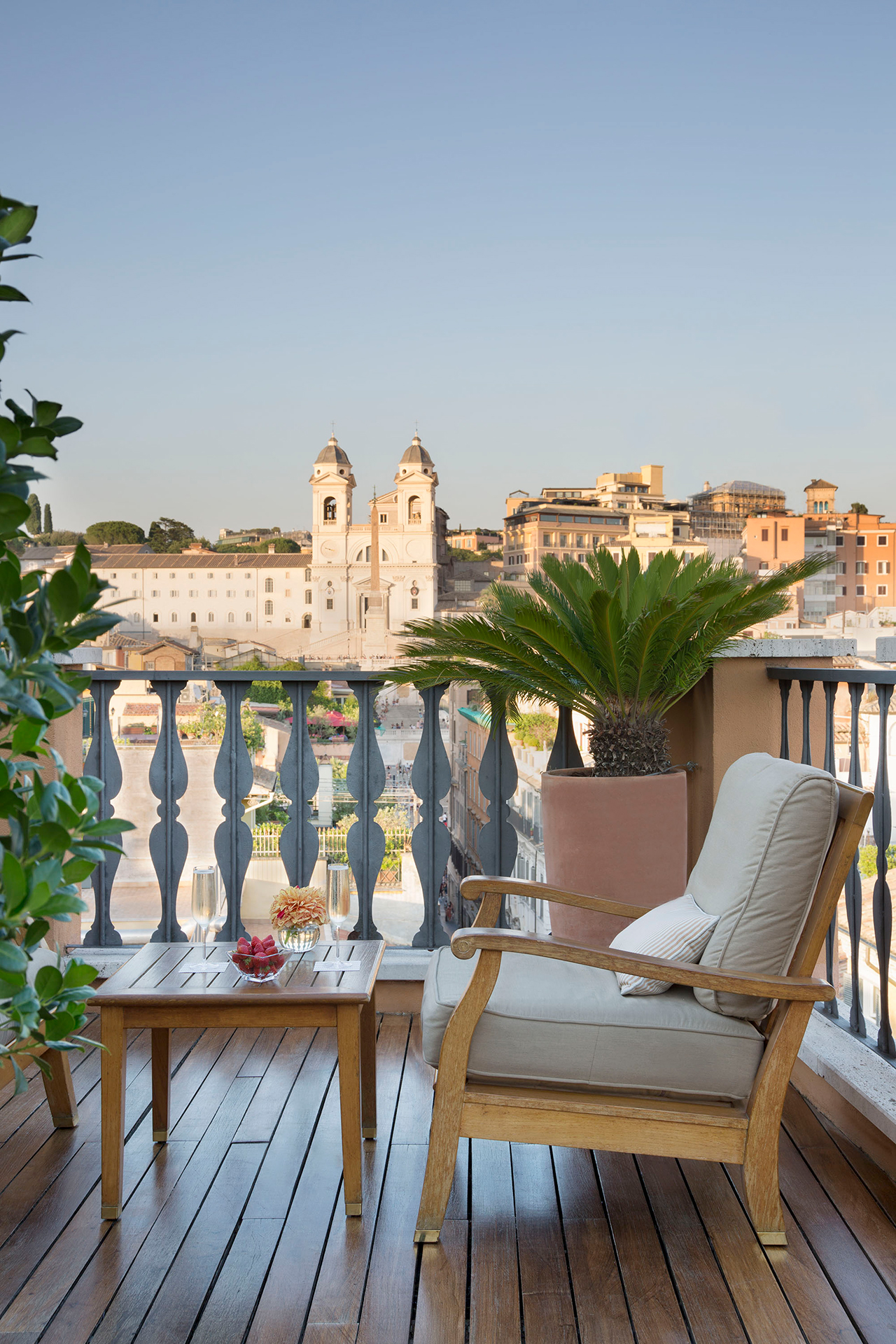
Eventually, those ideas found a more concentrated form in Portrait, now marking its 20th anniversary. The first property opened on Rome’s Via Condotti in 2006 and rebranded as Portrait Roma in 2013. The intimate address felt more like a private Roman residence than luxury hotel.
Portrait Firenze followed in 2014, with 37 suites designed by Florentine architect and interior designer Michele Bönan. The property looked to the 1950s and ‘60s, when Florence played a pivotal role in the emergence of Italian fashion. Archival photographs, Carrara marble, warm woods, and restrained midcentury references helped create a hotel deeply connected to its locale.
Just as important was the made-to-measure service that runs through Lungarno’s history. Rather than simply responding to requests once a traveler arrives, the Portrait Lifestyle Team aims to understand how a guest wants to experience the destination and shapes their stay accordingly.
“The Portrait brand was built from the ground up, not on instant recognition, but on substance,” Antonioli says. “through exquisite design, intimate service and a philosophy of tailored luxury.”
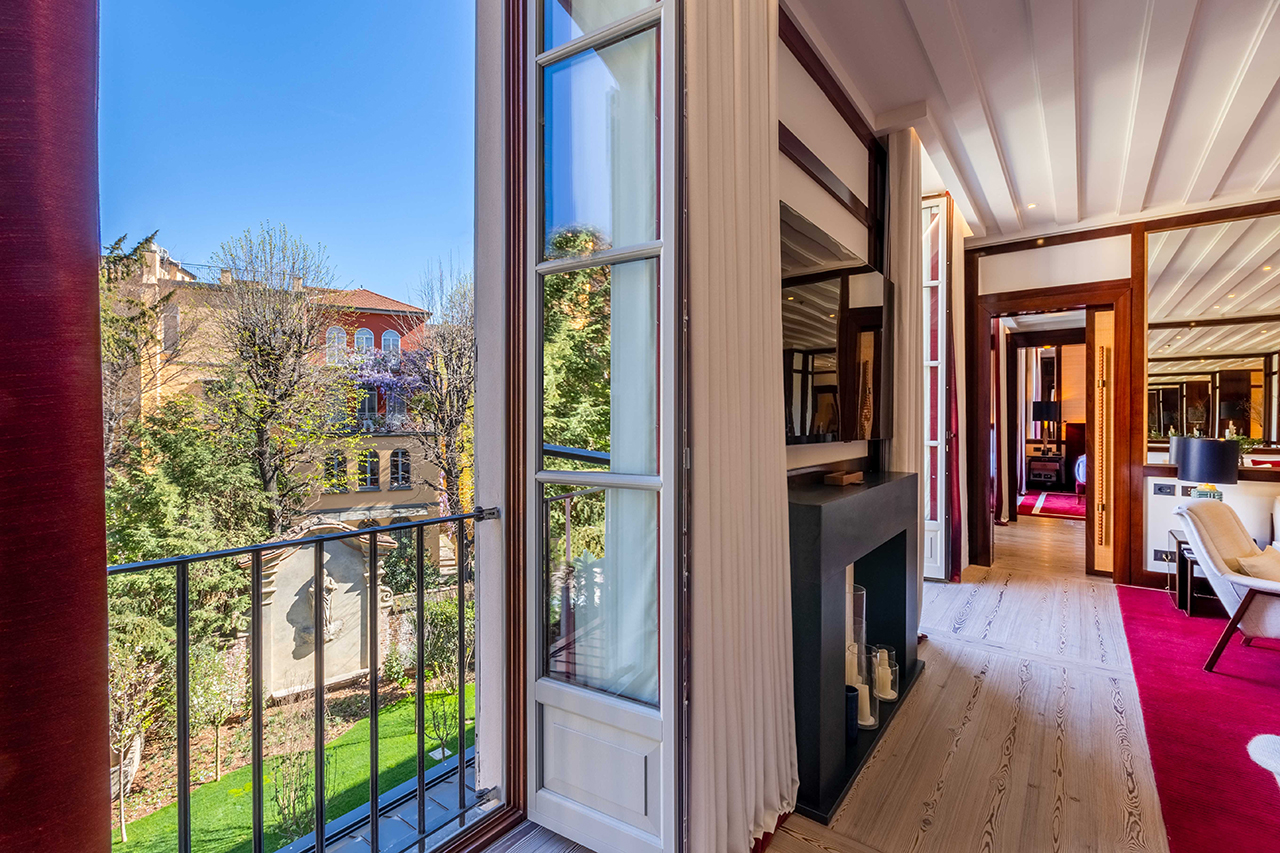
Then came Milan. Portrait Milano, which opened in December 2022, showed how far the Portrait concept could stretch. The hotel occupies Milan’s former Archiepiscopal Seminary on Corso Venezia, a historic complex dating to the 16th century. Architect Michele De Lucchi and his studio AMDL Circle led the restoration, while Bönan designed the interiors of its 73 rooms and suites, drawing inspiration from Milanese homes of the 1950s and incorporating details of Italian craftsmanship.
At the center of the complex is Piazza di Portrait Milano, a roughly 30,000-square-foot historic courtyard now open to the public. Connecting Corso Venezia with Via Sant’Andrea, the plaza introduced something unusual for a luxury hotel: a grand central space intended to belong to Milan as much as to the guests sleeping upstairs. Milanese residents can cross the piazza, meet for drinks or dinner, visit boutiques, and attend events without being hotel guests. The spa, too, welcomes all for treatments. Rather than sealing itself away from its surroundings, Portrait Milano participates in the everyday life of the city.
Milan also changed the scale of Portrait. Rome established the private-address model. Florence developed it further. Milan added dining, retail, wellness, events, and public space without losing its personalized service. That relationship between hotel and city has become increasingly important to the Lungarno Collection’s vision.
“Our values are rooted in authentic hospitality, respect for people and place, and a deep connection with the local community,” Leonardo Ferragamo says. “We believe true luxury is created through sustainability, cultural openness, and meaningful relationships that welcome guests into the spirit and life of each destination.” Now, the company is bringing some of what it learned in Milan back to the place where the story began.
Two decades after the first hotel opened, Portrait is being given a more defined identity. Portrait Hotels & Resorts now unites the properties in Rome, Florence, and Milan under refreshed branding within the Lungarno Collection. And in Florence, that future is already taking shape.
The historic Continentale is being integrated into Portrait Firenze, expanding the property from its current 37 rooms and suites to 67 and creating what Lungarno describes as a “city resort,” scheduled to debut in 2027. The project will also add a 3,200-square-foot spa with treatment rooms, an indoor pool, a sauna, a Turkish bath, and wellness facilities. La Terrazza Rooftop Bar, long one of the Continentale’s signatures, will remain open to the city, retaining its remarkable perspective over Florence while receiving aesthetic updates.
But the project reaches beyond additional rooms and amenities. Portrait Firenze will also incorporate the medieval Torre dei Consorti and extend farther into Vicolo dell’Oro, historically associated with Florence’s goldsmithing tradition. The plan is to strengthen the relationship between the hotel and the streets surrounding it — an approach that recalls, on a much smaller scale, what Portrait Milano accomplished with its piazza. Lungarno describes the idea as “hospitality that expands beyond hotel walls to create shared, inclusive spaces.”
The Ferragamo legacy is present throughout the hotels without dominating the experience. Its influence appears in the emphasis on craftsmanship, attention to the individual, and an understanding of Italian luxury that relies as much on discretion as display. That sensibility has traveled from the banks of the Arno to Via Condotti and, in Milan, an entire public historic complex.
For a company that has long resisted the urge to replicate itself, what comes next may be its most interesting chapter yet.
Read GRAZIA USA’s Fall/Winter 2026 Issue


