










Somewhere in Windsor Great Park, a mile or so from where the future king now lives with his three children, there is a thatched cottage with a front door most adults would have to stoop to enter. It has a working telephone, a proper cooker, hot and cold running water and a bookshelf of Beatrix Potter. It was built for a six-year-old girl who was not expected to become queen, and for the best part of a century it has been the one royal residence where nobody ever had to behave. This week, as royal watchers revisited its story, the question quietly changed: not who has played there, but who will.
A birthday present from an entire nation
In 1932, Princess Elizabeth of York turned six. She was a granddaughter of the King, not the heir, and her parents were a duke and duchess with a comfortable life in London and a country house near Windsor. That spring, on a visit to Cardiff, they were presented with a gift on her behalf from the people of Wales: a house. Not a doll’s house, a house – a two-storey, thatched Welsh cottage built at roughly two-thirds scale, with four rooms each about five feet high, its own front garden, hedges and flower borders included.
It was named Y Bwthyn Bach, Welsh for “The Little Cottage”, and it was designed by the architect Edmund Willmott, who is said to have built a simpler version for his own daughter first. Welsh craftsmen assembled it from materials left over from the construction of Llandough Hospital in the Vale of Glamorgan, which makes it, in a roundabout way, a public-works project. The journey to Windsor was not smooth: the thatched roof caught fire on the lorry partway there, and the whole cottage had to go back to Wales for repairs. It was then shown to crowds at the Ideal Home Exhibition at Olympia before finally being installed in the grounds of Royal Lodge, the family’s house in Windsor Great Park. Elizabeth and her younger sister Margaret were able to play in it from December 1933.
Not a playhouse so much as a house, only smaller
What set Y Bwthyn Bach apart from every other wendy house in Britain was that nothing inside it was pretend. The kitchen had an electric cooker and a refrigerator at a time when plenty of real homes had neither. The bathroom had running water and a heated towel rail. There was a small radio, a tea set for parties, and a miniature telephone that actually worked. Queen Mary, the princesses’ grandmother, is reported to have taken an interest in how it was furnished. The historian Dr Elin Jones has described it less as a cottage than as a replica of a very comfortable home – which is exactly what two little girls in the 1930s would have wanted to run.
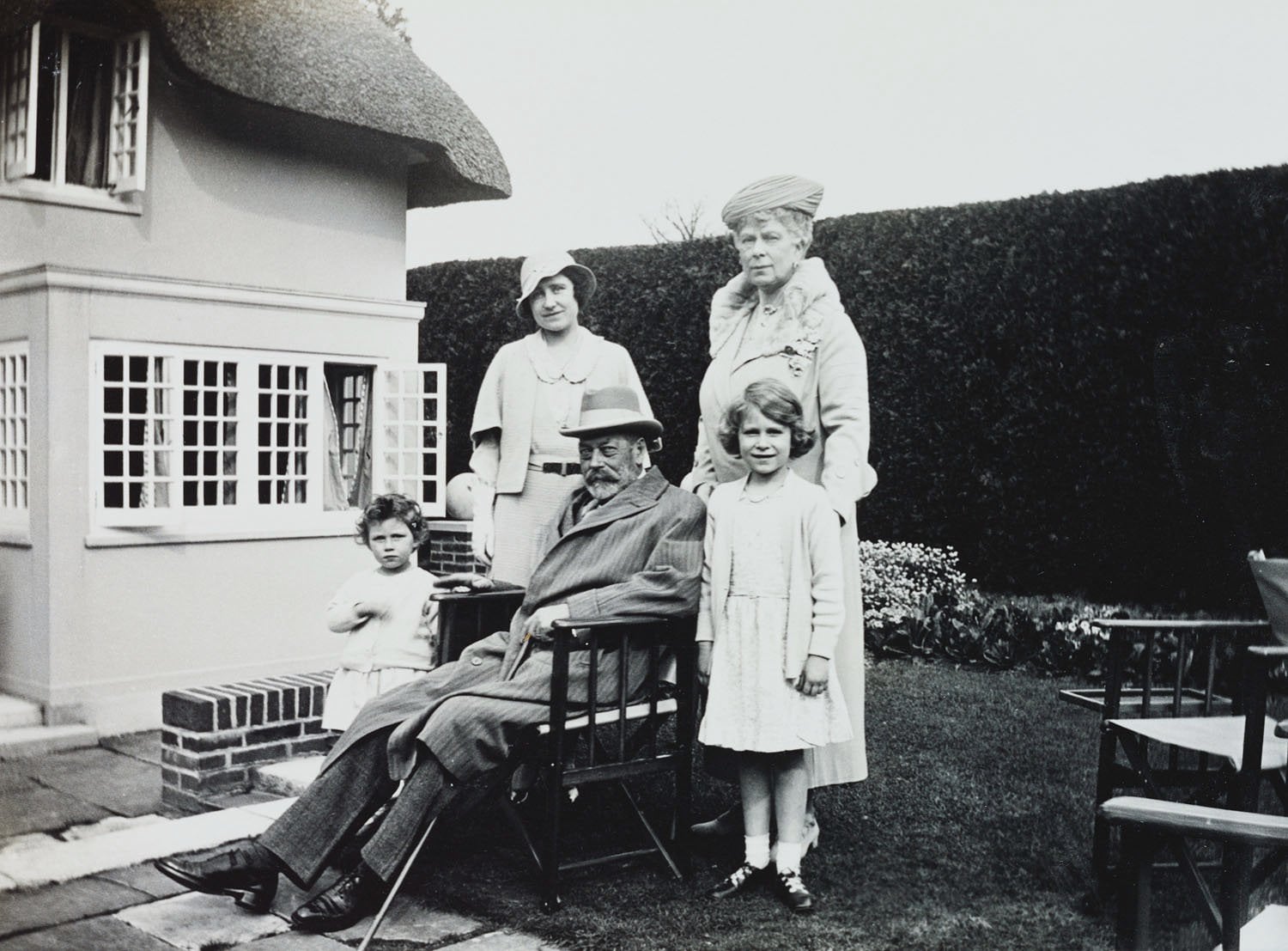
Photographs from the period show Elizabeth and Margaret at the door, in the garden, at the tiny windows. One of them, taken by her father in 1933 and kept in his own album, shows the two princesses at the door with their grandparents, King George V and Queen Mary, looking on – three generations in a single frame, before the fourth had even been imagined. They are among the most natural images of the future Queen ever taken, and they explain why the cottage went on to matter so much to her. As her granddaughter Princess Beatrice later put it, in a BBC documentary marking the Diamond Jubilee, it is “the most glamorous wendy house ever” – and the Queen still liked to go back and visit it well into her reign.
Four generations at the same little door
The cottage stayed exactly where it was, and the family kept coming. A young Prince Charles was photographed playing in it in the 1950s, and his sister Anne is understood to have used it too. Princes William and Harry are said to have played there as boys when visiting their grandmother. The Queen was photographed at the cottage with her first grandchild, Peter Phillips, on his first visit. And when Royal Lodge became the home of Prince Andrew and, for many years, Sarah Ferguson, it became the childhood playground of Princesses Beatrice and Eugenie – and later, when they brought their own children to see their grandparents, of a fourth generation.
By 2012, it needed help. For the Diamond Jubilee, Beatrice led a year-long restoration, paid for by her father: the roof was completely re-thatched, the electrics rewired, the paintwork refreshed, and new curtains and upholstery made to order. The Queen had one instruction, according to her granddaughter – that the fabrics should carry only very small patterns, because it was such a little house. The result was pale green sofas and cream curtains dotted with tiny dark pink flowers, plus china and glass made specially to fit the rooms. Beatrice described playing there with cousins and second cousins as a big family treat, and noted that with the Queen now a great-grandmother, the next generation could enjoy it too. It was, by then, an heirloom in its own right, and it is today owned by King Charles.
The house that stayed when everyone else left
Which brings us to this year. Andrew Mountbatten-Windsor, stripped of his titles and served notice to leave, departed Royal Lodge in 2026 after more than two decades there, reportedly moving to a far smaller house on the Sandringham estate. He could take his belongings. He could not take the cottage. Y Bwthyn Bach is not his, and given its age and fragility, it may not be safely movable at all – which would mean it simply waits in the garden for whoever comes next.
And nobody yet knows who that is. As HELLO! noted this week, the future of the little house remains unknown. In Wales, there is a gentle campaign to bring it home: Dr Jones has suggested it might belong at St Fagans, the national museum of history near Cardiff, as a record of the affection the Welsh people once expressed in thatch and stone. Others assume it will stay put and pass to the next family to live at Royal Lodge, as it has passed to every family before them.
There is one more detail worth knowing. Just over a mile away, at Forest Lodge, the Prince and Princess of Wales moved in with George, Charlotte and Louis late last year – the Queen’s great-grandchildren who now live closest to her childhood cottage. Whether any of the three has ever stepped inside it is not something the family has said. But if the little house does stay in Windsor, it is not hard to guess whose children might be the next to find that the telephone still works.
A gift that outlasted almost everything around it
Royal Lodge has changed hands three times since 1932. The monarchy has changed sovereigns twice. The girl the cottage was built for became the longest-reigning queen in British history, and her instincts about what mattered – small patterns, a working kettle, somewhere the children could be children – outlived her. Ninety-four years on, the most glamorous wendy house in the world is, for the first time, waiting for a family. It has never had to wait long.


