










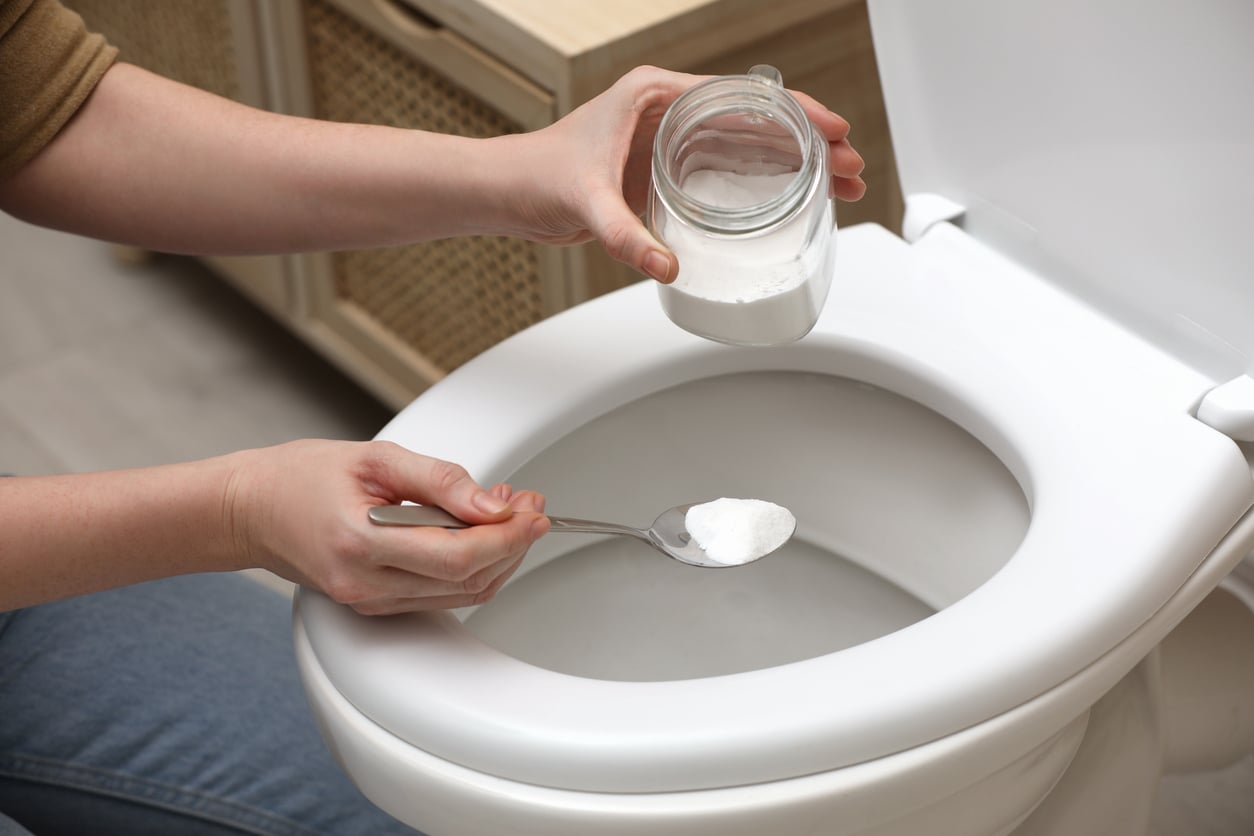
You scrub the bowl, you wipe down the seat, you might even hit the base with a disinfectant wipe. Yet somehow, the bathroom still smells a little off by morning. Most of us assume that keeping a toilet clean means dousing it in blue-tinted commercial cleaners and hoping for the best. But there is a far simpler, cheaper ingredient already sitting in most kitchen cabinets – and it works in places you have probably never thought to clean.
The part of your toilet you’re almost certainly ignoring
Here is a question worth sitting with for a moment: when was the last time you lifted the lid on your toilet tank? If you are like most people, the answer is somewhere between “a long time ago” and “never.” That is a problem. Mineral deposits can build up inside the tank over time, and those deposits can damage or interfere with the toilet’s operation. The general recommendation is to clean the tank at least twice a year to prevent that kind of buildup.
In bathrooms that deal with high humidity and mold issues, that timeline shortens considerably – monthly cleaning is the safer bet. And it is not just the tank that deserves attention. A toilet bowl that does not get constant use holds standing water, which creates an environment where fungal or bacterial growth happens more easily. So when we talk about a truly clean toilet, the visible bowl is only half the story.
How baking soda actually works – and the exact steps to follow
Baking soda is a natural product that neutralizes the bacteria responsible for odors and stains. It functions as a gentle abrasive, loosening stuck-on grime without damaging surfaces. It also deodorizes in a surprisingly elegant way: it transforms acidic and basic odor molecules into a more neutral, odor-free state. That dual action – scrubbing power plus odor control – is what makes it so effective in a space as prone to buildup as a toilet.
To clean the tank using baking soda alone, start by turning off the water supply and flushing several times to remove the water from the tank. Sprinkle a cup of baking soda inside the tank and wait 30 minutes. Then carefully scrub the interior, avoiding all the internal mechanical parts. Turn the water supply back on, allow the tank to fill, and flush to rinse everything out.
If you want to cut down on the elbow grease, combine baking soda with distilled white vinegar. When baking soda, which is a base, meets distilled white vinegar, which is an acid, the two create a fizzing reaction that helps loosen grime and minerals so they can be scrubbed away with less effort. Pour 2 cups of distilled white vinegar into the toilet tank and mix it into the water with a clean toilet brush. Then add 1 cup of baking soda to trigger that bubbling chemical reaction. Wait 10 minutes, scrub the inside of the tank with the brush, and let everything sit for another 20 minutes before flushing the tank clean.
For the bowl itself, you do not need commercial cleaners at all. Add 1/4 cup of baking soda and 2 cups of distilled white vinegar directly into the bowl. The solution will fizz. When the fizzing stops – wait at least 15 minutes – scrub the bowl with a toilet brush and flush. It is genuinely that straightforward.
Beyond cleaning: unclogging and the one mistake to avoid
Baking soda can also help with slow drains. Whether the toilet bowl is draining sluggishly or seems fully clogged, try adding 1 cup of baking soda to the bowl and pouring in 1 gallon of hot water. Let the mixture sit for 30 minutes. If you notice the water level has decreased or drained somewhat, the clog has dislodged and it is safe to flush. If the water line remains the same, move on to another method, like plunging, to clear the obstruction.
For tougher clogs, you can boost the mixture by adding 1/2 cup of grease-fighting dishwashing liquid. Dish soap is denser than water and should sink toward the blockage. Give it time to work – it should help loosen whatever is stuck and allow it to slip past the obstruction.
There is, however, one critical precaution. Too much baking soda can actually cause a toilet clog rather than fix one. Never use more than 1/4 cup of baking soda in the toilet bowl, and refrain from using more than one cup in the tank. More is not better here. Staying within those limits keeps baking soda working for you instead of against you.
What this means for your bathroom routine
The takeaway is refreshingly simple. A single box of baking soda – paired occasionally with distilled white vinegar – can handle tank maintenance, bowl cleaning, odor control, and even minor clogs. You now know the exact quantities, the wait times, and the one dosage rule that keeps everything running smoothly. No specialty products required, no harsh chemical fumes filling your bathroom. Just a pantry staple doing the kind of quiet, effective work we could all use a little more of in our lives.


