










You probably already suspect that your body doesn’t always agree with what your birth certificate says. Maybe you bounce out of bed feeling decades younger than your coworkers, or maybe your knees started filing complaints well ahead of schedule. The idea that we each carry a hidden “biological age” – one that may differ sharply from our chronological years – has gone from niche science to pop culture spectacle. Khloé Kardashian, who is chronologically 40, recently revealed on her show that an epigenetic clock pegged her biological age at just 28. But the tests behind that kind of result can cost hundreds of dollars. The good news? Researchers say there are several ways to get a surprisingly meaningful read on your inner age without spending a cent.
Why your reflection might be more honest than you think
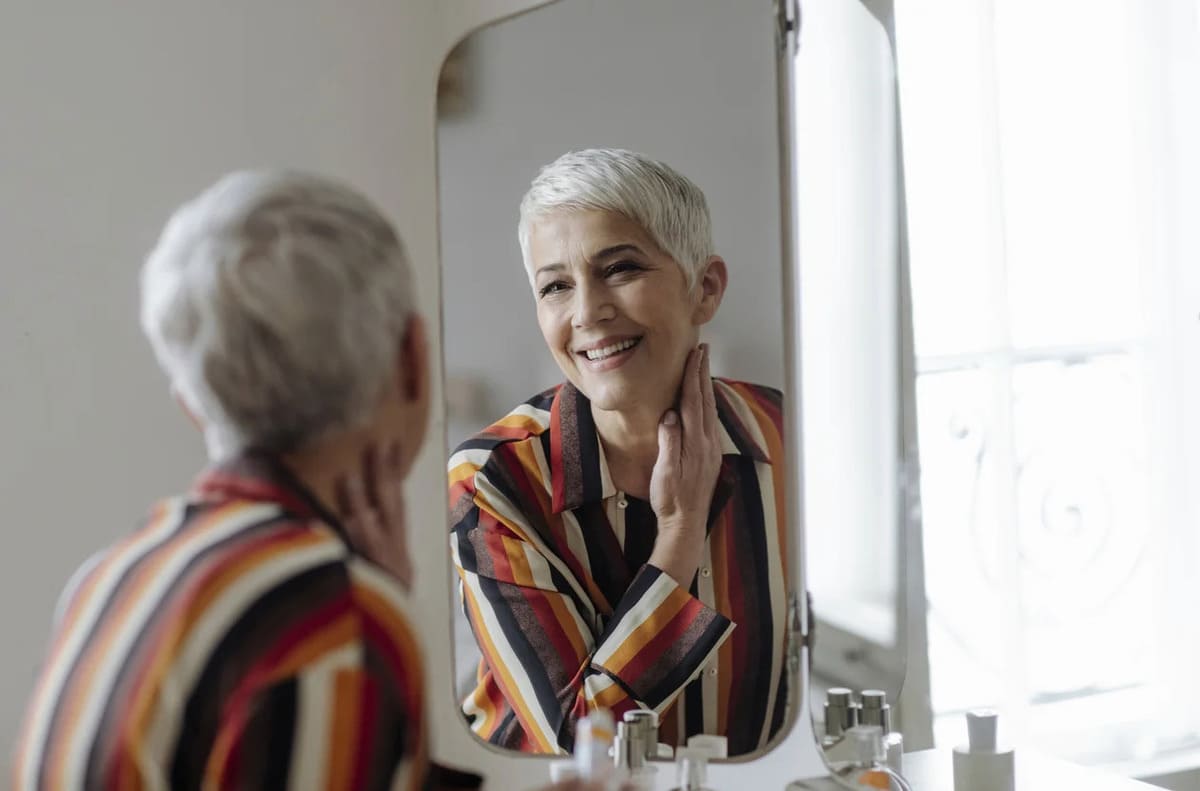
It sounds almost too simple, but how old you look turns out to be a legitimate proxy for how old you are on the inside. A study of almost 1,000 pairs of twins over the age of 70 asked panels of assessors to rate each twin’s apparent age. The unsettling finding was that a higher perceived facial age accurately predicted which twin would die first.
The explanation goes deeper than vanity. The same hallmarks of aging – from DNA damage in our cells to immune system dysfunction – drive everything from cancer risk and frailty to the external signs we associate with getting old, like wrinkles and grey hair. Collagen, the primary structural protein in skin, is also a vital component of blood vessels and bones. In other words, saggy skin can hint at saggy arteries and weakening joints beneath the surface.
If you want to gauge your own facial age, you will need neutral judges rather than your own mirror – we are rarely objective about our own faces. AI-powered apps offer a high-tech shortcut, though you should think carefully about who is behind any platform before uploading a selfie. And while cosmetic fixes like make-up, Botox, and fillers can change the number an algorithm spits out, they do nothing to alter the underlying biology of skin aging. Sun protection, on the other hand – avoiding peak UV hours, wearing a hat and sunscreen – actually shields collagen and DNA, reducing both wrinkles and cancer risk by keeping skin genuinely younger in a biological sense.
Two physical tests you can do right now
Balance is one of the physical abilities that quietly erodes with age, and doctors have formalized this into something called the timed unipedal stance balance test. At home, it is far less intimidating: fold your arms, stand on your dominant leg, and start a timer. If you uncross your arms, shift either leg, or topple, your time is up. The best of three attempts counts.
Researchers capped their study at 45 seconds with eyes open. With eyes closed, even the youngest group (ages 18 to 39) averaged only 15 seconds, while participants over 80 lasted roughly two. Scoring 13 seconds with eyes closed, for instance, corresponds to a standing-on-one-leg age of about 45. The test works because it demands coordination among your inner-ear balance sensors, muscle strength, and the neuromuscular connections that keep all of it communicating in real time – systems you rely on every time you walk or stand up. About a third of older people who fall and break a hip die within 12 months, largely because the physiological stress of the fracture and recovery period worsens other health problems. Better balance can prevent that fall in the first place.
Then there is VO2 max, the maximum volume of oxygen your body can consume during all-out exercise. A 2018 study found that people in the bottom 33 per cent of the population for VO2 max were almost twice as likely to die as those in the top third. The metric naturally declines with age – halving from 42ml/kg/minute for an average woman in her 20s to just 21ml/kg/minute in an 80-something female. A 65-year-old who exercises into the top 25 per cent for her age group could reach a VO2 max equivalent to an average person in her 30s. Many smartwatches now estimate VO2 max, though readings can vary by about 10 per cent either way, enough to shift your calculated age by a decade. If you lack a wearable, Norwegian researchers have created an online fitness-age calculator that requires only your chronological age, weight, height, resting heart rate, and an estimate of exercise level. Anything from a five-minute brisk walk to the recommended daily half-hour of moderate to vigorous exercise can nudge these numbers in the right direction.
Your ears have an age too – and it matters more than you expect
Human hearing is typically quoted as spanning 20 to 20,000Hz. In practice, that upper ceiling shrinks steadily with age due to the gradual loss of sound-sensing hair cells in the inner ear. If you can no longer hear sounds above roughly 11,000Hz, your hearing age is over 50. Online tests that play ascending tones can give you a rough estimate, though without calibrated headphones and a silent room the result is more entertainment than diagnosis – audio compression online can strip away the very high frequencies being tested.
What makes hearing worth tracking is its link to brain health. People who lose their hearing face an increased risk of dementia, while those who catch the problem early and use hearing aids can actually reduce their risk of cognitive decline. If you are concerned, the test offered by the Royal National Institute for Deaf People (RNID) is a practical starting point. It will not give you a tidy age number, but it can flag loss that, once treated, may protect your brain as well as your social life.
The bottom line
You do not need an expensive epigenetic clock or a cheek swab to start understanding your biological age. A mirror assessed by honest friends, a one-leg balance challenge, a VO2 max reading from your wrist, a quick hearing check, and even an existing set of blood results plugged into the free PhenoAge calculator – which uses nine common blood tests – can each illuminate a different facet of how your body is truly aging. No single test captures the full picture, so the smartest move is to treat them as a constellation rather than a verdict. And the lifestyle shifts they point toward – more movement, better sun protection, attention to hearing – are the same ones scientists would recommend regardless of the number that comes back.


