










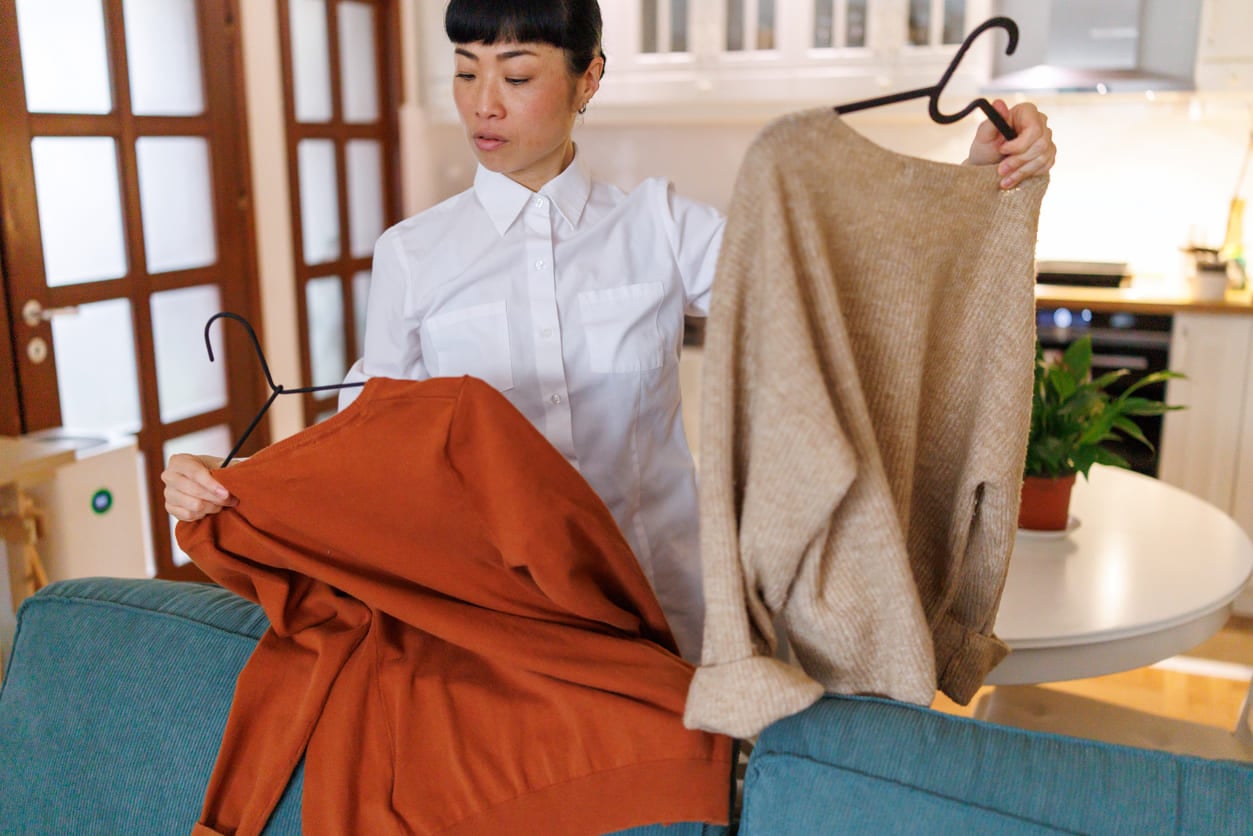
You reach into your drawer, pull out that gorgeous cashmere pullover you splurged on last winter, and there it is – a sharp, stubborn crease running right down the front. Or maybe you grab the one from your closet rod and notice the shoulders have developed two pointy bumps that no amount of steaming will fix. Most of us assume these are just the inevitable signs of wear, the cost of owning knitwear. But according to an industry insider with 13 years of experience in knitwear manufacturing, the damage has nothing to do with how often you wear your sweaters. It has everything to do with how you store them.
Why your closet is silently ruining your knitwear
Here is the uncomfortable truth: gravity is the single biggest enemy of a sweater. A knit garment is constructed from a series of interlocking loops of yarn, which is what gives it that beautiful stretch and softness we love. But that same looped structure makes it extremely vulnerable to being pulled out of shape by its own weight. When you slide a sweater onto a hanger, the entire garment hangs from the shoulder area, straining those delicate loops and elongating them permanently. The result? Those dreaded pointy protrusions known as hanger horns.
Compare that with a woven garment like a dress shirt. Woven fabrics have a stable, grid-like structure that can resist the downward pull of gravity, which is why hanging works perfectly for them. Sweaters simply do not share that structural advantage. Even the lightest knit you own is not designed to be hung. Manufacturers who use techniques like fully-fashioned construction – a method that shapes each panel of the sweater individually for a precise fit – still cannot engineer a knit that will hold up against gravity indefinitely.
So why do so many of us keep hanging our sweaters? Usually, it comes down to the fear of wrinkles. You want to avoid creases, so you reach for a hanger. But in solving one problem, you create a far worse one. Stretching is irreversible. A crease, on the other hand, can be dealt with – if you fold correctly.
The file fold method, explained step by step
Folding is always better than hanging for sweaters. It distributes the weight evenly and protects the garment’s structure. But not all folding techniques are equal. A simple fold in half might seem like the obvious move, yet it creates a hard crease right down the most visible part of the sweater – the front panel. Over time, that center line can become just as damaging to the look of the garment as hanger horns.
The superior approach is called the file fold method, and it works especially well for thick, chunky knits that tend to create lumpy, unstable piles in drawers. Start by laying the sweater face down on a flat surface. Fold the left third of the sweater toward the center, then fold the sleeve back over itself. Repeat on the right side. You should now have a long, neat rectangle. From here, fold the bottom hem up to the collar. If the sweater is extremely thick, fold the bottom third up first, then bring the top third down over it.
What you end up with is a compact, stable package – almost like a brick of fabric – that can be stored vertically in a drawer, arranged the way you would organize files in a filing cabinet. This means you can see every sweater at a glance and pull one out without toppling an entire stack. The method compresses the air out of the knit, making even the bulkiest pieces surprisingly compact.
Why the right fold protects more than just the shape
The advantage of the file fold over a simple half-fold goes beyond tidiness. Because the creases are distributed along the sides and body of the sweater rather than right down the center, they are softer and far less visible when you unfold the garment to wear it. The integrity of the front panel – the part of the sweater people actually see – stays intact.
Proper folding also supports the shoulder seams, protects the neckline, and prevents the body of the sweater from warping. For the designers and product developers who spend months perfecting a garment’s silhouette, storage is essentially the final step in the design process. It ensures that you experience the sweater exactly the way it was intended to look and fit. True knitwear quality is measured not just by how a piece looks on the first day it is sold, but by how well it performs after repeated wear, washing, stretching, and seasonal storage.
And this matters more than many of us realize. Durability problems – including pilling, shape loss, and surface fuzzing – often only become apparent after the garment reaches the customer. How you store your sweaters at home plays a direct role in whether those issues accelerate or stay at bay.
The one habit that will extend the life of every sweater you own
If you take away just one thing, let it be this: always fold your sweaters, and always use the file method. It prevents stretching, avoids visible wrinkles, saves drawer space, and maintains the sweater’s intended shape for years of wear. Folding is not just about being tidy. It is a critical step in preserving the quality and fit that went into making the garment in the first place. Your knitwear was designed with care – storing it with equal care is the simplest way to make sure it lasts.


