










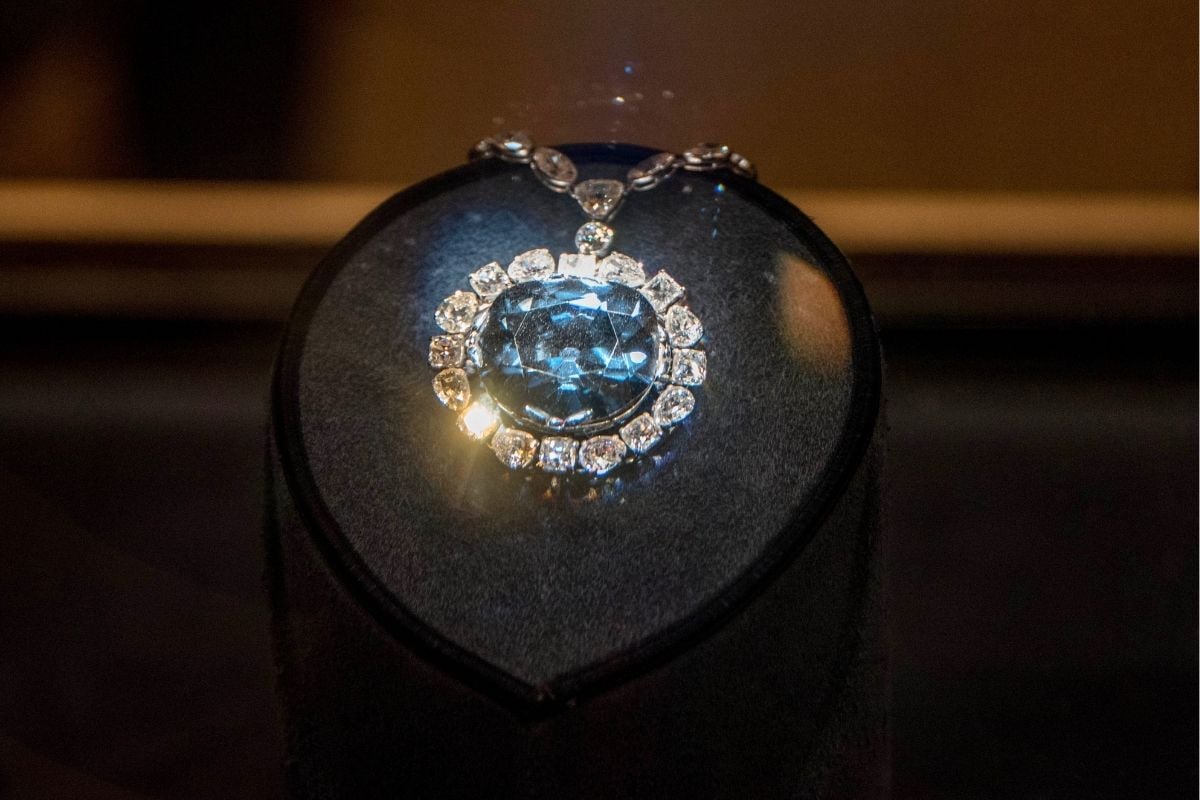
No armored truck, no motorcade: just a brown paper package and a letter carrier. How would you send the most famous diamond in the world? Most of us would imagine armed guards, a private jet, maybe a decoy or two. In 1958, the jeweler who owned it chose something far simpler, and far more surprising.
Harry Winston sent the 45.52-carat Hope Diamond from New York to the Smithsonian in Washington by registered first-class mail. The wrapper carries a postmark of November 8, 1958. According to the Smithsonian, the total cost was $145.29, and only $2.44 of that was postage. The rest paid to insure the package for $1 million.
The Letter Carrier Who Delivered It
An employee of Winston’s store mailed the package at New York’s main post office. In Washington, letter carrier James G. Todd picked it up at the city post office, the building that now houses the Smithsonian’s National Postal Museum, and delivered it to the Natural History Museum.
There, reporters and cameras were waiting. Leonard Carmichael, then Secretary of the Smithsonian, brought Todd into the Gem Hall, where Todd took the package from his mail satchel and handed it over. Edna Winston, Harry Winston’s wife, attended the ceremony and dismissed the diamond’s famous curse, noting that her family had owned it without any trouble.
The Curse, and a Very Calm Response
The Hope Diamond had long been said to bring bad luck. Before Winston, it belonged to Washington socialite Evalyn Walsh McLean, who wore it as a pendant. And within a year of the delivery, Todd’s own life went through a rough patch: he was hurt in two separate car accidents, his wife died of a heart attack, his dog died and part of his home in Seat Pleasant, Maryland, was destroyed by fire.
Todd refused to blame the stone. “I don’t believe any of that stuff,” he told a reporter. He said luck depended on one’s attitude, and that he was grateful all four of his children were outside when the fire broke out.
Why the Wrapper Is Now a Museum Piece
The Hope Diamond is still on display at the Natural History Museum. But the plain wrapper it traveled in, with its postage and registration marks, is now kept at the National Postal Museum. It is a reminder that some of history’s most valuable objects have traveled in the most ordinary ways. Jewels often carry stories well beyond their price, like the piece of Diana’s that Meghan chose to wear.
The choice was also smart. Registered mail is tracked and signed for at every step, and a plain parcel draws far less attention than a guarded convoy. It is the same logic behind other precautions with precious cargo, from jewels to people, such as the royal travel rule Prince William and Prince George just broke.
How to See It Yourself
If you visit Washington, you can see both halves of the story in one day. The Hope Diamond sits in the Natural History Museum on the National Mall, and the National Postal Museum is next to Union Station. Both are part of the Smithsonian and free to enter. Before you go, check each museum’s website for opening hours and current displays. The lesson worth borrowing is that the simplest solution is sometimes the safest one.
The Bottom Line
In 1958, Harry Winston mailed the Hope Diamond to the Smithsonian for $2.44 in postage, plus insurance for $1 million. Sixty-eight years later, even the wrapper it traveled in is a museum piece.


