










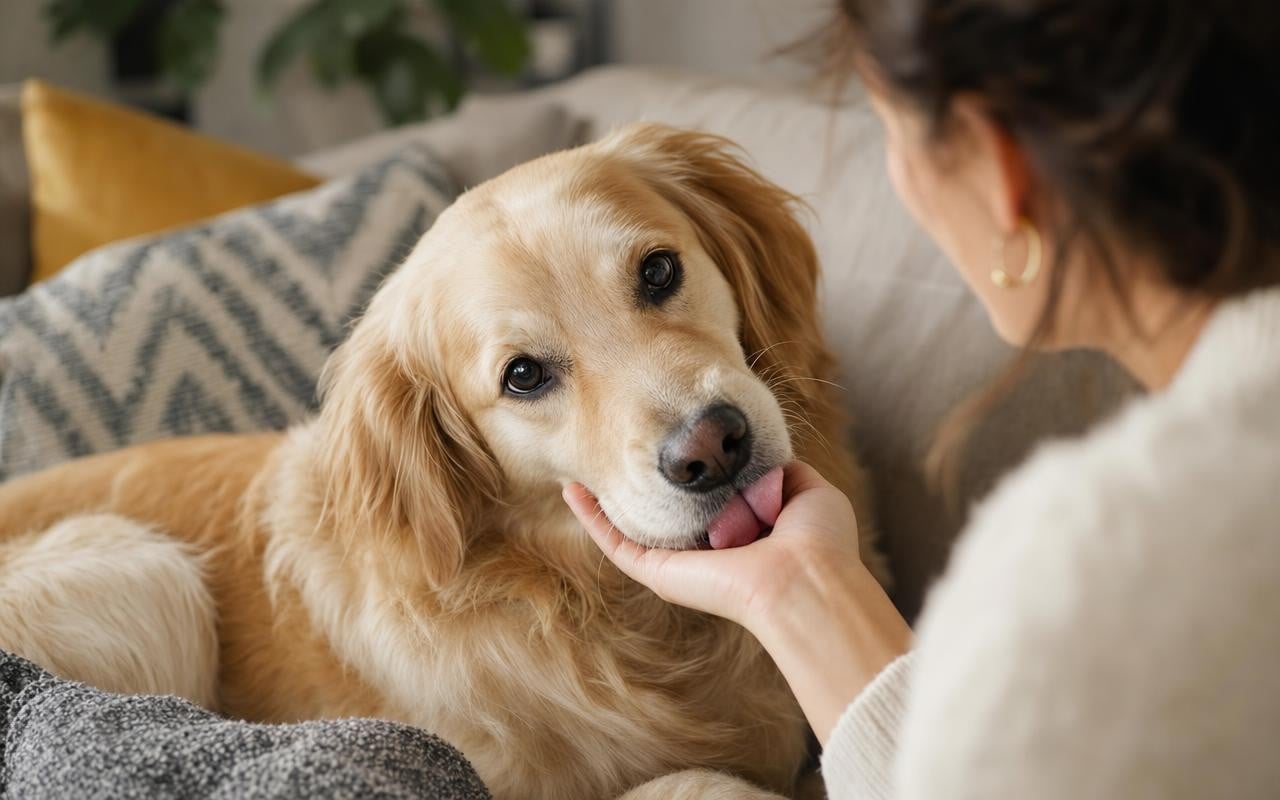
Your dog hops onto the couch, plants herself three inches from your nose and starts enthusiastically washing your face. Someone in the room coos, “Aww, dog kisses.” Cute, yes. Scientifically accurate, not quite. That damp little tongue is carrying decades of evolutionary baggage and surprisingly intricate psychology.
Behaviour experts and veterinary psychologists agree on one thing: licking is not a single-purpose “I love you” button. It is grooming, peace offering, status update, sometimes even a polite request for snacks. If you want to know what your dog is actually saying, you have to read the whole scene.
How Dogs Learn That Licking Gets A Reaction
Think of licking as a language your dog learned in puppyhood – one that was literally life saving from minute one.
Newborn puppies cannot see, cannot walk and certainly cannot get to the bathroom alone. Their mother’s tongue does everything: cleans amniotic fluid, stimulates breathing and circulation, and licks bellies and bottoms so tiny bodies pee and poop. From hour one, licking equals warmth, survival and being intensely cared for.
In wild canids, pups greet returning adults by licking at the corners of their mouths. The goal is not romance, it is room service. That licking triggers the adult’s regurgitation reflex so half-digested meat lands on the menu. Modern dogs inherit the script, even if no one at home is throwing up dinner.
The Main Psychological Meanings Behind Dog Licks
Stack those early lessons together and licking becomes your dog’s multi tool. Same motion, very different subtexts, depending on mood, history and what you do next.
Affection And Social Bonding
When a relaxed dog ambles over, leans into your legs and sprinkles a few gentle licks, affection is a safe bet. Studies cited by VCA Animal Hospitals and PetMD note that licking releases endorphins and dopamine in dogs, which feel good and lower stress.
Appeasement And Respect
That same tongue can also be a tiny white flag. Submissive dogs lower their bodies, tuck the tail, avoid direct eye contact and lick the muzzle or hands of whoever holds power – another dog or you with the food bowl. Psychologists read this as deference and a request for protection, not mischief.
Attention Seeking And Learned Habits
Dogs are gifted behaviourists. Lick your wrist once, and if you laugh, squeal, push them away then start petting, you just wrote the training plan. Licking becomes a go to move to get eye contact, conversation or that walk you are clearly late for. It is communication that you helped program.
Stress Relief And Possible Empathy
Because licking releases calming chemicals, some dogs use it like nail biting – repetitive, slightly frantic, hard to interrupt. You often see it during thunderstorms, vet visits or tense family arguments. Experiments also show that many dogs approach and lick people who are crying, a sign that the behaviour can double as comfort giving.
How Context Changes What The Lick Means
Here is where psychology gets practical. To figure out what your dog’s tongue is saying, you look at timing, body language and target zone. Licking your fingers after tacos is not the same as licking your face while you silently cry.
Hands, Arms And That Laptop Wrist
Hands and forearms are basically scent newspapers. They carry traces of food, soap, other dogs you petted and that subway pole you regret touching. A few licks here often mean curiosity plus “please stop scrolling and notice me.” If the dog is loose, waggy and playful, affection is probably folded in too.
Face, Mouth And Tears
Face licking is more intimate. Among dogs, it started as food begging and polite greeting, then evolved into a ritual of closeness. Most pups reserve it for their favourite humans or for emotionally intense moments. If yours zooms in when you sob into a pillow, that is likely comfort behaviour layered on top of habit.
Feet, Ankles And Post Shower Legs
Feet and ankles come with sweat, interesting street smells and the thrilling game of you yelping and yanking them away. Many dogs discover that ankle licking is a shortcut to interaction. If it bothers you, quietly stand up or step away and reward a calmer behaviour instead so you are not reinforcing it.
When Licking Signals A Problem
Call your vet if licking suddenly explodes, interferes with sleep, creates bald patches or comes with vomiting, weight loss or limping. Medical pain, allergies and gut disease all can hide behind “he just likes to lick things.”


