










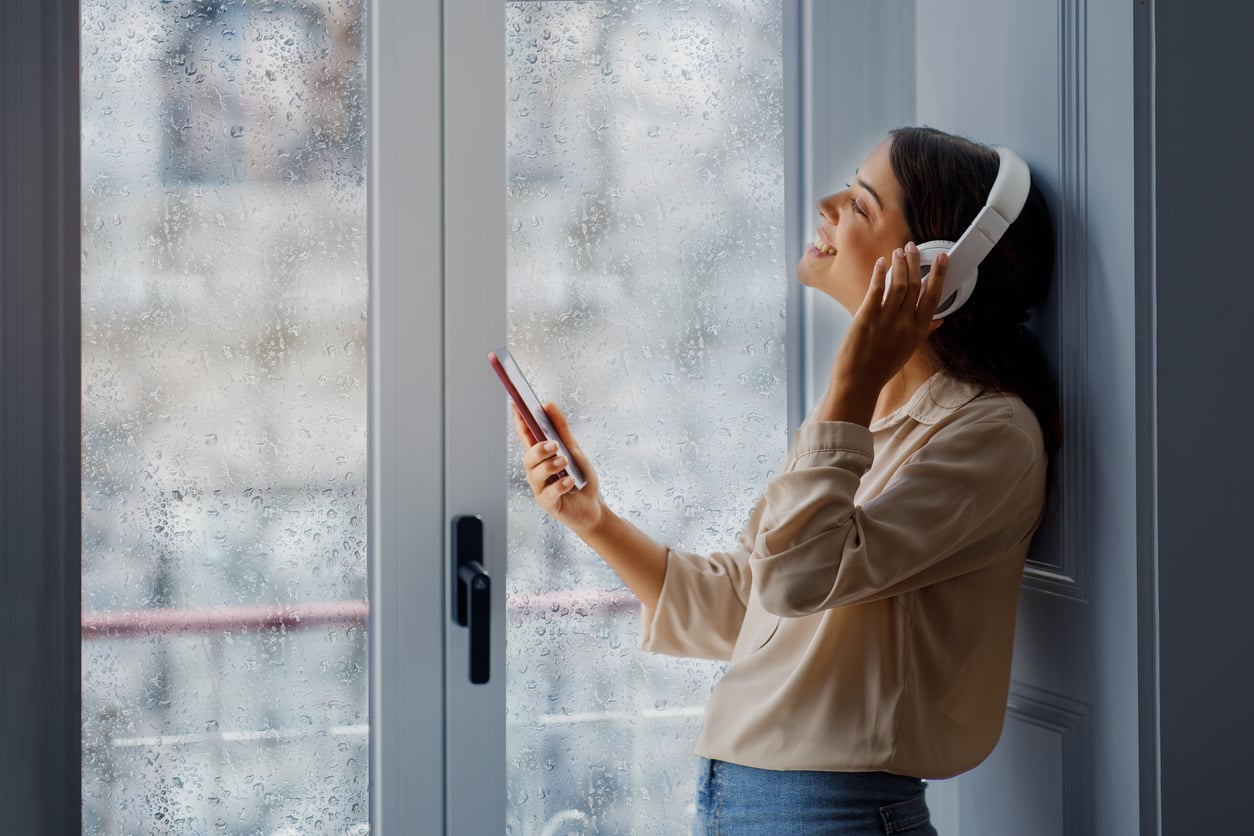
Some people feel a little lighter the moment the sky turns gray and the first drops hit the window. Others can’t wait for the sun to come back. Psychology suggests that loving rainy days has little to do with sadness, and research shows these people are far from alone.
In short
- Loving the rain is sometimes called “pluviophilia,” an informal word, not a medical term.
- Psychology articles describe rain as a soothing, low-intensity stimulus that gives the mind a break.
- In a 2011 study, more than a quarter of teenagers were in better moods on rainier, cooler, less sunny days.
Picture this
It’s Sunday afternoon. Rain taps steadily on the window, the light is soft and gray, and there is nowhere you need to be. For some people, this is the worst kind of day. For others, it is the best one of the week.
Not melancholy, but a mental break
People who prefer rainy days are not necessarily melancholic. What they enjoy, the article explains, is the rain’s “low-intensity stimulus”: a steady sound and a gentle movement that capture attention without demanding anything.
That gentle focus, the article argues, offers a kind of cognitive respite and frees the mind for reflection. Softer light on overcast days also means less visual stimulation. And there is a social side: bad weather gives people an accepted reason to slow down, cancel plans and rest.
What a study of weather and mood found
Science has looked at the question in more detail. In a study published in 2011 in the journal Emotion, researchers led by Theo Klimstra followed 497 adolescents for 30 days, comparing their daily moods with objective weather data, and repeated the analysis with their mothers.
As the study’s summary explains, they found four distinct profiles. About half of the participants were barely affected by the weather. But 27% of the teenagers, and 12% of the mothers, were “summer haters”: their mood was better with more rain, less sun and cooler temperatures.
And those who feel the opposite
The study also identified “summer lovers,” whose mood improved with sunshine and warmth (15% of teenagers and 30% of mothers), and “rain haters,” who felt particularly bad on rainy days (8% of teenagers and 12% of mothers). The researchers also noticed that these reactions seemed to run in families.
In other words, if you love a rainy day, you are not strange. You simply belong to a group whose mood works differently, like the people who always thank the bus driver or those who help waiters clear the table.
How to enjoy a rainy day
- Listen without screens: a few minutes of just hearing the rain can feel like a pause.
- Plan one cozy, unhurried activity, like reading, cooking or a long call with a friend.
- If you feel low when it rains, notice it: you may simply be a “rain hater.”
The limit
The Klimstra study measured self-reported moods among adolescents and their mothers and does not prove that loving the rain reveals a particular personality trait.
Loving rainy days is not a sign of sadness. For a sizable share of people, a gray sky is simply the moment the mind finally gets to rest.


