










You have probably scrolled past dozens of ab workouts promising dramatic results, only to realize they require a gym membership, a drawer full of resistance bands, or a solid thirty minutes you simply do not have. What if the most underrated piece of equipment was already built into your apartment? A plain wall – the one holding up your bookshelf – might be the missing ingredient your core routine has been waiting for. The concept sounds almost too straightforward, yet fitness coach Alice Parquet argues it works precisely because of that simplicity.
Why your core routine might be missing the point
Most traditional ab exercises rely on momentum. You swing your legs, yank your neck forward, and hope for the best. The deep muscles of the abdomen, the ones that actually support your posture and flatten your midsection over time, rarely get the attention they deserve. Wall-based Pilates movements change the equation by giving your body a fixed anchor point. When your feet press flat against a vertical surface, your pelvis stays stable and your core has no choice but to do the heavy lifting.
According to Parquet, a fitness coach, these moves target those deep abdominal muscles while remaining simple enough to weave into any daily schedule. No mat, no dumbbells, no elaborate setup. Just you and a wall. So why does the timing of your session matter almost as much as the exercises themselves?
The morning advantage and how to make every rep count
Parquet recommends choosing the best moment for your session carefully. Training in the morning before breakfast, she explains, can be a strong option if you want to kick off the day with an energy boost. Exercising on an empty stomach allows you to engage your abdominals as fully as possible. Morning movement also helps increase your metabolism for the rest of the day, enabling your body to burn calories more efficiently and improving digestive comfort.
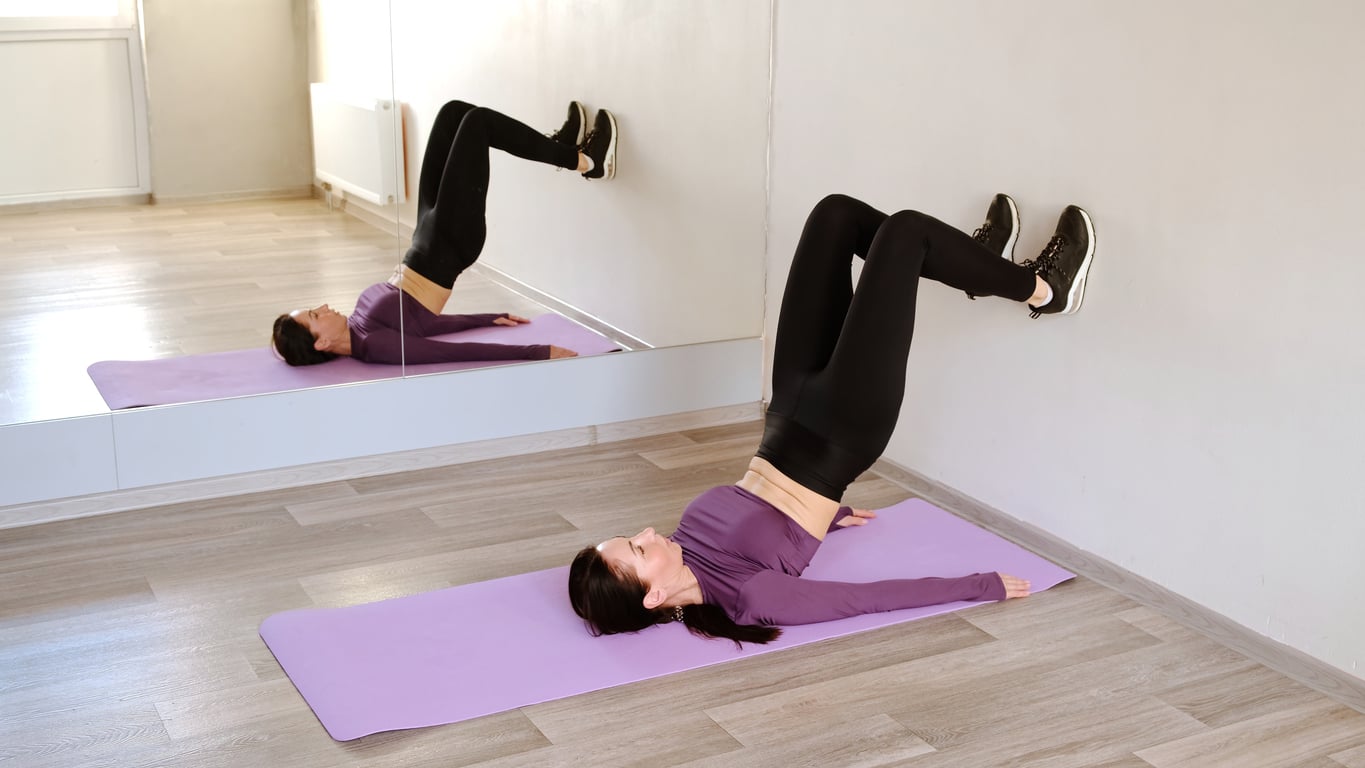
With that window in mind, here is how the four movements break down. The first exercise begins on your back with knees bent and feet placed flat against the wall. You lift your hips into a shoulder bridge position, maintaining a 90-degree angle between your legs and hips while your head and arms rest on the floor. The wall provides resistance and stability, forcing the deep core muscles to fire continuously.
The second move keeps you on your back with knees bent in a tabletop position and feet flat against the wall. Your pelvis stays in a neutral position with a 90-degree angle between the legs and hips. Arms remain alongside the body. On the exhale, you engage the center of your body to lift your head and shoulders off the mat while reaching your arms forward – no higher than shoulder height. Pressing the soles of your feet firmly into the wall creates sufficient anchoring to keep you steady. At the end of the set, you lower your head and shoulders back to the mat and gently turn your head right, then left, to release tension in the cervical spine.
A third variation has you lying on your back with feet on the wall, legs at a right angle and hip-width apart. Interlace your fingers behind your head, creating a light pressure from your palms against the base of your skull. Keep your feet planted on the wall throughout the movement to maintain a stable pelvis and solid grounding through the center of your body.
The fourth exercise positions you on your back near the wall. Start by bending your legs into a tabletop position at a distance from the wall. Your head rests on the floor, arms placed along the body. Inhale to lengthen your spine before initiating each repetition.
Form cues that protect your neck and lower back
Even the best exercise can backfire if alignment slips. Parquet offers a clear checklist. Make sure your ribs are not flaring outward. Confirm that your lower back is not arching away from the floor. And keep your chin tucked gently toward your chest to prevent any tension from creeping into the neck. These three corrections apply across all four movements and are especially important during the crunch variations where momentum tends to take over.
Another critical reminder is to avoid lifting your feet off the wall at any point during the exercises that call for wall contact. That steady connection keeps the pelvis anchored and the floor as a second point of stability, giving you greater solidity through the entire center of your body. If you feel your feet sliding, pause, reposition, and start again rather than powering through with compromised form.
What this means for your routine going forward
You now have a four-move wall Pilates sequence that targets the deep abdominal muscles without a single piece of equipment. The best time to do it, according to coach Alice Parquet, is in the morning on an empty stomach for maximum core engagement and a metabolic lift that carries through the day. Keep your ribs down, your lower back neutral, and your chin toward your chest. That wall you walk past every morning just became the most useful thing in your home.


