










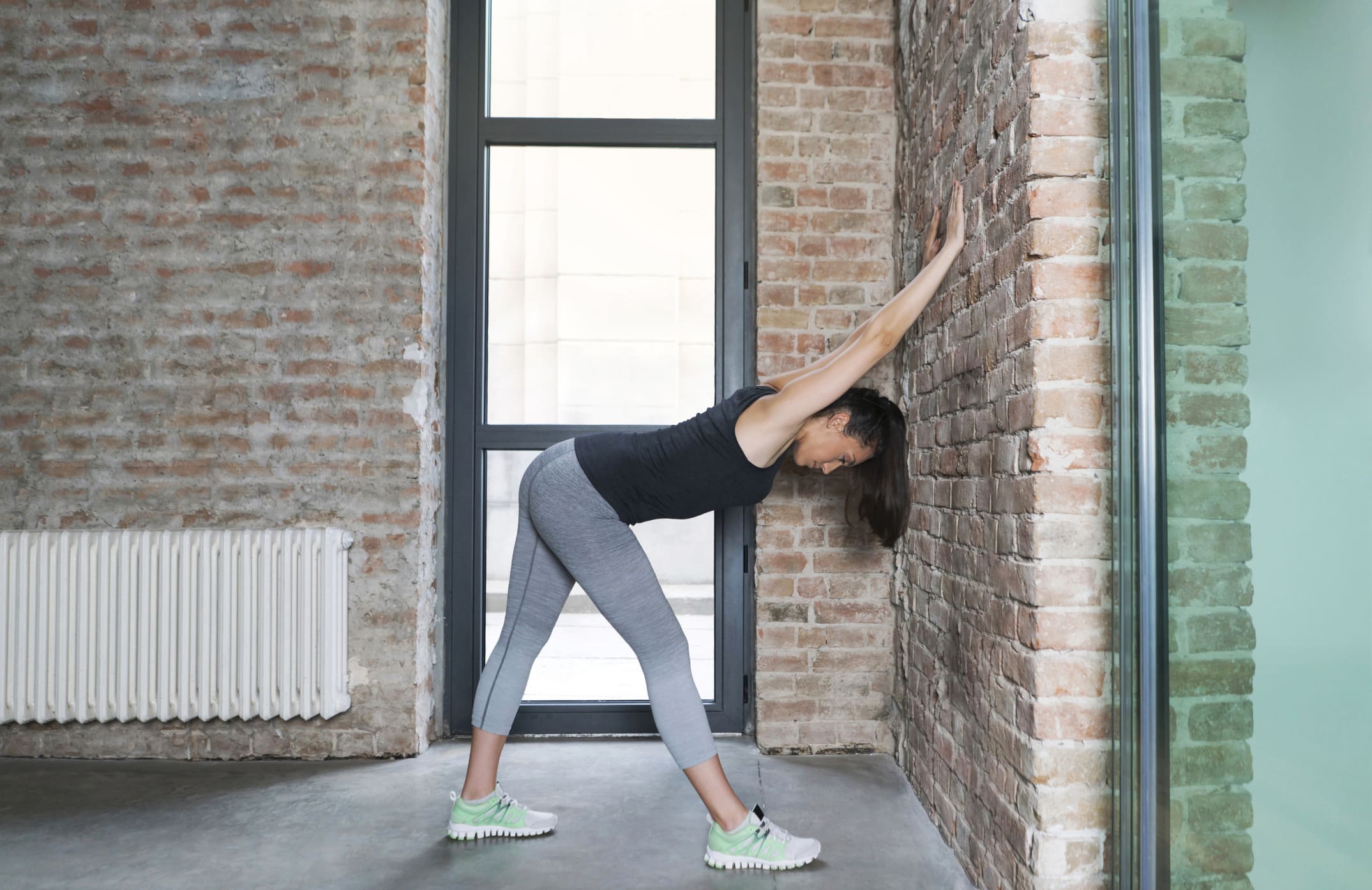
You catch yourself hunching over your laptop again. You pull your shoulders back, sit up tall, and within five minutes you are right back where you started – curved forward, spine compressed, neck craning toward the screen. If that cycle sounds painfully familiar, you are not alone, and according to one yoga instructor, the problem is not a lack of willpower. It is a lack of lengthening. A recent Instagram post from yoga teacher @yogthera offers a deceptively simple wall exercise that aims to stretch and decompress the entire spine – no equipment, no gym membership, no complicated sequence required.
Why your back keeps rounding (and why it is not your fault)
We spend hours each day locked in the same positions – scrolling on our phones, typing at a desk, staring at a computer monitor. Over time, as @yogthera explains, these everyday habits cause the spine to compress. The vertebrae gradually move closer together and the posture begins to close in on itself. The result is that rounded, hunched silhouette so many of us recognize in our own reflections.
The yoga instructor is clear on one point: the issue is not you. It is simply a lack of elongation. When the spine never gets the chance to stretch out and decompress, it stays stuck in that shortened, compressed state. No amount of reminding yourself to sit up straighter will override the mechanical reality of a spine that has not been lengthened in months – or years.
And there is a wider health dimension worth noting. According to France’s national health insurance system, the Assurance Maladie, a sedentary lifestyle is one of the leading causes of back pain. When we do not move enough, muscles slacken, lose the strength they need to support the spine, and lower-back pain follows. The scope of the problem is staggering: 84% of people have experienced, currently experience, or will experience lower-back pain, known as lombalgia, at some point in their lives. So if your back aches, you are firmly in the majority.
The one-wall move that targets spinal decompression
The exercise shared by @yogthera requires nothing more than an empty stretch of wall. She describes it as working without the weight of gravity pulling down on you, which is what makes it so effective for spinal elongation.
Here is how it works. Stand close to a wall and place both hands flat against it. Then walk your feet back until your torso and your legs form a right angle – your upper body should be roughly parallel to the floor, with your arms extended and pressing into the wall. Your gaze stays directed toward the ground and your neck remains straight, aligned with the rest of your spine.
On an exhale, you actively push the wall away with your hands while simultaneously pressing your thighs backward. That dual action creates traction along the full length of the spine, and you should feel it stretching out almost immediately. The instructor also recommends adding small lateral swaying movements once you are in position. These gentle side-to-side shifts help decompress the entire spinal column even further.
The promise is tangible: after performing this stretch, you should feel less compressed, taller, and in better overall shape. Because the move is so accessible – no props, no flexibility prerequisites – it can be done at home whenever your back starts to feel tight or your posture begins to cave.
Movement matters more than you think
One common misconception is that severe back pain always signals a serious underlying condition. In reality, the Assurance Maladie points out that pain intensity does not reflect the gravity of the problem in most cases. The majority of back pain episodes stem from mechanical causes – muscular and ligamentous strain rather than structural damage. That is reassuring news for the millions of people who panic at the first twinge in their lower back.
What truly matters is staying in motion. The Assurance Maladie puts it bluntly: not moving is the equivalent of rusting. A spine that is never stretched, never mobilized, will only stiffen further. Exercises like the wall stretch from @yogthera fit neatly into that philosophy – they are low-impact, require zero preparation, and directly address the compression that sedentary life creates. Of course, if you are dealing with persistent or worsening pain, consulting a healthcare professional remains essential.
A new reflex for a straighter spine
The key insight here is simple but powerful: a rounded back is not a character flaw or the result of laziness. It is a mechanical consequence of a spine that has been compressed by daily habits and never given the opportunity to lengthen back out. One wall, one right angle, a few conscious exhales, and some gentle lateral sways may be all it takes to start reversing that pattern. You do not need a complete lifestyle overhaul – just a few minutes and the nearest flat surface. Your spine will thank you.


