









You have probably heard it a hundred times. Your dog flops down beside you on the couch, presses against your leg, and releases a deep, theatrical exhale. Most of us barely register it anymore. Or worse, we assume it means they are bored, tired, or simply being dramatic. But what if that everyday sound is actually one of the most emotionally loaded signals your dog can send – and we have been reading it wrong all along?
That familiar exhale is far more complex than it sounds
Dogs rely on vocalizations and body language to communicate with us constantly. Yet the humble sigh tends to get overlooked, dismissed as the canine equivalent of human boredom or exhaustion. Experts say it is actually a complex emotional release, one that can carry very different meanings depending on the context in which it happens.
A canine sigh is a nuanced form of communication. It generally signifies either deep contentment or minor frustration. The difference? It often comes down to what the rest of your dog’s body is doing at the time. Experts emphasize the entire context and body language, not just a single cue like eye position. Soft, relaxed posture paired with a sigh usually points in one emotional direction. Tense muscles and restless positioning point in another entirely.
So how do you know which version of the sigh you are hearing? The answer starts with one surprisingly simple detail: whether your dog’s eyes are open or closed.
Closed eyes, open eyes – two completely different messages
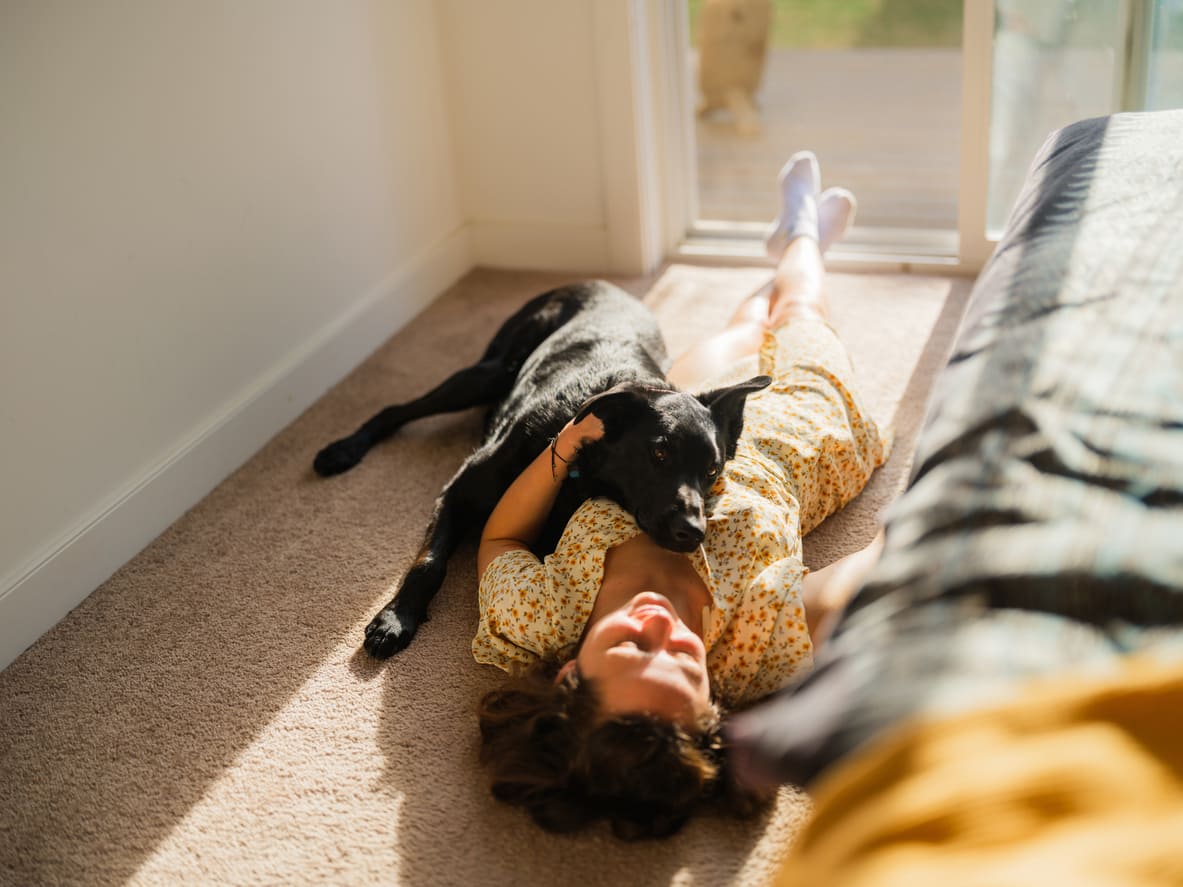
When your dog settles down next to you, closes their eyes, and lets out a long, slow sigh, you can take it as a massive compliment. This combination is the ultimate sign of relaxation and emotional security. In the wild, animals cannot truly relax unless they feel completely safe, and the wilderness is full of threats. By choosing to lie next to you and entering that state of deep rest, your dog is declaring total trust in you. They are letting go of any residual muscle tension from the day. Think of it as the canine equivalent of a human sinking into a warm bath after a long shift – the absolute pinnacle of calm.
Now flip the scenario. When those eyes stay open during the exhale, the meaning changes. An open-eyed sigh often signals resignation or mild frustration. Dogs quickly learn which behaviors attract human attention, and they are not above a little passive-aggressive commentary. If you just finished eating dinner without sharing, expect a dramatic exhale. If you ignored their subtle hints to throw a ball, that open-eyed sigh is their way of expressing disappointment – a kind of canine shrug that communicates the play session is apparently not happening.
This distinction matters because misreading the signal means missing what your dog actually needs from you in that moment. A contented sigh calls for nothing more than enjoying the quiet bond. A frustrated sigh might be an invitation to engage, or at least to acknowledge them.
Your dog’s built-in calm-down mechanism
Beyond emotion, the sigh also serves a purely physiological purpose. Much like humans use deep breathing exercises to calm their nervous systems, dogs use sighs to transition from a state of alertness and high energy to a state of rest and low energy. If your dog just had an intense play session, a walk, or a stressful encounter with the delivery truck, a sigh indicates that their body is shifting from an alert, excited state toward a calmer one. It is the physical manifestation of their parasympathetic nervous system – the branch of the nervous system responsible for rest and recovery – taking back control to lower their heart rate.
That said, not every deep exhale is benign. When a sigh is accompanied by soft body language, it typically signals contentment, safety, and physical relaxation. However, persistent heavy groaning paired with tense body language may indicate physical discomfort or pain. If moaning or stress signals accompany the exhale, it is worth paying closer attention and potentially consulting a veterinarian. The line between a happy sigh and an uncomfortable one can be subtle, which is exactly why reading the full picture – posture, facial tension, tail position, repetition – is so important.
What you can do with this knowledge right now
The canine sigh is not a random expression. It signifies relaxation, mild frustration, attention-seeking, or simply a body transitioning from activity to rest. Knowing this turns an everyday moment into a small window of genuine understanding between you and your dog.
The next time your dog lets out a long sigh while resting beside you, resist the urge to project human meaning onto it. Instead, take a quick read of the full scene: eyes open or closed, muscles soft or tense, body language relaxed or rigid. You will be surprised how much a single breath can tell you – and how much closer it can bring you to the animal curled up at your side.


