


Newsfeed


After the best part of a decade interviewing well-known names, I’ve learnt that you never quite know what you’re going to get. Everyone hopes for candour, but in an age of carefully managed images (and, to be clear, I understand why), it is rarer than ever, especially at the top.
Which is why Nour Arida catches me off guard. She is apologising before I’ve had the chance to say hello. “I’m sorry, I had a connection problem,” she says, as her face finally settles on my screen. “You know, I’m in Beirut, so…”
In fairness, I’m the one who should be apologising. I hadn’t realised that Lebanon’s clocks had gone back an hour and ours hadn’t, and my calendar invite has thrown our morning into chaos. She waves it away. “Everyone’s so lost today,” she laughs. “It’s chaos all over. It’s fine.” Within five minutes, the trappings of celebrity have fallen away, revealing someone with an easy, unguarded warmth. By the end of our hour, I understand why friendship runs through almost everything she does.
Beirut or nowhere
Beirut is a city I have never visited, although it has been on my list for years. I almost made it there last year, until tensions rose again, and this year has been harder still. Nour nods. “Wait a bit before you come here, because you won’t enjoy the full Beirut experience when it’s that tense.”
She knows that tension intimately. Nour was born in Maryland, US, in July 1989, in the final years of Lebanon’s civil war. After a couple of years in Cyprus, her family moved back to Beirut when she was a toddler. It is the city that shaped her, where she went to school and university, and where she met her husband, George Badawi. Then came 4 August 2020, when a vast store of ammonium nitrate exploded at Beirut’s port, killing more than 200 people and wrecking whole neighbourhoods. “We were home [with our daughter Ayla] and our house got destroyed,” she says. “George was, like, ‘Enough. We’re moving away tomorrow.’ We packed our things and went to Paris.”
Nour hadn’t wanted to leave, but Paris gave her something she had never known. “Actually, life does exist without this sensation of being on your guard the whole time,” she says. “I didn’t know how to live without that. I opened my eyes and the war was there.”
It also gave her solitude, which suits a self-confessed loner. She reconnected with herself, gave Ayla, then four, somewhere safe to grow up, and started therapy. “I fell in love with Paris in a very particular way,” she says. Yet Beirut kept calling, mostly for Ayla’s sake: Nour wanted her daughter to be “anchored” in the city, as she is. “My best friends are still my friends from school,” she explains. “I wanted her to have her very close Lebanese friends that would be her friends forever. I wanted her to grow up next to my parents, next to George’s parents, while they’re still healthy.”
I suggest that a lifetime of upheaval must leave you in a permanent state of fight or flight. “I used to tell people, yeah, we’re resilient, as if I was proud of that,” she says. “Now I’m, like, ‘No, I don’t want to live in a war. I want to be able to take my book and go to the park and read, without being scared that something’s going to explode next to us.’” She pauses. “I love Beirut, but I don’t trust it anymore. I think that’s the word.”
She calls it a “trauma bond”, then corrects herself. “I don’t hate it. It’s more of a love-scare relationship. I love it, but I’m always on my tiptoes. Before, I didn’t care. Now I have a daughter. The house broke on her head. I love it, but not at the expense of my daughter’s health and sanity.”
The family still keeps a home in Paris, but Beirut is their base, for now. “Maybe when Ayla graduates [we could move back to Paris],” Nour says. “But not now. She’s so happy here.”
“I love Beirut, but I don’t trust it anymore. I think that’s the word… I love it, but I’m always on my tiptoes. Before, I didn’t care. Now I have a daughter.”
This year tested that choice. Since the war between Israel and Hezbollah escalated again in early March, around 1.2 million people have been displaced across Lebanon, and a ceasefire announced in mid-April brought little relief. Through all of it, Nour held on to a plan made in January: Sorbé, the skincare brand she launched in November 2025, would take over Beirut’s Sporting Club for the month of June. The seafront club has been a city institution since 1953. Her parents and grandparents went there, and nobody, she says, had ever been allowed to do anything like this there before.
“When the guy from Sporting said yes, it was that huge for us,” she says. When the war started, they nearly pulled out. “We were going to invest so much money, and maybe not enough people would come.”
Then her friends in London, Milan and Paris started calling. “They were like, ‘We’re coming to Beirut no matter what,’” she says. “So I was like, okay, I’m doing this pop-up no matter what.”
Two days before it opened, things turned frightening again, with planes flying low over the city. “I was looking at George and saying, ‘We’re crazy. How are we even doing this?’” By then it had become more than a pop-up. “It was a message that no matter what, we’re still doing it. Even if the airports are closed, my friends will do anything to be here.” The name of the residency said it all: Beirut or Nowhere.
For someone who has just told me she is done with being called resilient, it feels like the most resilient thing she could have done. She laughs. “I’m telling you, it’s a toxic relationship.”
A reluctant star
Long before Instagram, it was the women in Nour’s life who shaped her path. Her father, lovingly, wanted her to study medicine or engineering (“Arts and fashion, it’s just a hobby”), so she took the numbers route, studying economics and maths at the American University of Beirut. But her grandmother had managed a boutique in Beirut, and when Nour graduated and told her mother she couldn’t picture herself in a suit at a bank, it was her mother who suggested she work with a cousin whose family runs some of the city’s biggest luxury stores. She became a buyer, sourcing around 140 brands, from Vince and Theory to Alice + Olivia, and travelling to New York and Paris for the collections. It was George – the keen photographer she would later marry – who wanted to put her in front of the camera.
“I was very shy,” she admits. “I didn’t even have Instagram.” So George took her phone and made her an account. After their wedding at the Salon de l’Opéra in Paris in 2014, she woke up to 15,000 followers: wedding pages had reposted a photo of her sheer, pinkish gown, and it had gone viral. (Her verdict now: “I hate the dress. You look back at old pictures and you’re like, why did I wear such a thing?”) George, her “visionary”, as she calls him, suggested they try to monetise it. “I said, ‘Monetise what?’” she laughs. “It was very absurd.”
When she was pregnant with Ayla, she began posting her maternity outfits, which took her to around 50,000 followers and brought her first paid job. “I was telling George, ‘We made money out of a picture. How weird is that?’” During the pandemic, her account exploded. Since then, she has been a global ambassador for numerous brands, and in 2025 she was the only Arab woman in Audemars Piguet’s 150th anniversary campaign, alongside Serena Williams and Winnie Harlow.
Today, she has more than 10 million followers, a number she admits feels abstract until she meets it in person. She recently spoke on a women’s empowerment panel where there wasn’t one empty chair. On a trip to Saudi Arabia, the officer at passport control looked at her passport and asked, “How’s Ayla?” “I’m like, how does he know me?” she says. “Then I realise it’s 10 million followers. It’s real.”
Still, she never chased fame. She used to feel physically sick before giving a speech, and she is still happier one-to-one than in a crowd. “I see Ayla’s friends, they’re 10, 11, and if you ask them what they want to be, they say, ‘I want to be famous,’” she says. “I wasn’t like that. It was never in my plans. Sometimes I’m like, when did all of this happen?”
It is a fair question. In a little over a decade, there has been a wedding photo that went viral, a daughter, a house destroyed, a move to Paris and back again. Then there were ambassadorships with notable Maisons and now Audemars Piguet and a brand of her own. None of it, she insists, was the plan.
Nor did she expect to build a working life with her husband. “[George] is a Capricorn, I’m a Cancer,” she says. “He’s a decision-maker. He likes to do things quickly. I like to take my time.” She describes herself as a romantic loner who absorbs other people’s energy; George is pragmatic, “1 + 1 equals 2”. “He’s always so sure of everything he says or does,” she says. “So I trusted his vision blindly.”
That trust led to Sorbé, which they dreamed up on their sofa in Paris. Nour wanted skincare first, with a touch of makeup, and the brand describes itself as multi-effect skincare. “I know the future is skincare,” she says. “It’s not makeup anymore.”
Then comes the detail that surprises me most. “I’m the finance [officer] in the company, by the way. No one knows that.” So all that maths finally paid off? “Exactly! I told my dad, see?” she laughs. “I love working with numbers. It satisfies me.” When she was only modelling and doing ambassador work, she felt she wasn’t using her brain enough. “I got bored. Now with Sorbé, I’m using all of my capacity. I’m always on a dopamine high.”
She also leads product development and insists on understanding every ingredient, from ceramides to niacinamide, before she briefs the lab. George handles the marketing and creative sides, alongside their creative director, Dana. “He’s this creative genius,” she says of George. “He loves beauty. He sees beauty in everything.”
So, what is it like being married to your business partner? I’m expecting a diplomatic answer. I don’t get one. “It’s horrible, honestly,” she says, laughing. “Work comes home every day. It doesn’t stop.” But they have found a balance, mostly. “We haven’t found it 100 per cent, but I’ll let you know.” When other couples ask whether they recommend it, the answer is no. “In a relationship, each one should have their own world, and then a third world you create together,” she says. “We don’t have that. We have everything together. Even for Ayla, to have her parents talk about work at home all the time… it’s heavy.”
Finding meaning
All of which raises the question: does she have anything that is just hers? The answer is instant: her humanitarian work. Then she says something I relate to more than I’d like to admit.
“Sometimes I feel like what I do is a bit shallow, especially in the world we live in,” she says. “Children are dying in Gaza every day, there’s famine in Africa, and I’m like, what am I doing? I’m taking pictures… I feel so stupid sometimes. I sometimes feel empty.”
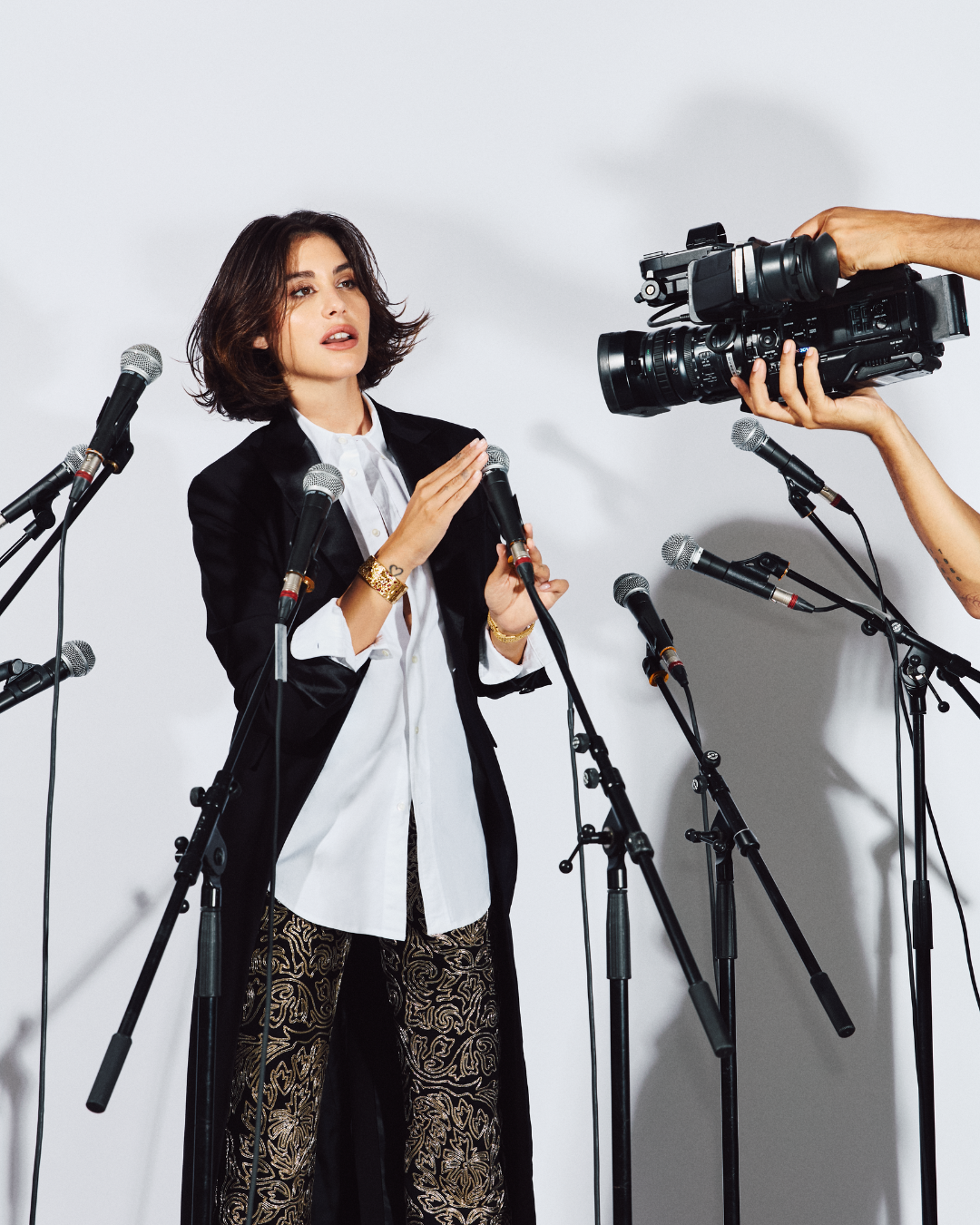
Her answer has been to use her platform for the conversations most people avoid. In January 2025, she and Haifa Wehbe released Harassment Isn’t Virtual, a short film directed by Elie Fahed in which the two women sit watching abusive comments projected onto a screen. Its reach, she says, went beyond anything anyone could have imagined. “People trust me,” she says. “They trust me with the brands I work with, with how I am in life. So they trust me when I come and say, ‘Guys, there’s a problem.’”
“Arab women have been through so much; I can’t tell you how much. From the age of five, we’re the responsible ones. We take care of our parents, our husbands, our children, the house, and we work if we have to.”
Before that, she worked with the Lebanese NGO ABAAD on a campaign against the stigma that silences survivors of sexual violence in Lebanon. It cost her. “I went into a very big depression after that,” she says. “It was very hard to stop thinking about it and go back to showing my outfits and being present at Fashion Week.” She says the campaign helped push for changes to around 22 laws in Lebanon, which she hopes will be signed this year. “When I see that the work actually matters, I say, okay, even if it sometimes feels shallow, even if it feels heavy, at least I’m able to make it better for women here.”
This year, that work became very practical. As displacement spread across Lebanon, Nour donated three bathroom units, containing showers and toilets, which humanitarian organisation Anera (American Near East Refugee Aid) installed in Beirut shelters in March. At the time, she pointed out that while aid was covering food, water and basic needs, women’s hygiene, dignity, safety and comfort were being overlooked.
She absorbs a lot, she admits. A friend called her that morning with a problem at home, and she hasn’t stopped thinking about it. So she is learning to switch off, and has been logged out of Instagram for almost a month. “It’s a bit toxic to always be on the app, reading what people say about you,” she says. “I need to focus on my brand, on my daughter, on myself. I need to be able to take a book and read it.”
It’s clear, even from an hour on a video call, that she expects a great deal of herself and carries it. When I ask how it feels to represent so many women, as the only Arab woman Audemars Piguet chose for its anniversary campaign, she starts by describing what Arab women carry.
“It’s a huge responsibility, but I feel proud,” she says. “Arab women have been through so much; I can’t tell you how much. From the age of five, we’re the responsible ones. We take care of our parents, our husbands, our children, the house, and we work if we have to.” Often, she adds, they can’t admit they’re tired. “It’s frowned upon to say, ‘I’m not feeling well’. She needs to be there. She needs to be supportive.”
That is why being visible matters to her. “Ten years ago, we wouldn’t even have dreamt of being all over the world,” she says. “You could become famous here, but that was it. I want to show women that we can be famous everywhere. Our voice can be heard.”
As one of the Arab women in the Audemars Piguet family, she has found a partner that amplifies that voice rather than tempering it, even on the hardest subjects. “Some brands don’t like it when I talk about a controversial topic, but AP have always been the first to encourage me,” she says. She describes the Maison’s CEO, Ilaria Resta, as someone who knows what each of its ambassadors is doing, and the ambassadors themselves as a group of friends who pick up where they left off whenever they travel together. “It’s not about working with a brand,” she says. “We have the same values, and we stand by them. I feel like AP and I have grown together.”
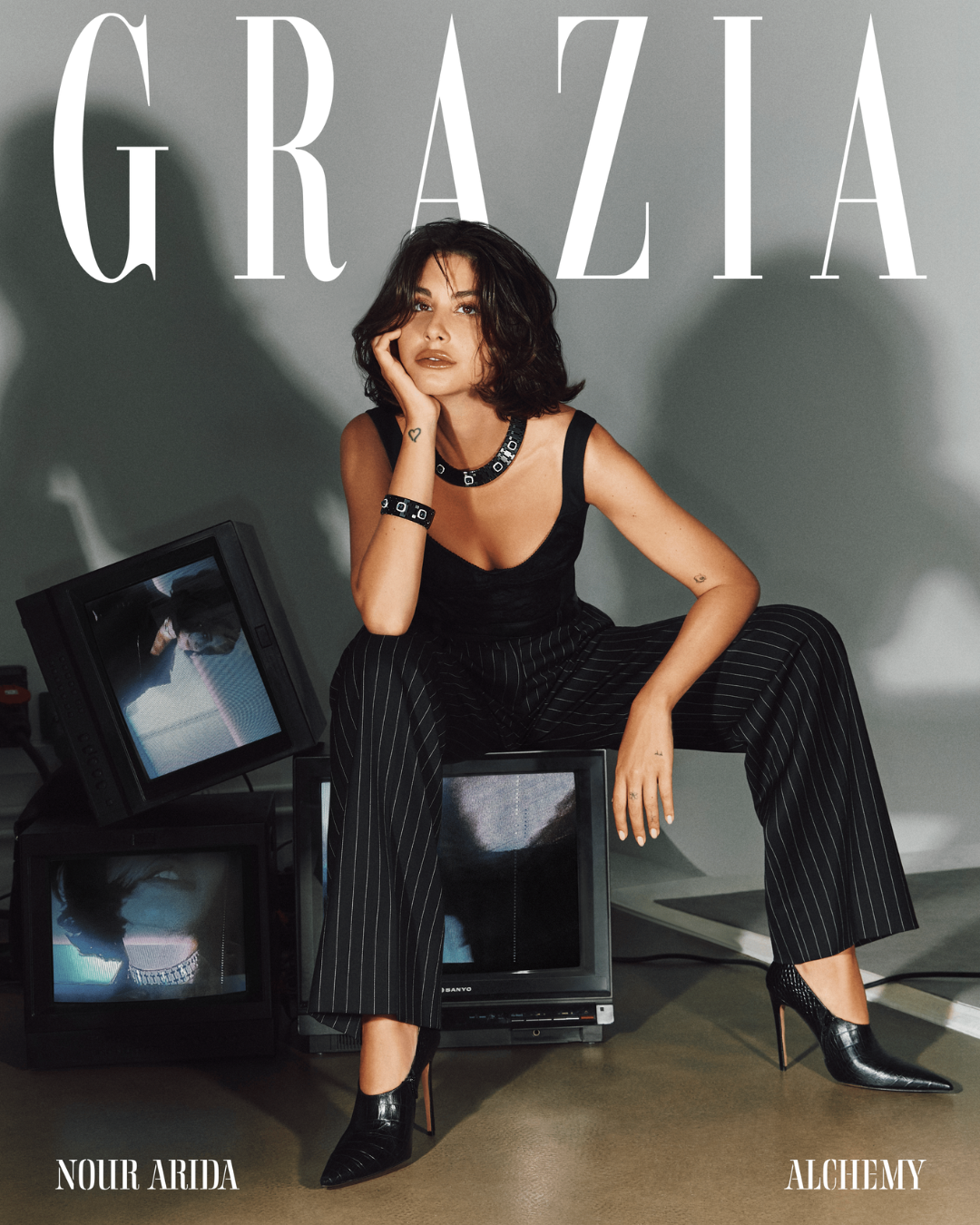
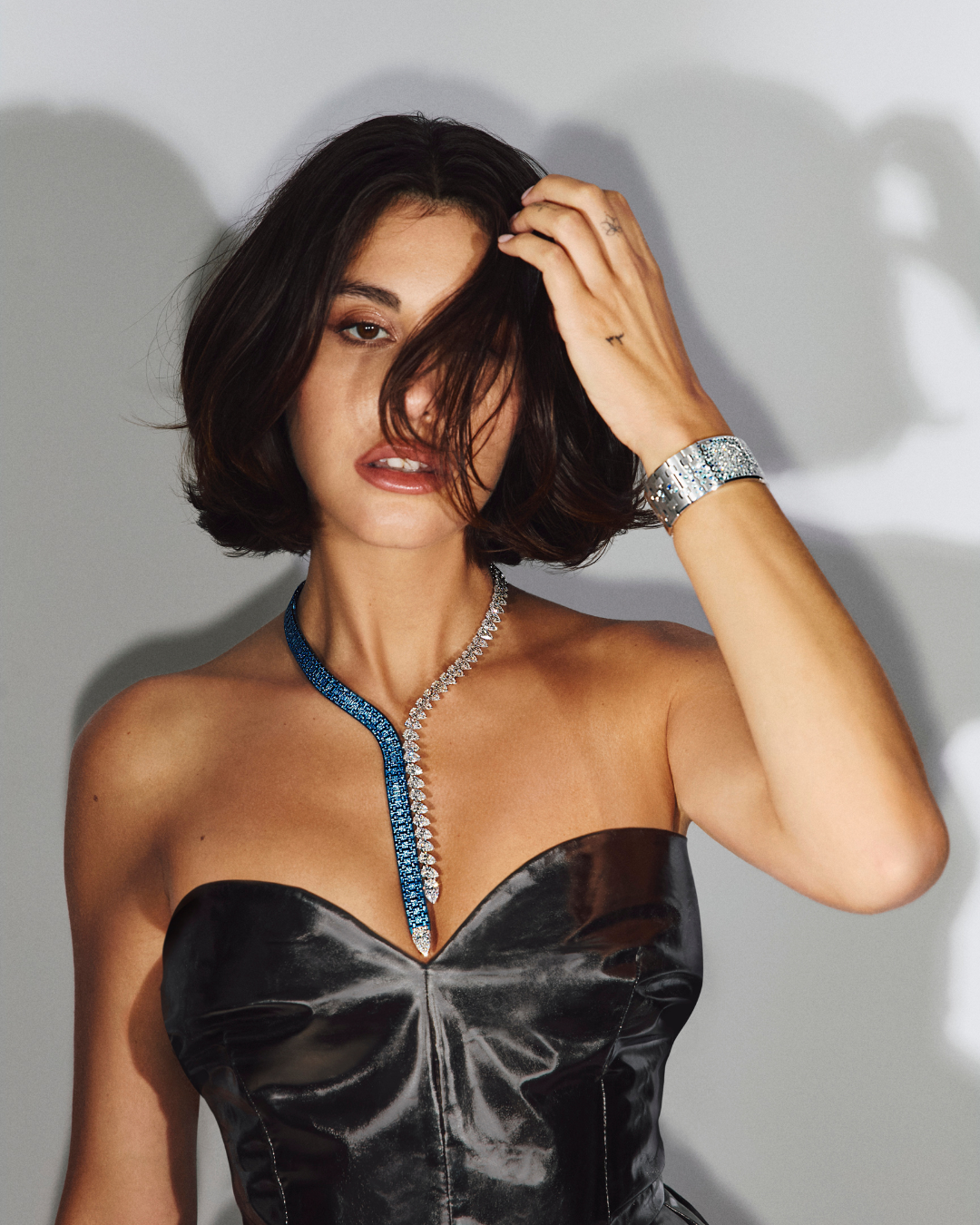
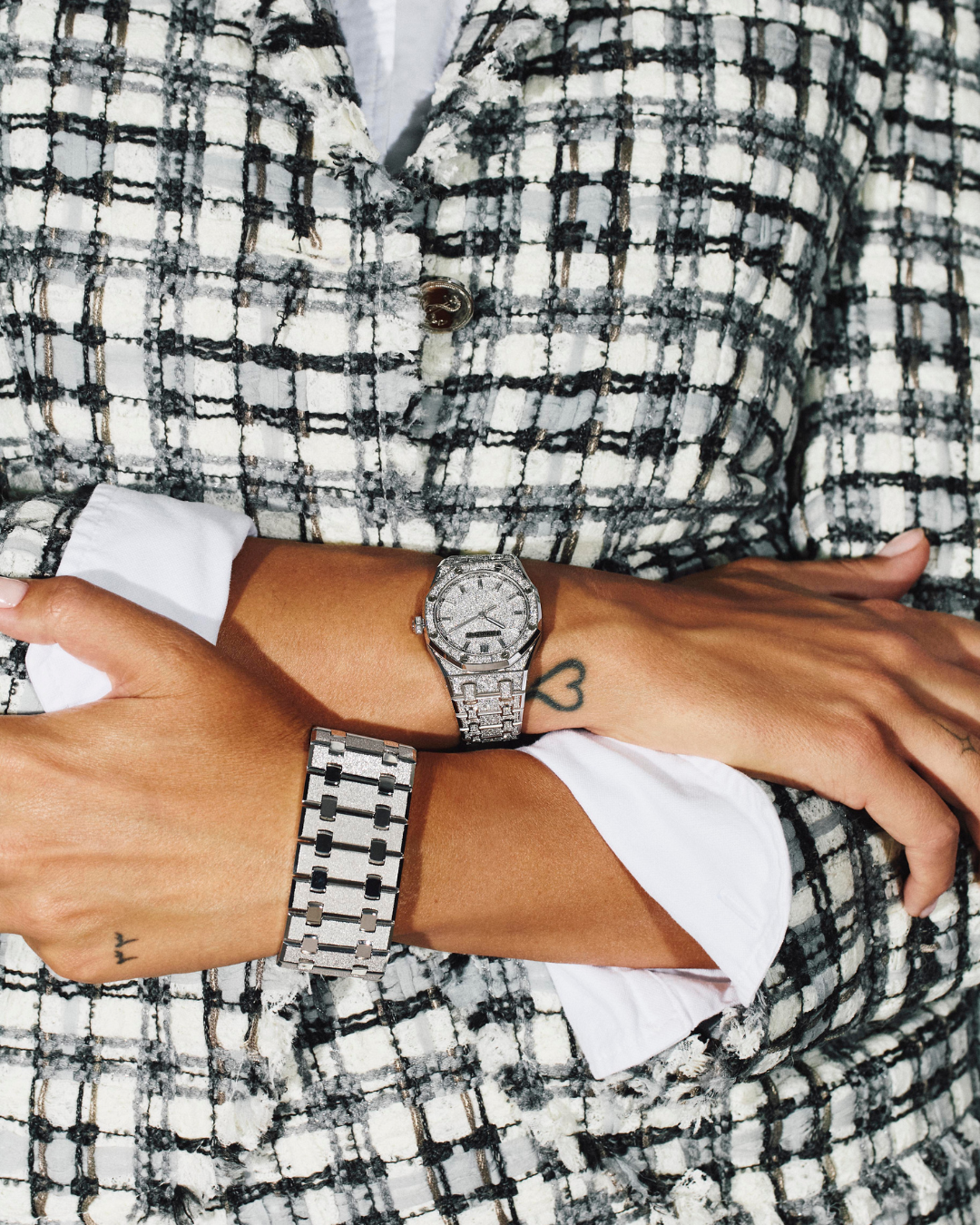
That growth is on show this season. At the beginning of July, Nour was among the first to wear pieces from the Royal Oak Joaillerie, Audemars Piguet’s new high jewellery collection, which reimagines the Royal Oak’s famous bracelet as cuffs, chokers and statement necklaces. And while they may look heavy and bold, she insists they are “so wearable… easy to move with”. When she met one of the artisans in Paris a fortnight ago, he told her each piece had taken at least six or seven months to complete. “You look at these pieces and [you know] it’s AP. It couldn’t be anything else,” she says.
Home is a feeling
As our hour runs out, I ask the question I’ve been saving: after a year like this one, what does home mean to her? She has moved nine times in 14 years, she tells me, and used to grieve every house, every bed, every neighbourhood. Not anymore.
“Home is being surrounded by my loved ones, even if we’re not in the same country,” she says. George travels constantly. Her two best friends don’t live in Beirut. “But checking up on them every day, for 10 minutes, and knowing they’re okay. That’s home. It’s not a place anymore. It’s a feeling.”
“Sometimes I feel like what I do is a bit shallow, especially in the world we live in. Children are dying in Gaza every day, there’s famine in Africa, and I’m like, what am I doing? I’m taking pictures… I feel so stupid sometimes. I sometimes feel empty.”
She tells me about a dinner with her girlfriends a few nights earlier. “It’s only now that we realise how important female friendships are,” she says. “We used to take them for granted. We’re all doing our therapy separately, and we always say it: having your female friends next to you is the biggest blessing you’ll ever have. A message saying, ‘I’m here if you need anything.’ For me, that’s comfort. That’s home too.”
I’m not ashamed to say it gives me chills. When I half-jokingly say men will never understand those bonds, she lights up. “Never! When you’re in your early thirties, it frustrates you. Then you grow older and you’re like, I don’t even want men to understand what I’m feeling.”
It is a bond she is passing on to Ayla, who already counts her mother’s friends as her own. Mostly. “Whenever I have a girls’ reunion, she’s like, ‘I’m coming’. And I’m like, ‘No, you’re not. You have school tomorrow. I need my personal time,’” she laughs.
Passing things on matters to her, “like your watch from one generation to another”. The watch on her wrist is proof of the idea: the Royal Oak, a design that has been handed down, in its way, for more than half a century. On that hand, she also wears a ring her grandfather bought her grandmother in the 1940s. Evidently, the things worth keeping are the ones you pass on. “I always tell Ayla, you have to cherish your female friendships,” she says. “They’re the ones that will make you grow. They’re the ones that will make you feel understood.”
It has taken Nour most of her life to learn what those friendships are worth. She would like Ayla to learn it sooner.
“I love Beirut, but I don’t trust it anymore. I think that’s the word… I love it, but I’m always on my tiptoes. Before, I didn’t care. Now I have a daughter.”
CREATIVE DIRECTION: MARNE SCHWARTZ & DANÉ STOJANOVIC
PHOTOGRAPHER: VLADIMIR MARTÍ
FASHION STYLIST: CARMELO CORVAIA
HAIR: JEAN LUC AMARIN
MAKEUP: SHARBEL HASBANY
NAILS: NAFISSA DJABI / B AGENCY
SET STYLIST: CAMILLE ROUSSEAU
EXECUTIVE PRODUCER: STEFF HAWKER
FASHION ASSISTANT: VALENTINA MORELLI
SET ASSISTANT: DANIA BACCARI
PHOTOGRAPHY ASSISTANT: OLIVIER COLAIRO


