



Newsfeed


The first thing Saffron Vadher does when the call finally connects is let out an unfiltered laugh that dissolves the formality of a cover interview in seconds. I’m half in transit, half balanced on the edge of a Wi-Fi signal that keeps threatening to evaporate somewhere between Sheikh Zayed Road and the small cafe I had to take a pitstop at on a Tuesday evening due to traffic woes. Saffron is dialling in from her phone between castings.
Our screens freeze and unfreeze and reframe frequently throughout the call; at one point I’m apologising for the sound of traffic, at another she’s adjusting her camera to find better light. She thought she’d be calling from her agent’s computer, but “that’s not happening”, she says, cheerfully. So we’re both here – slightly ad hoc, slightly chaotic, and completely unbothered by it.
It feels improvised and oddly perfect, not least because it mirrors the way she describes her life – a series of doors that opened when she least expected them to. Namely, stepping into the fashion industry was never something at the forefront of her mind.
But by happenstance, during a stint as a hostess during Wimbledon over a decade ago, someone told her she should model. “I was like, ‘No, that’s not me,’” she admits, still laughing at how quickly she dismissed the idea. “I never really thought about going down this avenue at all,” she continues. “It wasn’t planned, but it also didn’t feel random, it just unfolded naturally.”
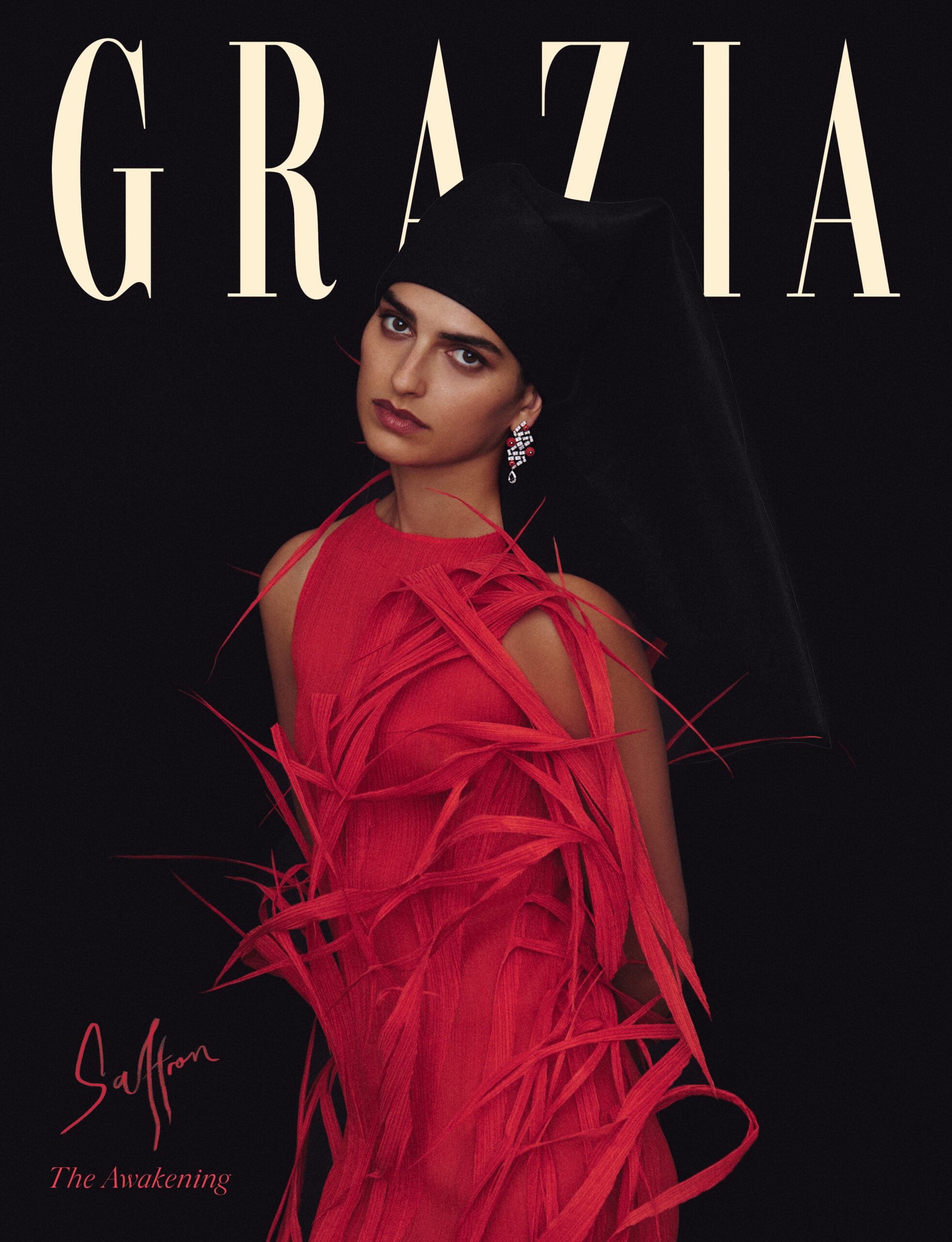
Looking back now, with 10 years in the industry under her belt, multiple magazine covers and more cities than she can easily list, what stays with her isn’t the pace but the feeling fashion brings to her.
The realisation, early on, that fashion for her was less about the runway and more about the imagination behind it. “Magical” is the word she comes back to – describing not only the outcome, but the process, too.
Perhaps it’s a perspective that’s been rooted in her dual-national upbringing. Saffron is British-Indian, with a family history that holds multiple geographies. Her mother is British, her father is Indian – born in Nairobi, Kenya, before moving to the UK when he was around 12 years old. It’s clear her heritage is something that she takes great pride in. I ask how that same sense of duality – of seeing the world through more than one lens – has been shaped by her heritage, and how it informs the way she moves through fashion today, not just as a model, but as someone in whom many young women now see themselves.
For Saffron, though, the answer doesn’t begin with fashion at all, but with the women she grew up watching – her two grandmothers.
Her British nan’s hair was in big rollers, nails always done, heels on, perfectly put together. “My granddad said he liked pink nails,” she tells me, “so for 60 years my nan has had pink nails”. Quintessentially British, and, as she puts it, “always, always dressed up”. Then her Indian grandma: long, dark hair, colourful saris, stacks of jewellery worn, no matter what the occasion. “Even in the kitchen,” she says, “bangles, earrings… it always looked really nice”.
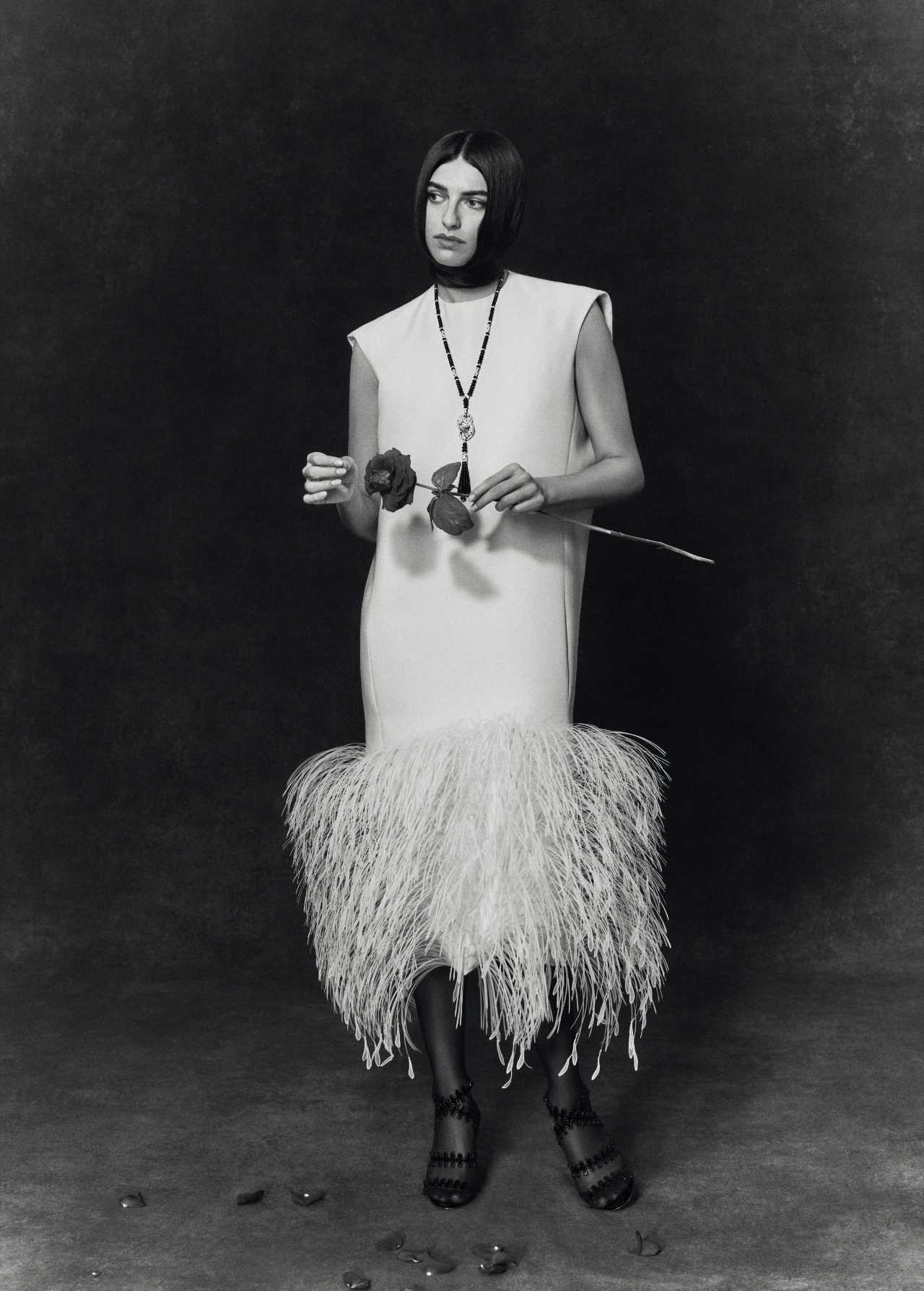
What she recognises now is the common thread between them. Different aesthetics, the same intention – a belief that getting dressed was simply part of the day. Both women would cook in full uniform, as though there were no such thing as an off-duty version of themselves. “That’s the last thing I would do now,” she laughs, and I tell her I’m exactly the same. It’s only in hindsight, she says, that she understands what she was absorbing. “Growing up with them side by side gave me such a strong sense of two different kinds of beauty from two different heritages,” the model reflects.
However, despite having two strong (and stylish) female role models growing up, Saffron admits she didn’t see herself reflected in the fashion world during those formative years.
At that time, she explains, there was a diaspora dynamic, where integration was a priority – being British first – while heritage was something primarily expressed in private. She is careful to frame it generationally – “a sign of the times” – but its impact was lasting.
Without visible South Asian models in Western fashion, there was no established image in which she could recognise herself. Indian cinema provided one kind of mirror; Western fashion, at that point, did not. “I never really saw myself in the girls on the catwalk,” she says, and so her career became, in part, an act of placing herself into a space where no obvious reference point existed. “When I first started, it was almost like I was seeing where I fit myself.” In short, she is the one who is now the blueprint.
Now, with a decade of work behind her, she is more direct about what that lack of representation still looks like in practice. There are brands she wants to work with, brands she has asked to be pushed toward – and she has been told, plainly, that they don’t work with Indian girls.
“I’ve been in conversations where I’ve gone, ‘I want to work with this brand,’ and they’re like, ‘No, they don’t want to work with Indian girls.’” It’s 2026 and she is still navigating the limits of someone else’s imagination. That, she says, is where “responsibility” comes in. “There is still a long way to go with things,” Saffron affirms bluntly – and rightly so.
That responsibility she speaks of extends beyond industry representation terms. The desire to be visible for others stems from a much earlier chapter. “I would like for people to look at the magazines and see the work I do with charity and things like that,” Saffron explains, referring to her ambassadorship with Leukaemia UK.
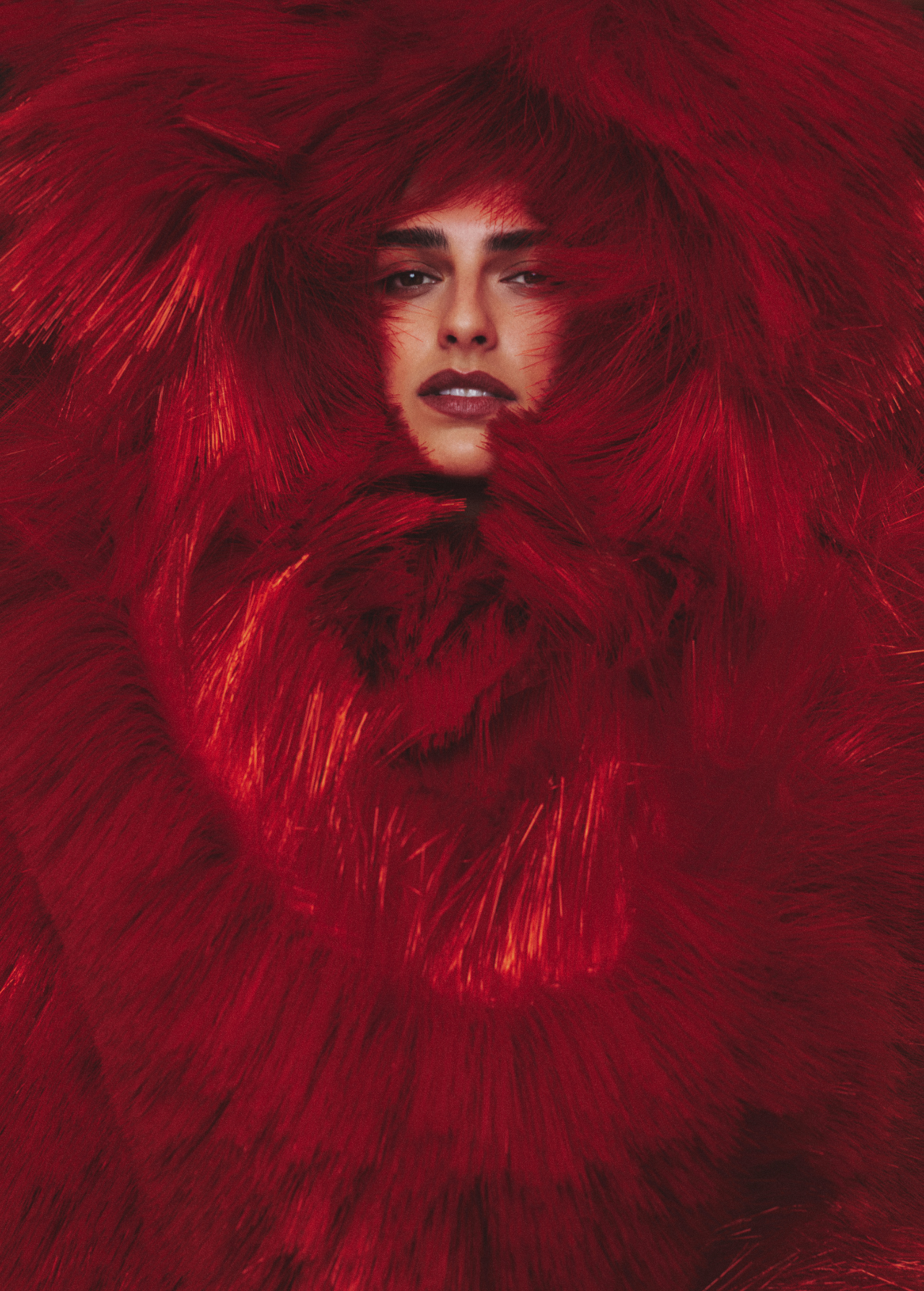
Saffron was diagnosed with leukaemia aged three, with treatment stretching until she was seven – arguably an age bracket that sits right at the edge of memory. When I ask her how this period of her life shaped her, she pauses, thoughtful. “It’s interesting,” she says, “because if you asked me three years ago, I think I would have had a different answer”.
As we discuss her cancer battle, she goes back to the word “resilient” multiple times, but doesn’t appear to remember hospital visits as a negative thing – she remembers it as… life. It was made to feel almost positive, with small things to look forward to after treatment such as ball-pits, play and more. “There was never a negative thing,” she reiterates. The only enduring fear is injections – she laughs, but she means it: “I absolutely hate injections.”
The shift, she tells me, happened when she started seeing children in her family grow up, particularly her cousin’s kids, now seven and three. “It’s so interesting watching them,” she says, “how what you put into their minds carries on”. And in watching them, she reflects on her treatment years. “It was always about just getting on with things, but not in a ‘let’s not talk about it’ way, but just, you have to do these things in order to get better.”
It’s only now, she tells me, through the work she does with families currently in treatment, that she has begun to understand the magnitude of what her own parents lived through. Speaking to mothers and fathers standing at the beginning of that same journey has shifted the perspective. “Parents are terrified,” she says simply. “They just want to know their child is going to be OK.”
She remembers one conversation in particular, with a father who told her that his instinct – as a parent, as a man – was to fix things, to find a solution, to take control. “And I can’t do anything here,” he said. “I can’t fix this.” The helplessness of it stopped her in her tracks, because what she sees now is the parallel story with her own parents. Her father, she says, was “beside himself”, something she only discovered later in the clinical notes she was given access to as an adult. Her mother responded differently. “She went into overdrive,” Saffron recalls.
Even now, however, it’s in the smallest details that the weight of what a young Saffron went through reveals itself. She starts telling me about a kitchen renovation not long ago, but then stops. “Oh my god, I’m going to cry,” she says, catching herself mid-sentence. In the middle of clearing cupboards, she had found a blue plastic tub tucked away at the back. Inside were strips of unopened medication. The fashion model recalls initially thinking it was paracetamol, when it was in fact remnants of her leukaemia medication.
“I was like, ‘Mum, why have you still got this?’” Saffron recollects. “And she was like, ‘Because I feel like, if I was going to give it away, then it might come back.’” A superstition born not of logic but of fear. Saffron pauses again, but continues, “But she said, ‘No, I can’t get rid of it, because I feel like if I got rid of it, then you’d get ill again.’”
However harrowing, it’s from these experiences that Saffron is now able to offer comfort to those going through something similar, which she says she cares so much about.
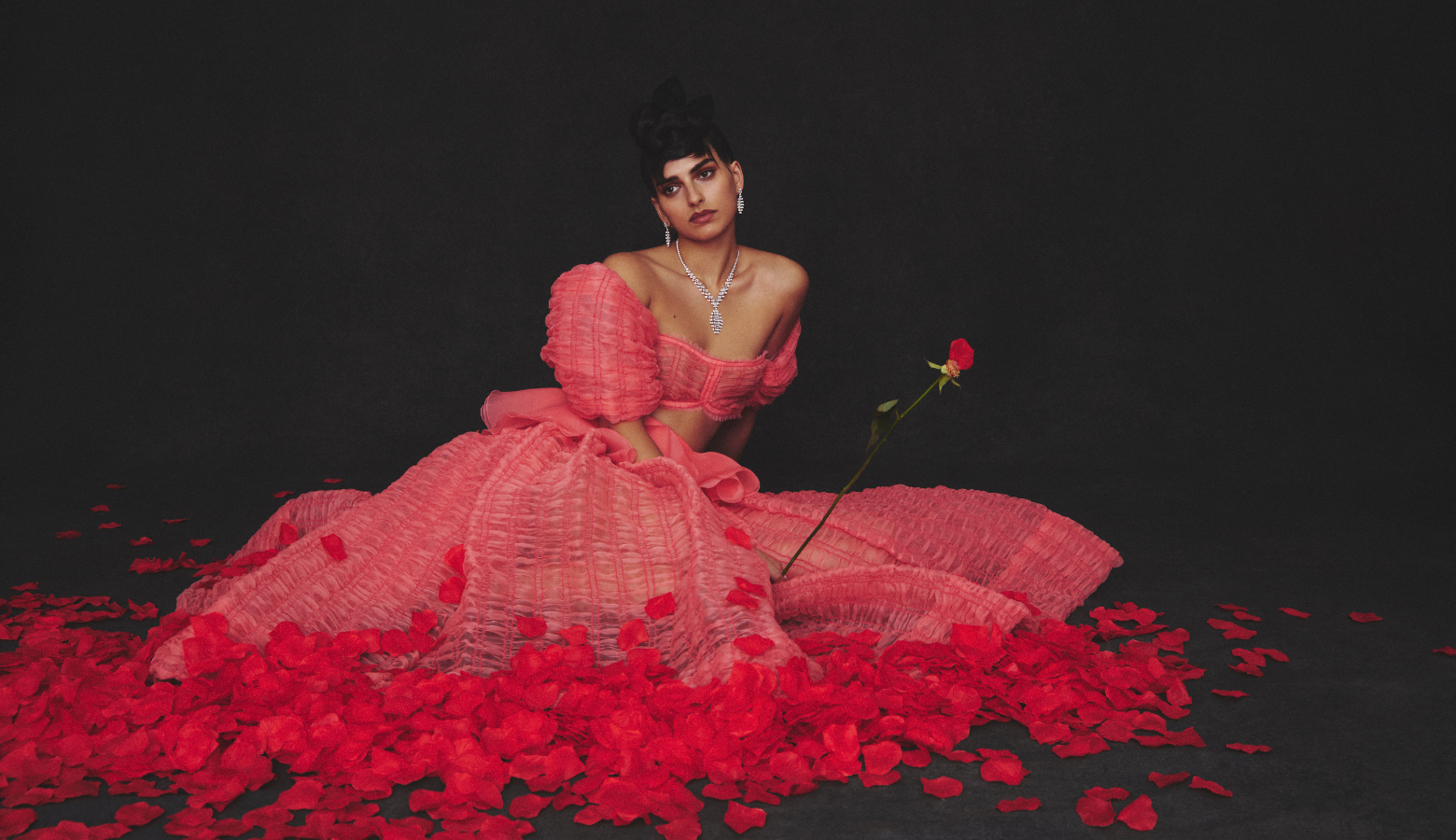
“Being able to respond from my own lived experience is honestly the most meaningful part for me,” she adds. “Sometimes there are things doctors can’t answer, or things parents don’t want to ask, and I’m happy that I’m able to answer those questions for parents or children.” If she could say one thing to those currently in it, she adds, it would be this: “This moment isn’t forever. When you’re in it, it can feel completely all-consuming, but there is a future beyond it. You are so much more than your illness.”
It feels like the natural point to turn the lens back onto her. Having spent so much of our conversation talking about survival, visibility and the long arc of becoming, I ask what awakening (aptly our theme for this edition of GRAZIA) looks like in her own life – whether it arrives as a single, defining shift or something quieter.
The answer, when it comes, is characteristically undramatic. She doesn’t believe in a single, cinematic turning point. “I don’t think we only have just one awakening,” she says. “For me, life feels more like a series of big and small moments that quietly shift the path you’re on.”
What she describes instead is a deepening sense of connection, be it to time, to the people around her, to the versions of herself she has already lived. Her cousin’s baby girl, now a few years old, altered her perspective in ways she didn’t anticipate. Being asked to be her best friend’s maid of honour had a similar effect.
While the past year has been a slower, more reflective one for Saffron, she is ready to embark on a new chapter with acting – one of her earliest ambitions.
“I’ve been thinking more about where I put my energy,” she says. “It feels less about proving anything now, and more about growing.” Speaking further of acting, she continues: “Creatively, I’m stepping into something new, which has made me feel more curious and a bit braver about where my work might go. It doesn’t feel like I’m following a set path anymore. I’m just letting myself explore and being open to learning as I go, even if that means changing my mind or seeing things differently.”
In a way, it’s a beginning again, but not as a reset, rather a continuation. But when we specifically speak about the so-called five-year plan, it’s not about work milestones, it’s life. “A husband and a baby is in my future,” she says with ease.
From being the child who learned resilience before she understood the word, to being the teenager who entered an industry without a reference point, and now the woman returning to her earliest creative instincts, it’s clear that Saffron Vadher is not stepping into a role that already exists – she is the one writing it.


