










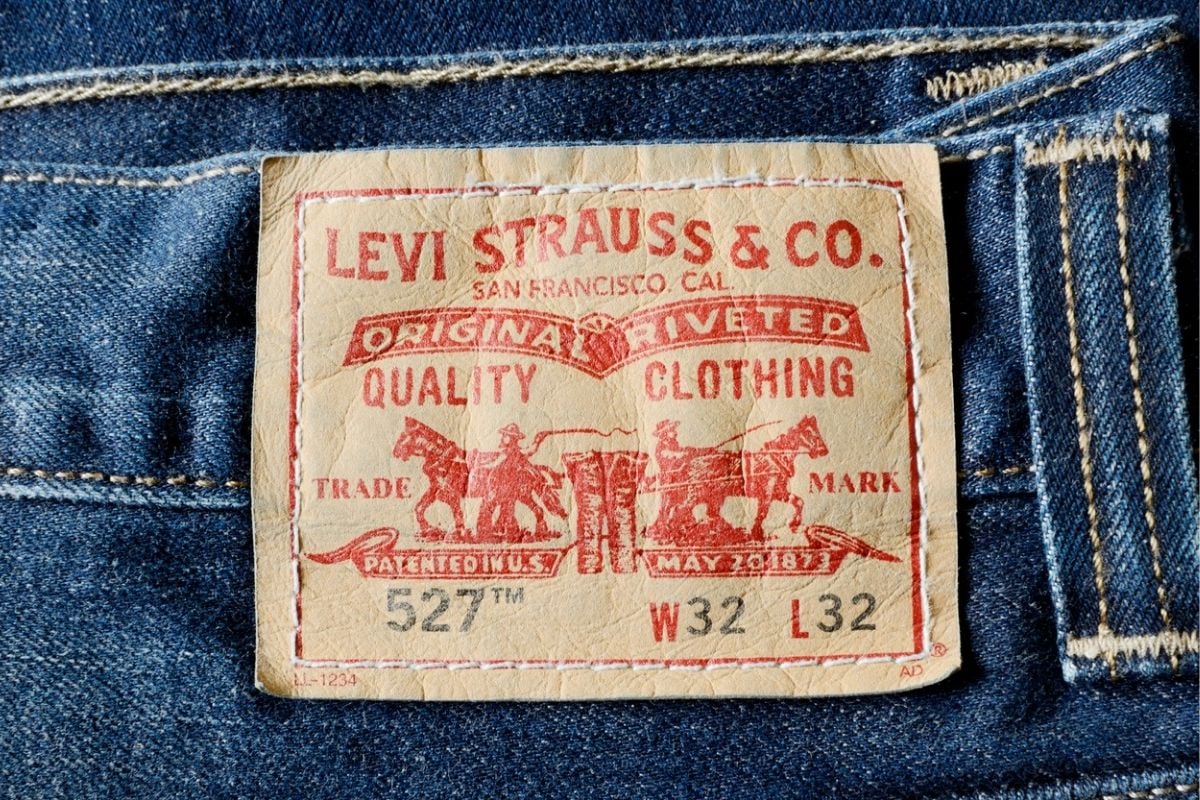
You have probably never given it a second thought. That small leather patch stitched to the back of your jeans – the one with two horses pulling in opposite directions – feels like it has always been there. It is such a familiar detail that most of us assume it was simply part of the original blueprint for denim. But that tiny rectangle of leather is actually the relic of a fierce branding battle that played out more than a century ago, long before marketing departments and social-media campaigns existed. The story behind it reveals how the modern concept of brand identity was born on the back pockets of American workwear.
How denim branding became a battlefield
The evolution of the jean is saturated with references to Levi’s, and that is no coincidence. The company played a pivotal role at the dawn of the modern jean, and its desire to stand out from competitors and dominate the market led to innovations that went far beyond stitching and rivets. One of the most consequential of those innovations was the brand patch itself – a deceptively simple idea that changed the way clothing companies communicated with their customers.
But here is the twist most people miss: Levi’s was not the first brand to use a visual symbol on its workwear. Sweet-Orr, a company founded in New York in 1871, had already been featuring a tug-of-war scene on the back pocket of its jeans. In Sweet-Orr’s design, a pair of jeans replaced the traditional rope in the tug-of-war, conveying the idea that the fabric was tough enough to withstand enormous force. Garments bearing this design were being sold a full fifteen years before Levi’s placed its own patch on its jeans. So when we talk about who started the visual branding race in denim, the timeline tells a more complicated story than most of us assume.
The two-horse patch and the power of pictures
Levi’s introduced its famous Two Horse leather patch in 1886. The design is elegantly simple: two horses try in vain to rip apart a pair of jeans, visually depicting the durability of the product without a single word of explanation. The message is unmistakable – literally, two horses could not pull them apart.
Before that patch existed, Levi’s had relied on a written declaration of the product’s durability and originality. Words worked, but they had obvious limitations. The shift to a graphic design was not just an aesthetic upgrade; it served a deeply practical purpose. In the late nineteenth century, many potential customers were either illiterate or foreign-born workers who did not read English. A picture of two horses straining against indestructible fabric communicated the brand promise instantly, regardless of language or literacy. It was, in many ways, one of the earliest examples of universal visual marketing in American consumer goods.
The fact that Sweet-Orr had been using a similar visual concept for over a decade before Levi’s adopted the approach raises an interesting question. Was the Two Horse patch a direct response to a competitor’s branding, or simply a parallel solution to the same problem? Either way, the rivalry between these workwear makers pushed both companies to think beyond the product itself and invest in how that product was perceived.
When competitors carved out new territory
Levi’s dominance in denim was closely tied to one specific customer base: miners. The company had essentially locked up that market by the late nineteenth century. So what did its competitors do? Rather than fight for scraps in a segment Levi’s already controlled, brands like Wrangler and Lee set their sights on the ranchers and cowboys of the Midwest, an industry that was rapidly growing in the early twentieth century.
This strategic pivot is a fascinating piece of the larger branding puzzle. It shows that the competition was not only about logos and patches; it was also about identifying entirely new audiences. While Levi’s spoke to the miner hauling ore out of the ground, Wrangler and Lee began speaking to the cowboy roping cattle on the open range. Each brand developed its own visual language, its own fit, and its own cultural identity – all because the original branding war made it clear that standing out was no longer optional.
Today, the denim world has expanded far beyond these American pioneers. Japanese denim brands have built an entire culture around craftsmanship, offering everything from lightweight everyday fabric to heavyweight denim that demands patience, comfort trade-offs, and genuine commitment from the wearer. The branding instinct that Levi’s and Sweet-Orr pioneered in the 1800s is now a global phenomenon.
What that little patch really tells you
The next time you pull on a pair of jeans and feel that stiff leather rectangle press against your waistband, you are touching a piece of marketing history. That patch exists because nineteenth-century workwear companies understood something we now take for granted: a brand is not just a name, it is a story you can see. Levi’s did not invent the idea of visual branding on denim – Sweet-Orr was there first, fifteen years earlier. But Levi’s perfected it, turning two straining horses into one of the most recognizable symbols in fashion. And the competitive pressure that fueled that innovation ultimately shaped the entire industry, from the mines of California to the ranches of the Midwest and well beyond.


