








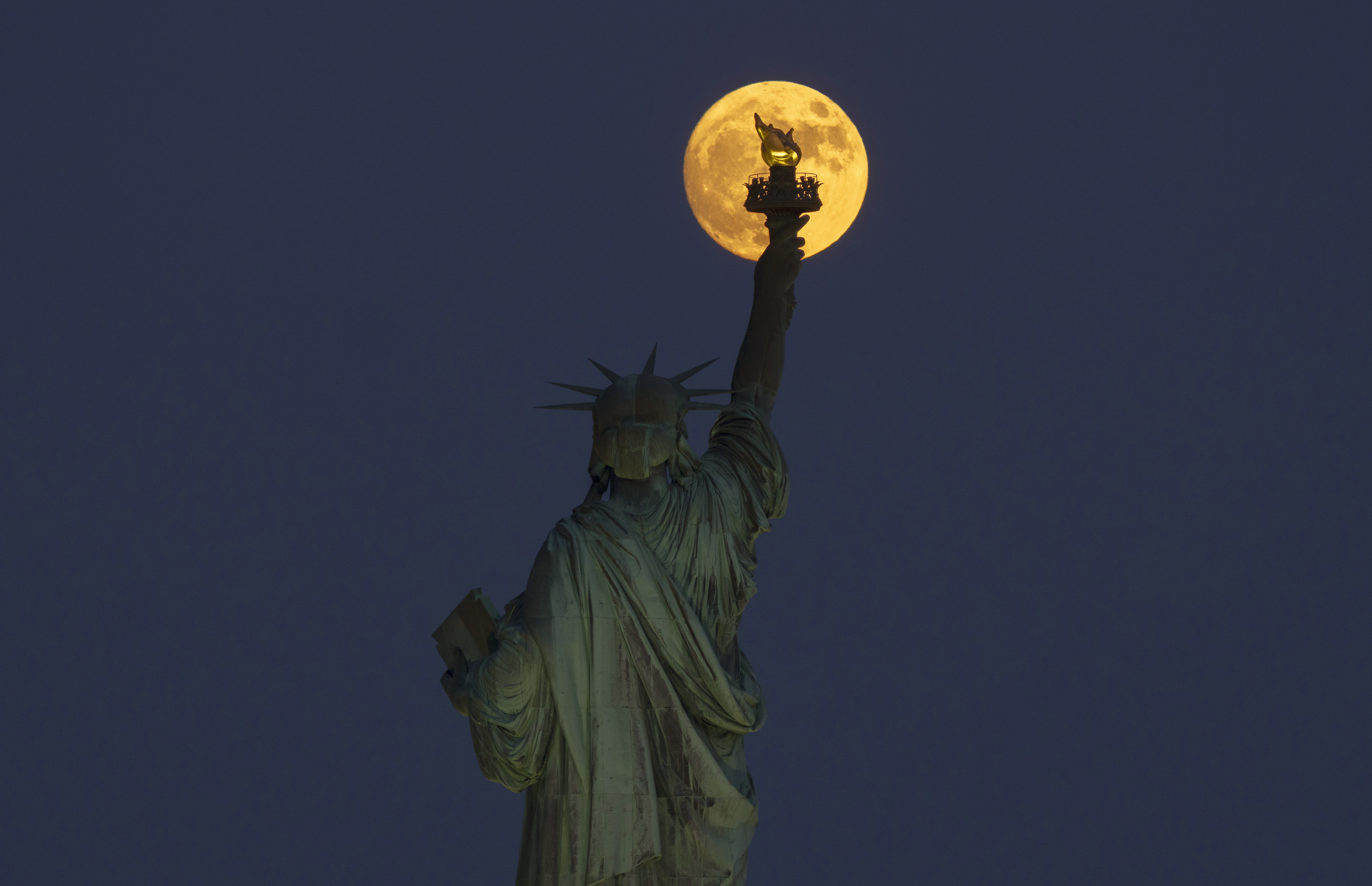
The Buck Moon is clocking in tonight, and she is not subtle. July’s full moon is strutting in as an Aquarius showstopper, hanging low and orange over the horizon while most of us are still answering one last email we should have ignored.
This is more than just another pretty celestial selfie backdrop. The Buck Moon on Wednesday, July 29 2026, is the second full moon of summer, landing two weeks before a total solar eclipse and stirring up big Aquarius-meets-Leo feelings. Think: how you show up for your people, how loudly you speak your truth, and what, exactly, is growing its own antlers in your life.
Quick Facts: Buck Moon 2026 At A Glance
- Peak fullness: Wednesday, July 29 2026 at about 10:36 a.m. EDT
- Best time to look: Moonrise tonight, shortly after your local sunset
- Direction: Low in the east to southeast, then climbing higher through the evening
- City anchors: About 8:33 p.m. in New York City, about 8:18 p.m. in Los Angeles
- Look: Big, yellow-orange at the horizon, whitening and shrinking as it rises
- Astrology: Full moon in Aquarius opposite the Sun in Leo
- Label check: Not a supermoon or a blood moon, just classic Buck Moon drama
When And Where To See The Buck Moon From The Us
Astronomers say the Buck Moon is technically full around 10:36 a.m. EDT, while it is tucked below the horizon for the US. But for us, the magic is tonight, as the full moon hauls itself over the eastern horizon right after sunset.
In New York City, the Buck Moon rises at roughly 8:33 p.m. In Los Angeles, it appears around 8:18 p.m. Most US cities will see moonrise within about an hour of local sunset, so if you can remember how to check a weather app, you can time your moon-viewing window.
Face east or southeast and give the moon a clean runway. Rooftops, beaches, lakesides, high balconies, or any place without a wall of glass towers work beautifully. The first half hour after moonrise is the most photogenic – the disk is low, colored, and framed by buildings or trees – but it will look bright and full all night to the naked eye.
Why July’s Full Moon Is Called The Buck Moon
In many Algonquin-speaking communities and other Indigenous traditions across what is now the northeastern US, July marked the time when young male deer showed off new, velvet-covered antlers. Settlers picked up the image, and “Buck Moon” stuck as shorthand for midsummer growth and muscle quietly taking shape.
Different cultures named this same moon for what mattered locally. Thunder Moon for electric summer storms. Hay Moon and Mead Moon for fields being cut and honey turning to drink. Herb or Wyrt Moon for backyard apothecaries in full swing. Salmon Moon or Raspberry Moon for rivers and hedges overflowing. None is more “correct” than another – they are all snapshots of July in different places.
What The Buck Moon Will Look Like Tonight
When the Buck Moon first lifts over the horizon, it will likely look oversized and tinted orange or amber. That color comes from Rayleigh scattering, the same atmospheric trick that gives us red sunsets: Earth’s air scatters shorter blue light and lets longer red and orange wavelengths slip through to your eyes.
The “giant moon” effect is mostly a mind game called the moon illusion. Your brain compares the low moon to buildings and trees and decides it is huge. Photograph it at the horizon, then again when it is high overhead; the image size barely changes, even though your inner drama queen swears it has.
This Buck Moon follows June’s Strawberry Moon and arrives two weeks before the total solar eclipse on August 12 2026, which the US will see as a partial eclipse, especially in the Northeast. The next act is the Sturgeon Moon on August 28, slipping into Earth’s shadow for a deep partial lunar eclipse. Think of tonight as the luminous opening scene of an intense late summer sky trilogy.
Spiritual and Astrological Meaning Of The Aquarius Buck Moon
Astrologically, this full moon lands in Aquarius, across the sky from the Sun in Leo. Leo rules the main character energy; Aquarius cares about the group project. Together, they ask where you are clinging to the spotlight and where you have been hiding your weird, brilliant ideas from the people who actually need them.
Jupiter in Leo turns the volume up on confidence and theatrics, so small dramas may feel larger than life. Uranus in Gemini stirs surprises around conversations, news, and technology. Neptune retrograde in Aries nudges you to revisit old dreams that once made your heart race, while Pluto retrograde in Aquarius digs into power dynamics in friend groups, teams, and online spaces. With the North Node in Aquarius and the South Node in Leo, the collective lesson is trading pure ego boosts for something that actually supports your community. Astrology is metaphor, not physics – but as a lens on mood, this one is sharp.