










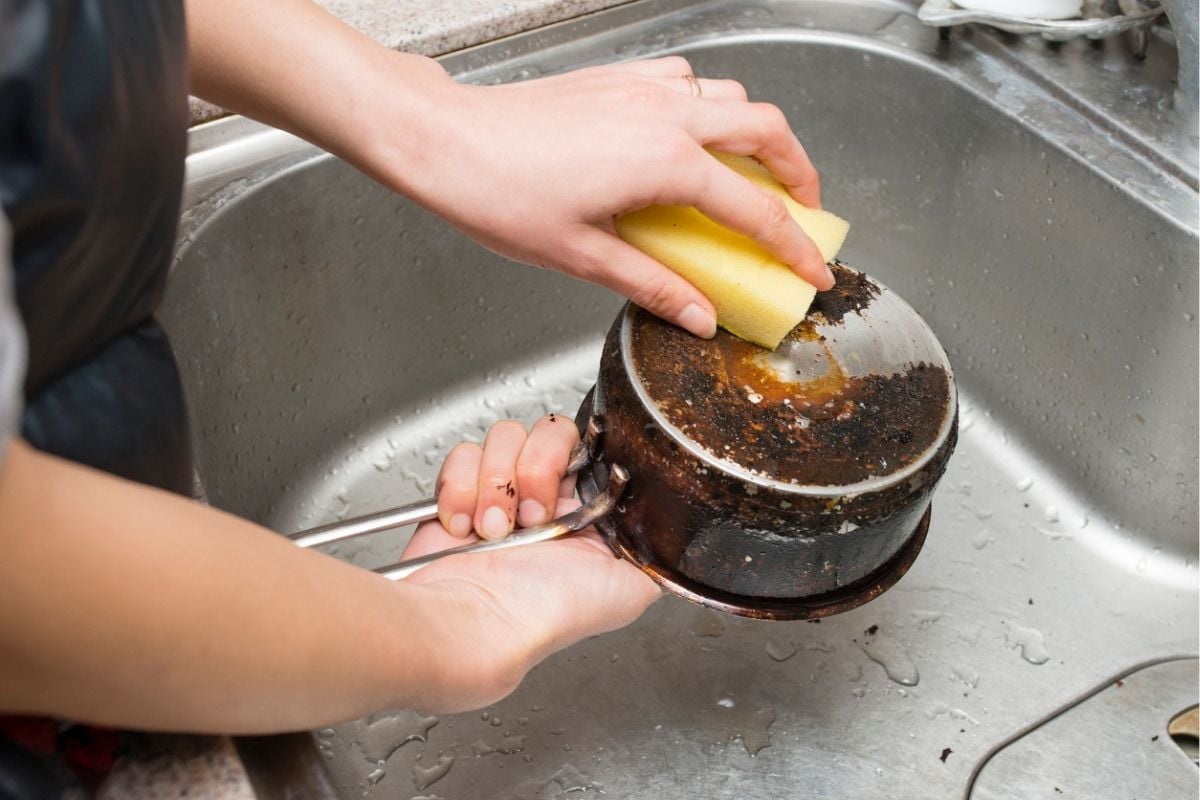
You stare at the blackened bottom of your favorite saucepan and feel that familiar sinking feeling. Scrubbing for twenty minutes straight barely made a dent. Tossing it in the trash crosses your mind, but something stops you – maybe it was expensive, maybe it was a gift, maybe you just hate waste. What if the fix was already sitting in your pantry, and all it needed was a little heat to unlock a surprisingly powerful chemical reaction?
What actually happens inside that crusty pot
At room temperature, baking soda – sodium bicarbonate – is a mildly alkaline white powder. Dissolved in water, it registers a pH of around 8.1, which makes it far gentler than washing soda. It is an anhydrous compound that has been used since antiquity and is available in several grades, including a so-called technical grade intended specifically for household cleaning. At this stage, it can handle light grime, but the charred, carbonized residue welded to the bottom of a scorched pan is another story entirely.
Once the water temperature climbs past roughly 40 °C, the baking soda granules dissolve more efficiently and greasy deposits become more fluid, already making the cleaning process easier. Push the heat further – around 50 °C and then all the way to boiling at 100 °C – and something more dramatic occurs. A portion of the sodium bicarbonate undergoes thermal decomposition, transforming into sodium carbonate, water, and carbon dioxide. That sodium carbonate is comparable to washing soda and carries a pH close to 11. At that alkalinity, it acts as a powerful degreaser capable of saponifying cooked-on fats and breaking apart carbonized deposits. In plain terms, the heat turns a gentle pantry staple into a serious cleaning agent right before your eyes.
Here is a detail worth remembering: the popular combo of white vinegar plus baking soda produces a satisfying fizz, but the acid in the vinegar actually neutralizes the base. That means the real cleaning power diminishes when you mix the two together. If your goal is degreasing, the boiling-water method on its own is the smarter play.
The step-by-step rescue for a scorched pan
We have all been there – a pot left on the burner a few minutes too long, the smell of something burning drifting through the entire kitchen. Recommended by the ADEME, France’s environmental agency, as a core ingredient for eco-friendly cleaning, baking soda becomes a surprisingly effective ally against baked-on grease and stubborn odors when it is heated.
To save a blackened bottom on a stainless-steel or enamel pot, cover the damaged area with 2 to 3 centimeters of water and add 2 to 3 tablespoons of baking soda. Bring the mixture to a gentle boil and let it simmer for 10 to 15 minutes. You will notice the charred patches beginning to lift and float to the surface almost on their own. Turn off the heat and let everything cool down to lukewarm – rushing this step with cold water could cause thermal shock. Then use a wooden spatula to scrape away whatever remains, and rinse. For extreme cases, some guides suggest letting the pan soak for an additional 20 to 30 minutes after boiling.
The technique works well on stainless-steel pots and pans, steel cookware, and certain enameled cast-iron pieces. Nonstick coatings, however, call for caution. Care instructions from brands like IKEA recommend using less baking soda, shortening the heating time, and avoiding any metal scrubber to prevent wearing down the coating.
Beyond the pan – a bay leaf spray and a cleaner drain
Once you have rescued your cookware, do not pour that hot bicarbonate water down the drain just yet – or rather, do exactly that. Pouring the still-warm alkaline water into the sink drain helps dissolve early-stage grease clogs, which fits neatly into the more sustainable cleaning approach promoted by the ADEME.
Another use that has been circulating widely on social media is a bay leaf deodorizing spray. Boil about 1 liter of water with roughly ten bay leaves for about ten minutes, then let the liquid cool to lukewarm and strain it. Stir in 2 tablespoons of baking soda, mix well, and transfer the solution into a spray bottle. This mildly alkaline, lightly scented mixture helps neutralize kitchen odors on non-porous surfaces such as stainless steel, tile, and laminate countertops. Avoid spraying it on marble, limestone, aluminum, or waxed wood, all of which are sensitive to alkaline products.
A few ground rules to keep things safe
A handful of simple precautions will save you from turning a clever hack into a kitchen mishap. Never let the water boil away completely, because an empty pot on a hot burner risks overheating the base. Skip the steel wool and metal scouring pads – they scratch stainless steel and destroy nonstick surfaces. And resist the temptation to dump vinegar into the same pot if your aim is to degrease, since the acid-base reaction cancels out much of the cleaning benefit.
It is also worth noting that baking soda, even when heated, is not a disinfectant on par with bleach. It is a simple, inexpensive household product that works remarkably well when properly dosed – and it should always be stored out of children’s reach. Now you know the chemistry behind your grandmother’s go-to trick, and the next time a pot turns black, you will reach for a spoon of white powder instead of the trash can.