










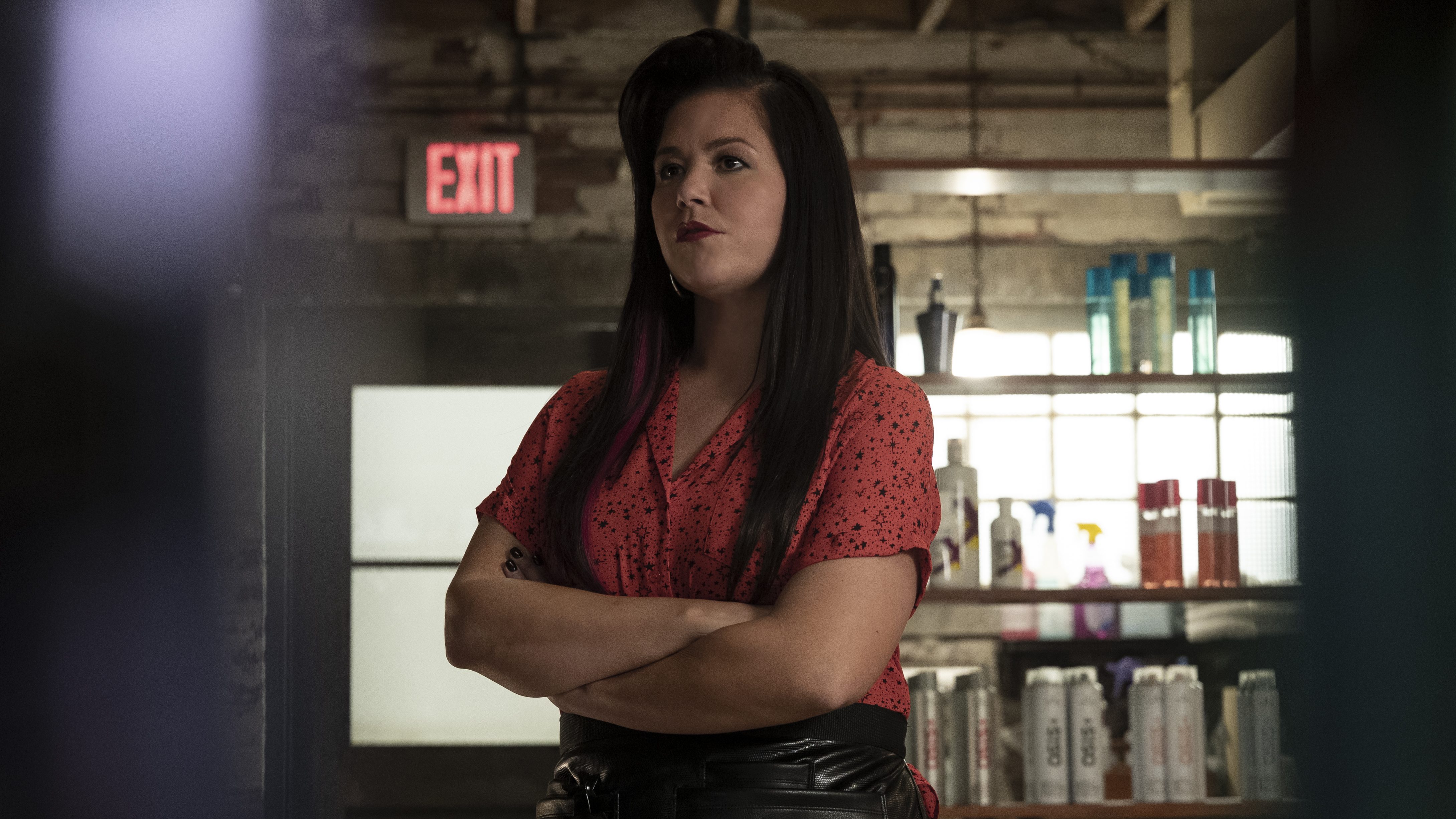
It’s always remarkable to talk to an actor who bears almost zero resemblance to their character. On AMC’s dark sitcom satire Kevin Can F**k Himself, Mary Hollis Inboden plays sullen, cynical tough girl Patty, the wisecracking foil to Annie Murphy’s type-A Allison. But Zooming in from a friend’s sunny LA garden, Inboden is the polar opposite of her character in almost every way. She’s as she is bubbly as she is thoughtful about the show’s complicated themes, ready to discuss thorny issues in her Arkansas twang.
“I was told by our brilliant dialect coach that I had the farthest to run,” she says of mastering Patty’s working-class Worcester accent.
On the show’s most recent episode, Patty’s world begins to fall apart. Kevin (Eric Petersen) banishes her from his group of friends, her boyfriend breaks up with her and her side hustle as a small time oxy dealer is beginning to catch up with her. Needless to say, Inboden had a lot to say about all of that.
The show is, of course, a satire of a certain type of
network sitcom. Does Patty have a sitcom analogue that you’re aware
of?
Carla from Cheers comes to mind—her relationship with
Diane specifically. She’s pretty biting and bitter. We’re talking
about a sitcom, we’re talking about sort of one-note people.
Tropes; the idea that you can only be one thing, and those things
never change because that’s what makes it so comfortable watching a
sitcom.
People have compared your performance to Rosie
O’Donnell. What do you make of that?
I’ve seen the Rosie O’Donnell comparison, and I’m completely
flattered by that. I didn’t think about it until I started working
on the accent, and in order to learn the accent I had to spend a
lot of time looking at myself in the mirror. And with this dark
hair, there’s a resemblance. I’m completely flattered. I think
Rosie O’Donnell is incredible and still has one of my favorite talk
shows of all time. But as long as we’re talking about it, Rosie
O’Donnell would absolutely be the one who plays Patty [on a
traditional sitcom], and she would be the one-note trope while
she’s capable of so much more.
So, what notes are being added to your character in the
scenes where she’s not in Kevin’s sitcom?
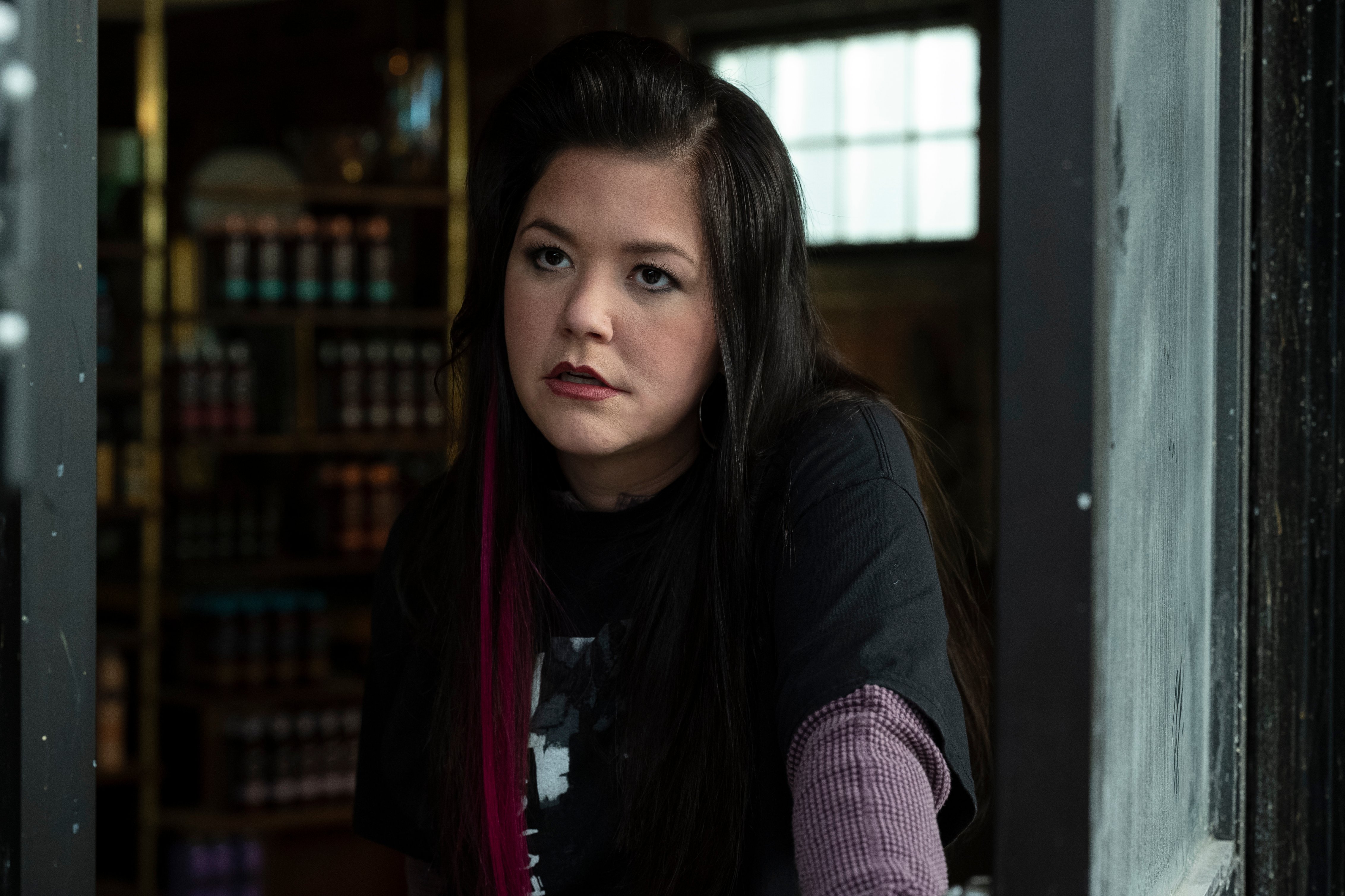
With Patty, there’s more than meets the eye. She’s such a hard
shell on the outside, but really, we’re starting to realize why.
And one of those reasons is, while she’s constantly hanging out
with the boys and throwing out her quips, she’s the member of the
club that’s attempted to keep her brother alive. When you
think about Neal and his antics, this is a man who suffers no
consequences, like Kevin, and Patty is the one who has to kind of
make sure that problems get solved. I’m sure Patty keeps the lights
on at their house next door. She’s the responsible one. So, when
the women are able to step outside of Kevin’s universe, you find
that [Patty’s] not really as tough as you would originally
think.
Why does she hang out with Kevin and
co.?
I think it’s a lack of choice, honestly. She doesn’t wanna make a
choice. It’s easy. They’re next door. She can sort of circulate
there and make fun rather than participate, and she doesn’t really
have to have an opinion about anything. She doesn’t want to be a
girl like Allison. What that means to her is—they’ve decided that
they have absolutely nothing in common, and really they do, because
they’re two women circulating in this world. Allison’s constantly
dreaming, and Patty is constantly pragmatic, and it’s not until
they step outside that they realize that Patty can be the
implementer of Allison’s dreams. And what a combo that is.
She has warmed to Allison over the past few episodes.
Why do you think that is? What does she see in Allison now that she
didn’t before?
Allison starts to make Patty think about a life beyond their two
houses. And we know now that Patty has this secret life that has
been fulfilling her that has nothing to do with Kevin. She keeps it
to herself because it’s illegal, but also it’s something that makes
her feel really good. Patty is dealing drugs and knows that that’s
wrong, but also comes at it from a place of just wanting to help
people out. You don’t see all the help that she provides [to Kevin
and Neal], and really what she’s doing is being a fly on the wall
just in case something goes wrong. When she steps outside, we
realize that she’s got all these secrets. And then Allison comes
along and she’s questioning Patty. You’re fine with things
always staying the same? Patty’s actually not. She just
doesn’t know a way out. Dreaming really scares a person like Patty.
Dreaming means you’re stepping outside yourself and where you
belong, and the shoe is always going to drop and it’s going to fall
on your head. This is a woman who has suffered a lot of
disappointments.
There’s a line in Episode 4, after Allison and Patty
have been stopped by the cops, Allison says to Patty, “You just
laughed at the way Kevin treated me for 10 years.” I feel like in
that moment Patty is a stand-in for the audience, especially when
she says, “It seemed harmless.”
It is, in fact, the thesis of the show. There’s one other line that
Patty has in the pilot that was always so important to us: “Don’t
tell Kevin I ratted him out. He got the mailwoman deported.” We
slide right over it, but if you think about the serious
implications of that… But the line that you’re talking about, when
Annie and I were performing that, I remember thinking, Oh, my
gosh! I’m changed. Mary Hollis won’t be able to watch one of
these shows again without realizing that in a white male led
sitcom, the butt of the joke most often is a female, a person of
color or a gay person. And when we know better, we need to do
better.
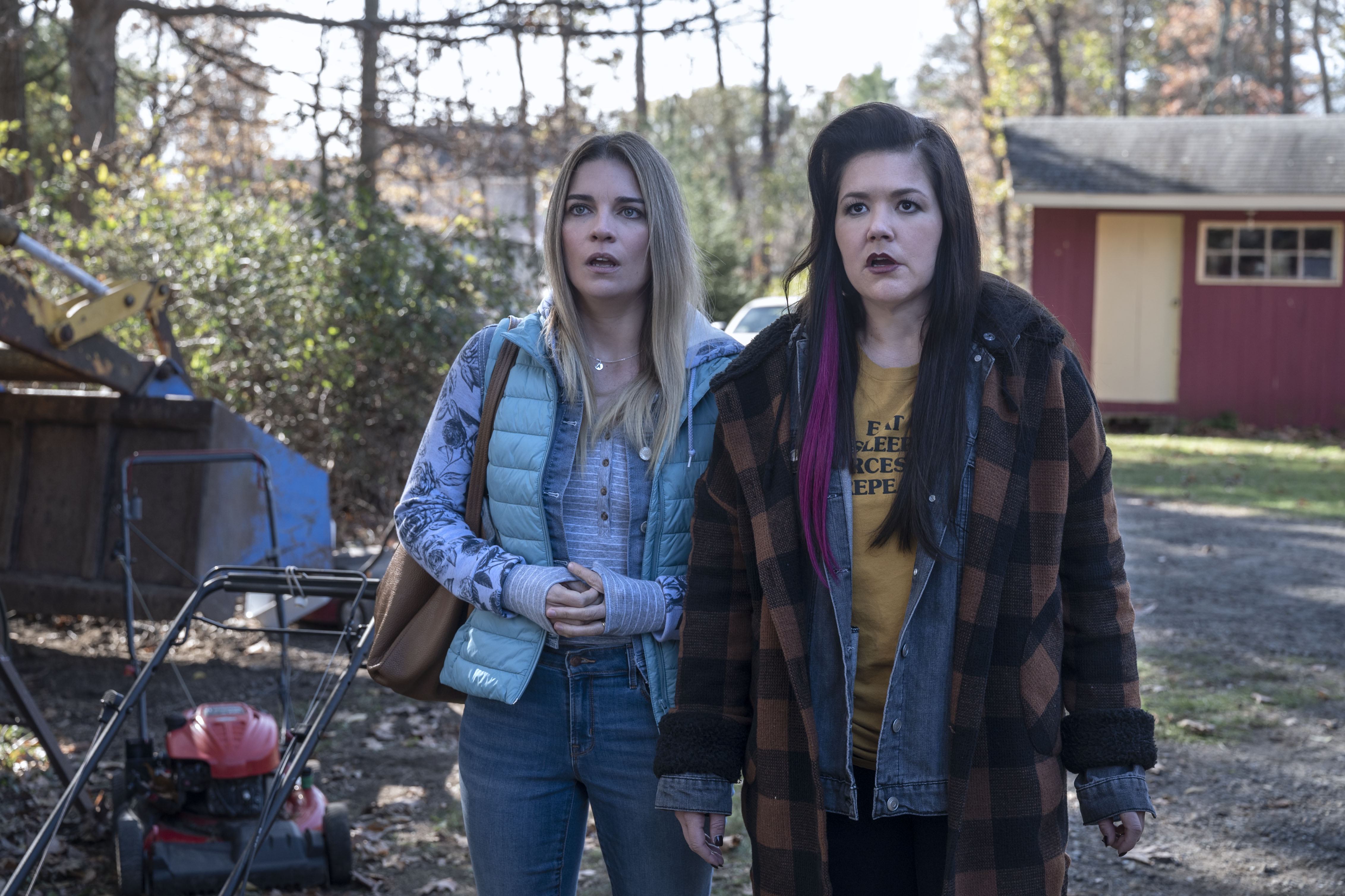
It’s interesting hearing you talk about Patty’s
caretaker side, which I hadn’t really thought about. But I wonder
now if that’s part of why Allison tells Patty about her plan to
kill Kevin—because she knows on some level that Patty won’t let her
do something so self-destructive.
I think Allison tells Patty that she’s gonna kill Kevin because at
that point, after we see Kevin be so incredibly toxic and actually
almost get Patty in trouble, they’re now in mutually
assured destruction territory. A lot of people ask us, you know,
Why not just leave him? Kevin, if we ever got to meet him
in the single-cam scenes, is an abusive person. He is somebody who
would not actually let her leave. And how does she leave? With $194
in her pocket? I think in that mode, Patty is able to be like,
Ok, I’ll help you.
We talked earlier about thinking about the mailwoman
joke, and there’s something similar in this most recent episode.
Kevin kicks Patty out of their group and replaces her with “New
Paddy.” That’s kind of a familiar sitcom storyline, but when you
think about it, Kevin has told this woman that she’s replaceable,
that her friendship means nothing to him.
Completely and quickly and in front of her, and we’re all laughing
at it. And I want to be clear: sitcoms have a place. They’ve been
around forever and I don’t think they need to go away! Those can be
beneficial, especially in a stressful world.
But it’s worth reconsidering whose perspective these
jokes come from and what messages are being put out
there.
That’s right. Because for years and years, those writers rooms were
made up of one type of person: white older gentlemen. I’m not on
the attack about that. But we need many voices and we need
representation.

Is there a vibe between Patty and Detective Ridgeway?
What’s going on there?
There is a vibe. But I think Patty is so scared that Detective
Ridgeway is sniffing around—Detective Ridgeway might have a vibe,
but at this point it’s safe to say that Patty is like, I have
to do whatever you say so that I avoid trouble for me and my
friend. There’s this tension, you’re not sure where this is
gonna go. I think Patty’s sexuality, by Episode 5, we’re curious,
we’re opening things up. Her boyfriend has broken up with her, so
it’s leading her to ask a lot of questions of herself. That’s one
thing that I really love about Patty. Again, in the multi-cam
[scenes] you would never explore that. Her sexuality becomes so
important to the single-cam world, really becoming the person that
she wants to be instead of this sardonic trope.
I want to go back to something you said earlier about
what Kevin would be like if we ever saw him in the single-cam
scenes. I think I took it for granted that we never would, so I
hadn’t thought about what he might be like outside of that sitcom
version of reality. But in reality, that character could
potentially be kinda scary.
So, I had a different take on it than Valerie Armstrong did. I
thought these were men who would be, like, sexually assaulting
people. And I think it’s actually far more powerful to think of
these men as… Neal for instance: he somehow avoids paying his
taxes. He is constantly up to shenanigans that put our house in
danger. Kevin, I feel like he’s a really controlling and
manipulative guy who gets what he wants.
Right, he doesn’t have to be literally physically
abusive to affect the people around him in profoundly hurtful
way.
Sure. Or even a thing where a woman is talking about her
Me Too experience, and instead of getting the space to talk
about that experience, the Kevin in the room will stand up and tell
her what that experience was. I guess my first take on Kevin in the
outside world was that he was incredibly abusive. Valerie’s was,
yes, he’s controlling and manipulative, but he’s a guy that
everybody will still be around because he’s very fun and he’s
charming. He’s very well-liked.


