










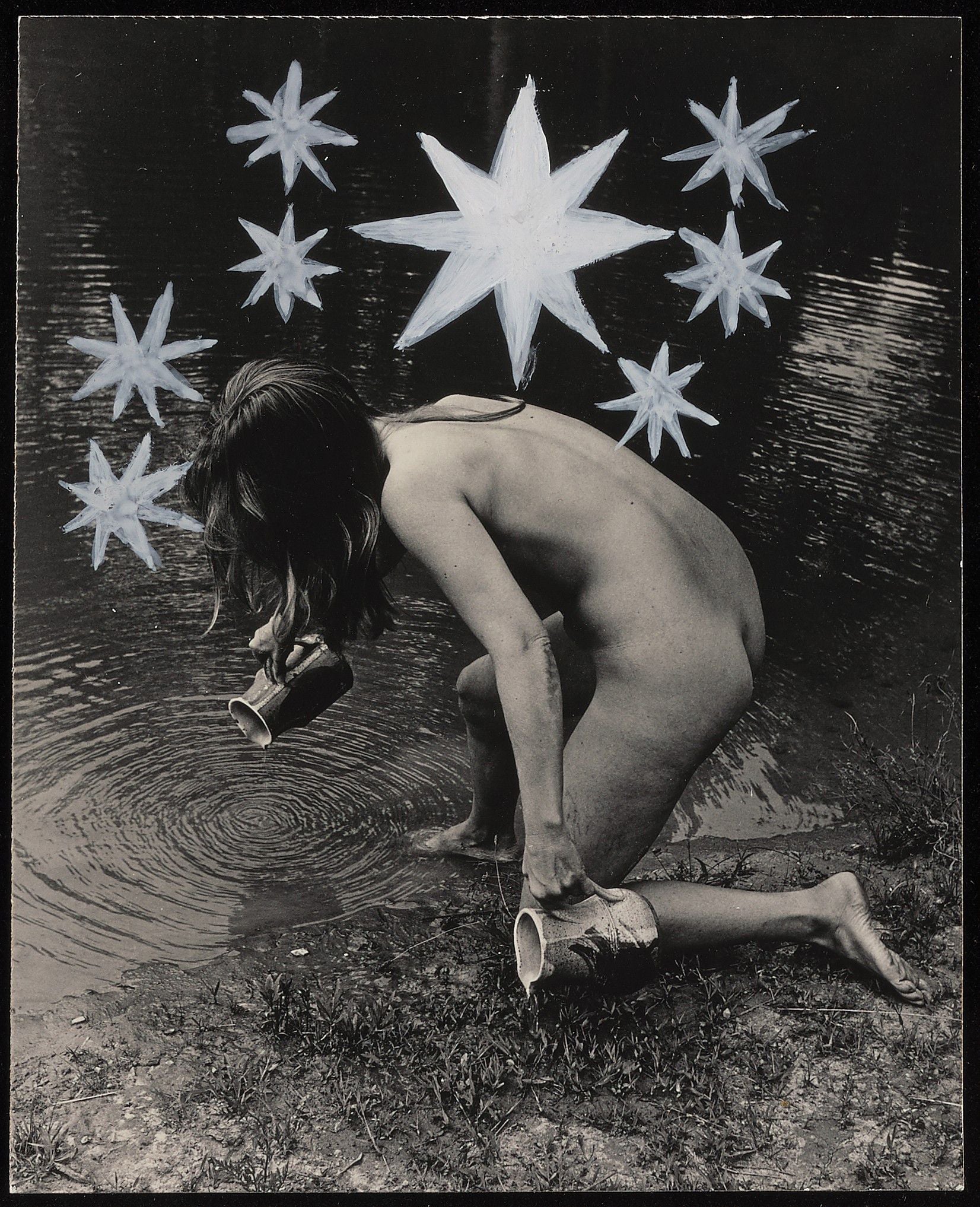
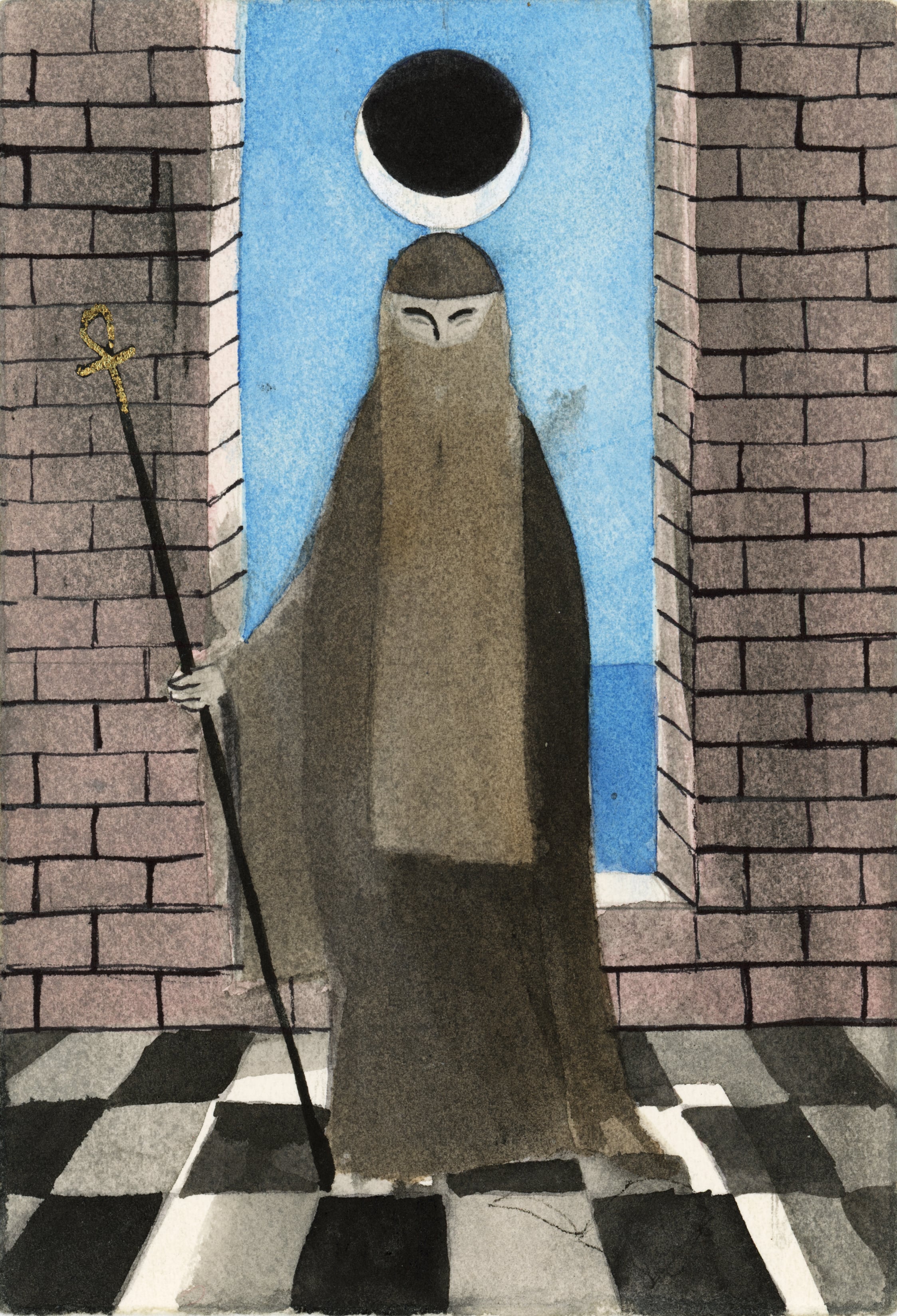
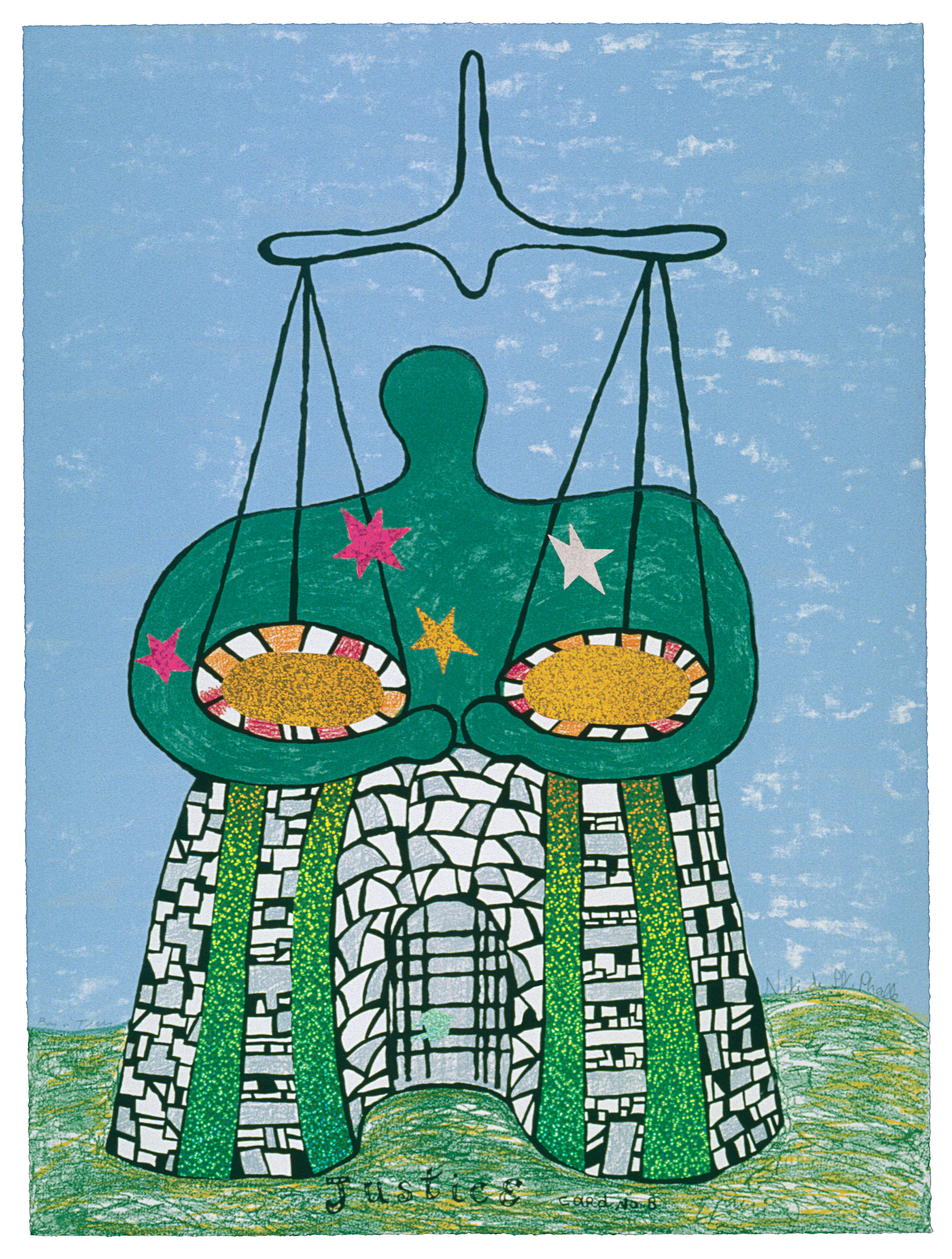
“Oh my god, Mom, look. These cards are from 1456,” a wide-eyed teenager exclaims, steadying the phone she’s clutching to snap a picture of a delicate gold-and-silver-leafed Queen of Swords gleaming from behind a glass case at the Morgan Library and Museum in New York. The card, which hadn’t been shuffled by human hands in centuries, was part of the Visconti-Sforza deck on display in an exhibit that traced tarot’s enigmatic history and showcased some of the artists, from Leonora Carrington to Dorothy Iannone to Chris Ofili to Kim Krans, who have found creative inspiration in the cards. In the first room, Renaissance Symbols, rarely-seen decks like the Visconti-Sforza and Sola Busca from the 15th century and the iconic Rider-Waite-Smith from 1909, dazzle alongside other ancient treasures like an intricately illustrated prayer book by Michelino da Besozzo, a prominent court artist commissioned to create a lavish deck for a duke in Milan in the early 1400s; a colorful zodiac diagram from the deluxe version of a popular 1425 Austrian textbook; or a “Wheel of Fortune” from Naples circa 1510 advertising the services of Renaissance astrologer Luca Gaurico. For curator Claire Gilman, who has tracked tarot imagery in art for years, the exhibit’s second room, Modern Visions, offered her a forum to tell the story of tarot from the British occult revival to Surrealism to the U.S. in the ‘60s and ‘70s, up to its contemporary moment in a way that felt comprehensible and complete. A bridge between tarot’s ancient symbolism and its modern interpretations.
Tarot dates back 400 years, and it started as a game for Renaissance-era nobility. “In its origin it was a higher-level card game like bridge, and while, even in the Renaissance, there were definitely occult associations with the cards, it was not a divinatory practice until later,” says Gilman. In the 1700s, tarot would evolve from high-brow amusement to a tool of prognostication, its decks (which are made up of 78 cards, divided into the Major and Minor Arcana) studied and read to gain insights into the past, present, and future. The designs of the decks have evolved over the years, often serving as a time capsule of the decade in which they were made, but their intention hasn’t.
Centuries later, the most dramatic shift may be tarot’s audience. Take the Bravo-verse. Tarot readings have served as plot points on the Real Housewives of Salt Lake City and Orange County, Vanderpump Rules, and Southern Charm. Don’t know what show to binge next? Netflix created a “tarot TV guide” to predict your streaming future. There are tarot-themed coloring books for sale at Target, and you can get your cards read while shopping at Selfridges. Jonathan Anderson and Gabriela Hearst have looked to the tarot for both personal and design guidance, and, in 2021, Maria Grazia Chiuri famously transformed the 22 archetypes of the Major Arcana into haute couture for Dior. Chanel’s Les Tarots makeup collection featured two “mysterious” shades of blush, while Hermès branded its own silver-edged tarot deck (which comes, naturally, in its signature orange box). In fact, nowadays, there’s a deck to suit any interest: a pasta tarot, a Jane Austen tarot, a Buffy the Vampire Slayer tarot, a Disney villains tarot, a Marvel tarot, a Taylor Swift tarot, and the list goes on and on.
Tarot is one part, along with witchcraft, crystals, and astrology, of a larger mystical groundswell. Kendra Scott is selling healing stones, Urban Outfitters has a crystal starter kit, and Hot Topic’s witchcore includes a cosmic aura gothic witch ring set and celestial lace maxi skirt. “An object can be incredibly powerful because it gives intention to a physical form, but there is a difference between buying from an actual practitioner and buying from a company that has simply noticed that moons, crystals and evil eyes are selling,” says Corbin Chamberlin, an intuitive and founder of Sage & Salt. “The other danger is the suggestion that you can purchase your way out of doing any actual work.”
While healing isn’t something to be bought at the mall, that these practices are even surfacing there is indicative of how widespread collective interest is. According to Spate, an AI-powered trend forecasting platform, vision boards, numerology (or life path numbers), astrology, and birth charts are surging in popularity. That’s in part because witches and astrologers have found a vast new audience via our Instagram feeds. Having a shaman or healer, personal energy coach or spiritual guide may have once been considered outre; now, not so much. People are simply more open to this kind of work than they were even 10 years ago, says Anna Toonk, who has been offering tarot and Akashic record readings and creative consultations since 2016. “When I started reading professionally, it was still wacky and outside convention,” adds Toonk. Chamberlin, who has been called everything from an intuitive strategist to a witch to a psychic, has lately embraced the title of energetic butler. “I read the energy around a situation,” says Chamberlin, adding that sometimes that involves tarot, clearing a space, creating a ritual, or just telling someone what they already know but have spent six months trying to talk themselves out of. “People imagine me as a witch arriving in a cloud of smoke, but a lot of my job is extremely practical.” He’s cleared houses in the Hamptons, private planes, and some very fabulous closets, but also helped business clients look at the timing of a deal, the people involved and the motivations behind a decision. Most often, people are turning to these practices when things aren’t going as planned, says Toonk. “Very rarely are they like, ‘My life’s amazing, let me seek out spirituality,’” she adds.
Social media has been a double-edged sword for these spiritual practices: It can quickly disseminate information and ideas, but it can also oversimplify or misrepresent them. Same goes for the language that has become associated with it all: a decade ago, manifesting, grounding, vibes, and intention were not part of the popular lexicon, now they’re a hashtag. In her new solo off-Broadway show Broad Strokes, comedian Cat Cohen asks, jokingly, whether she should be learning how to manifest from an influencer with noticeable filler on TikTok? “Manifestation and intuition may have become the Uggs of spirituality,” says Toonk, who believes people should know these words, but also do their due diligence and find out what they mean.
Giorgia Pecora, an astrologer, writer, and teacher, is quick to eyeroll at the buzzwords but is interested in why this vocabulary has become normalized. “I think some very old human needs simply found a new language,” says Pecora. While ideas around ritual, meaning, intuition, and transcendence were long relegated to religion or other traditional institutions, she adds, as more people no longer relate to those structures, the need hasn’t disappeared but rather migrated towards spirituality, astrology, meditation and manifestation. “Social media accelerated that because it collapsed the distance between niche subcultures and mainstream culture,” says Pecora. “Twenty years ago, you might have had to actively seek out an occult bookshop to encounter some of these ideas, while now a video about ‘protecting your energy’ appears between a recipe and a celebrity interview.”
There’s a reason why this mystical wave happens to be surging right now. Part of it is how perpetually online we find ourselves. “The more digital our lives become, the more desperate we are to touch something real,” says Chamberlin, adding that some of the tactile parts of these practices give the body an experience that cannot be scrolled through in three seconds and forgotten. It’s why words like “grounding,” says Pecora, have become so relatable. “We spend so much time online, in our heads, consuming information, and scrolling, that modern life has become incredibly disembodied,” adds Pecora. Then there’s the declining participation in organized religion in the West, which may indicate a loss of faith in the church’s authority, but not a loss of spirituality. According to Google, searches for “how to be spiritual” hit a 15-year high in 2026. “We still want to believe that our life belongs to some kind of larger pattern, and we want rituals, meaning, symbols, timing, and something that helps us place suffering and change inside a bigger story,” says Pecora.
Historically, religion used to fill much of that void, but increasingly astrology, tarot, and other spiritual practices have begun to occupy that space. “Astrology is especially powerful because it gives you a cosmology without necessarily asking you to belong to an institution, follow a doctrine or believe in a single authority, and that fits very well with the way people live now where spirituality has become more self-directed,” says Pecora. “Astrology has this strange ability to make you feel both individual and connected to something much larger than yourself.” And that kind of connection is vitally important right now as we live through a period of ongoing political unrest, economic uncertainty, social change, and rising distrust in government and institutions. “When people feel they have less control over the world around them, they start looking for ways to understand it and regain some personal agency,” says Chamberlin.
Tarot and astrology have become a way to connect and feel a sense of belonging, but also a means of reclaiming power and direction at a time when we feel collectively unmoored. But can these ancient practices align with our increasingly digital future and the growing use of AI? While artificial intelligence will likely become infinitely more adept at combing through and interpreting astrologic and symbolic information, says Pecora, a digital reading can’t replace human intuition or the relational part of this work. Much like relying on Chat GPT as your therapist, adds Toonk, asking it for a 12-card reading completely misses the human variable. And that’s where the real magic lies.
Those who are still dismissive of astrology or intuition, says Pecora, should consider how shaped their daily lives are by magic algorithms that have captured and monetized their attention while making them believe their wants and needs aren’t served up but spontaneous. “We are more technologically connected than ever and yet incredibly disconnected from our bodies, our own rhythms, and from the ability to be bored long enough to hear ourselves think, and part of the attraction to astrology, tarot, and ritual is a countermovement to that, a desire to recover some sense of interiority,” says Pecora. It’s why these ancient practices are experiencing a distinctly modern-day buzz, even though they may run totally counter to our current optimization culture. “They’re effective, they’ve been around for hundreds of years, but they’re not sexy, and they’re not fast,” says Toonk. “It’s interesting to see people not fighting that but embracing it.”
Gilman and her colleagues at the Morgan knew the tarot show would be popular, but they never dreamed of it attracting as many visitors, attention, and goodwill as it did. “So many people reached out to express their gratitude and said they had been waiting for this show their whole life,” Gilman shares. The exhibit, much like the experience of tarot itself, feels like the ultimate antidote to the endless scroll. A chance to pause, wonder, reflect. “Tarot gives people something they rarely have anymore,” says Chamberlin, “a moment to stop.”