










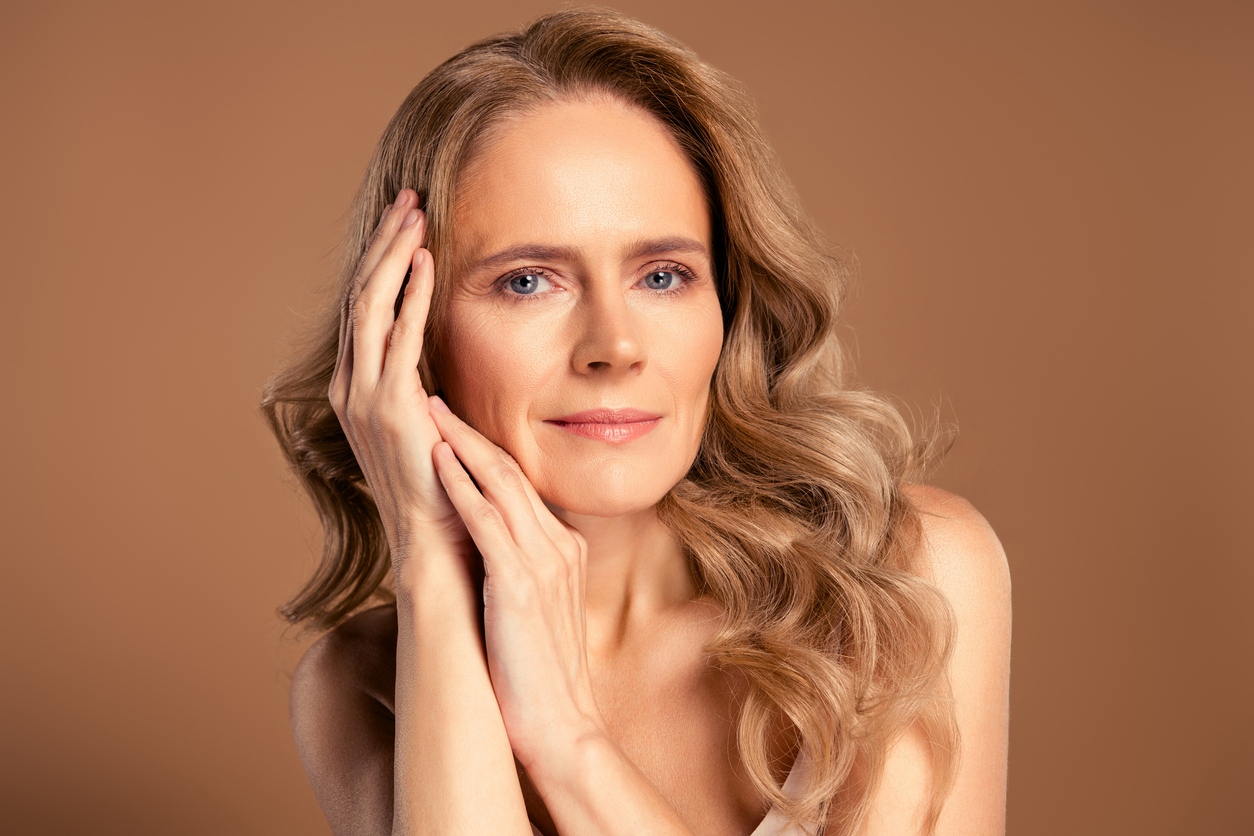
You probably have a ten-step routine for your face. Serums, retinoids, SPF – the works. You track every new fine line the way a meteorologist tracks a storm. But when was the last time you gave your hair that same level of attention? Most of us invest serious money in anti-aging skincare without ever considering that the strands on our heads are quietly going through the exact same process. The truth is, what works for your complexion at 25 will not cut it at 45 – and the same principle applies above your forehead.
Why your strands lose their edge over time
Hairstylist Courtney Foster puts it plainly: hair, nails and skin are all made up of the same components, yet when we think about anti-aging, skin is the only thing that comes to mind. We simply do not consider that hair is aging right alongside it. And stylists across the board agree on the visible signs – as the years pass, hair tends to lose shine, elasticity and volume.
So what is actually happening? Dullness creeps in, strands become more brittle and thinning can accelerate. According to Amy Abramite, creative director, salon educator and stylist at Maxine Salon, aging hair is especially prone to looking lackluster. She notes that formulas containing lactic acid – an exfoliant that lifts dulling residue – paired with vitamins and minerals can help nourish strands that have lost their luster. Meanwhile, Salon 120 West hairstylist Kasey Bertucci points to the Olaplex line as a strong option for tackling dullness as well as brittleness and breakage, because it helps restore protein to the hair shaft.
But before you fill a cart with every product that promises to turn back the clock, multiple pros suggest looking inward first. Could the real culprit be something far simpler than your shampoo?
The lifestyle habits that matter more than you think
Bertucci recommends starting with hydration: a little over 11 cups of water per day, according to the U.S. National Academies of Sciences, Engineering and Medicine. She also stresses sleep – between seven to nine hours each night, per the National Sleep Foundation – as a way to reduce stress-induced hair loss. These two basics alone can make a measurable difference before a single product touches your head.
Then there is what happens while you sleep. Rita Sanders, owner and stylist at Tousled Hair Salon in Jersey City, New Jersey, suggests treating your nighttime hair care with the same seriousness you bring to your evening skincare. Her recommendation is refreshingly low-tech: switch to a satin pillowcase. The reduced friction prevents hair from knotting, tangling or drying out overnight from whatever products you applied earlier in the day.
Over-washing is another quiet saboteur. Bertucci warns that shampooing or brushing excessively can lead to excess hair loss. Abramite echoes that sentiment, advising people to shampoo only as often as necessary and to choose products designed for their specific hair type – ideally ones free of silicones and waxes, which cause buildup rather than removing it. And every stylist interviewed circled back to one non-negotiable: scalp health. As Foster puts it, when your scalp is healthy, your overall hair is healthy.
What the pros actually reach for – and why
When it comes to specific product categories, the experts have clear favorites. For thinning hair, shampoos formulated with biotin and hyaluronic acid offer an affordable entry point. Foster is a fan of the Alterna line for mature hair care, noting that the brand shares the philosophy that hair ages just as skin does. She highlights its use of vitamins A and C, which target brittleness and moisture loss, and she recommends the matching conditioner to complete the routine.
Volume is another major concern. New York City-based hairstylist Jasmine Burnside favors an Oribe texturizing spray for creating the appearance of fullness, describing it as delivering real grit and texture you can feel. She also relies on a Bumble and Bumble pre-styling spray applied to damp, clean hair before using heat tools. For a non-aerosol option, powder sprays applied 4 to 6 inches from the root in sections can add major body without stiff or sticky residue – just start with one pump and build from there.
Abramite highlights a Kerastase mousse as a softer alternative that will not weigh hair down or leave it crunchy, and she pairs the brand’s Initialiste serum with its Densifique shampoo and conditioner for a regimen that prevents breakage while deep-cleaning buildup. She also recommends a non-greasy Kerastase scalp and hair serum with a milkier consistency that plumps strands, reduces breakage and leaves hair feeling softer, shinier and thicker. She suggests applying it on stressed or recessed areas and finishing the styling process with a bit of heat.
For those dealing with hair growth concerns, Bertucci turns to a treatment line formulated with mint, capsicum and botanical extracts that is designed to stimulate new growth when massaged into the scalp twice a day. And if shine is the primary goal, Sanders recommends a lighter serum – such as a sesame oil – that sits on top of the hair to add luminosity without heaviness.
The real takeaway for your routine
What all of these experts make clear is that anti-aging hair care is not a single product purchase – it is a shift in mindset. The same intentional, layered approach we bring to skincare belongs in our hair routines too. Hydration, sleep, scalp care and targeted formulas with ingredients like biotin, lactic acid, vitamins A and C, and protein-restoring compounds can collectively slow down and even counteract the visible effects of time on your hair. You already know how to invest in your skin. Now you have the playbook for everything above it.


