











Thirteen of the world’s leading happiness researchers logged on to a Zoom call, pooling roughly 600 years of combined experience in studying human wellbeing. Their reflections just landed in the Journal of Happiness Studies, and their answer to what really makes life feel good is disarmingly simple.
What Researching 600 Year Happiness Has Taught Scientists
The new paper, charmingly titled “Reflections on the Past, Present, and Future of Well-Being Science from Several of Its Pioneers,” is not a single big experiment. It is a roundtable of people who helped build the field itself, including co-editors of the World Happiness Report and architects of how governments, from the OECD to small municipalities, now measure life satisfaction.
Around the virtual table were names like Jan-Emmanuel De Neve of the Wellbeing Research Centre at the University of Oxford and Richard Layard from the London School of Economics’ Well-Being Programme, alongside social psychologist Lara Aknin from Simon Fraser University. These are the people whose graphs end up in policy briefings and self-help books alike.
As Trestlewire and other commentators have pointed out, this is a reflective essay, not stone tablet data. The pioneers debate old models, acknowledge criticisms, and still circle back to a theme that has stubbornly survived every methodological food fight: who you spend your time with, and how, matters more than almost anything else.
Relationships: The Secret To A Happy Life
Across cultures, income brackets, and personality types, relationships keep showing up as the strongest, most reliable predictor of happiness. Aknin and colleagues point out that having even one person you can truly count on is “extremely consequential” for wellbeing, and each additional community you feel part of seems to stack the benefits.
The famous Harvard Study of Adult Development, which has followed people for more than eight decades, found that warm, dependable relationships predict life satisfaction and physical health better than social class, IQ, or cholesterol levels. De Neve’s own research links something as humble as sharing a meal to higher happiness and lower stress, with this pattern appearing in every country they looked at. Brief, positive interactions with strangers and small acts of connection also nudge our mood in measurable ways.
This all lands in a very specific US moment. The US Surgeon General’s 2023 advisory on loneliness reported that roughly half of adults experience measurable loneliness, which is associated with about a 30 percent higher risk of premature death, comparable to smoking around 15 cigarettes a day. Put bluntly: it is not the Peloton or the promotion that keeps you alive and reasonably content. It is the group chat that actually meets up.
How Much Of Your Happiness Is Under Your Control
If you have seen the “happiness pie” on Instagram, this is where it comes from. An influential 2005 paper by Sonja Lyubomirsky, Kennon Sheldon, and David Schkade proposed that roughly 50 percent of differences in happiness between people could be linked to genetics, about 10 percent to life circumstances, and up to 40 percent to what they called volitional activities –– how you choose to spend your time.
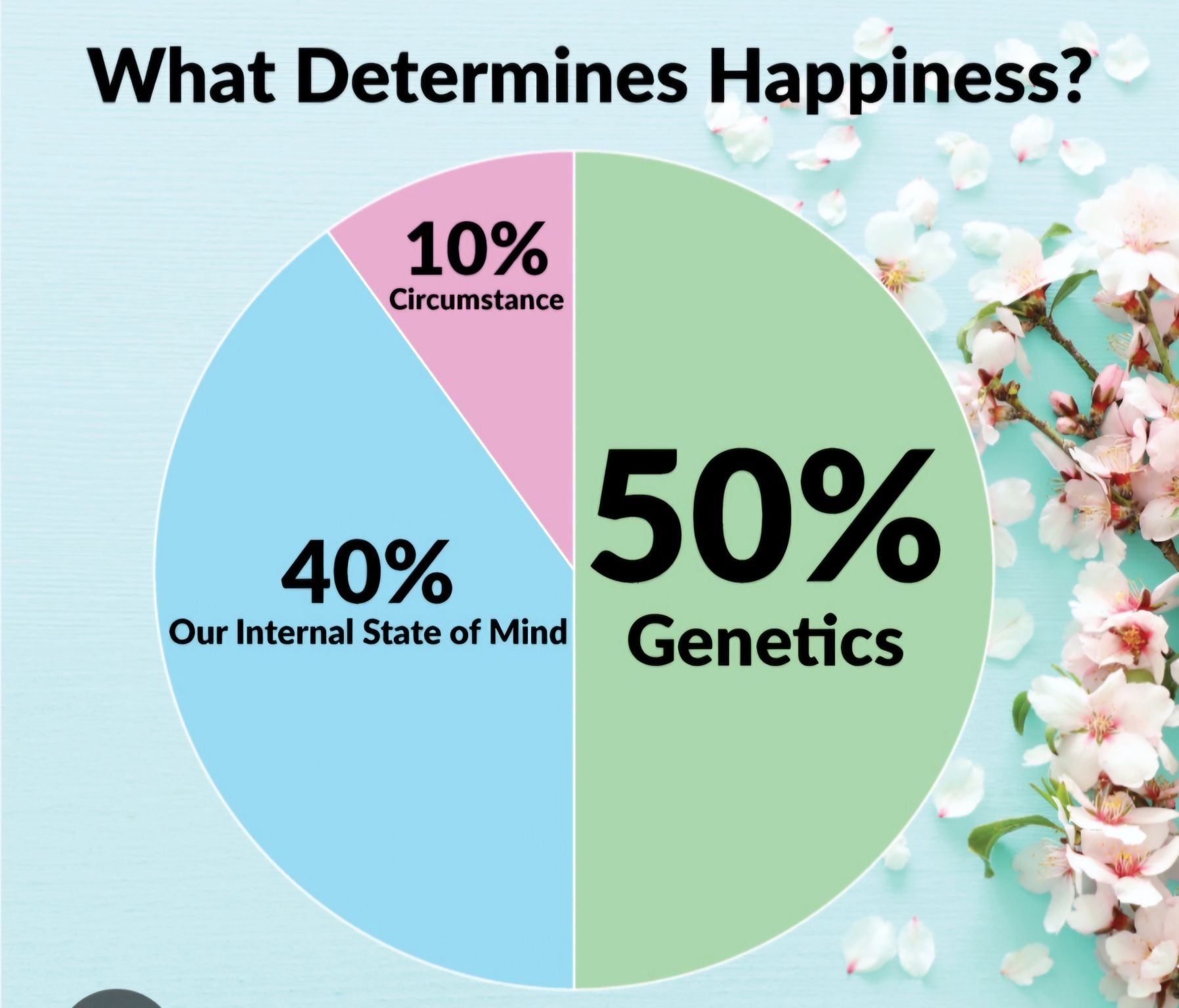
The new 2026 reflections nod to this idea while also acknowledging the backlash. Researchers like Brown and Rohrer have argued that those exact percentages are on shaky statistical ground and that carving human lives into neat slices risks overselling personal control. The pioneers largely agree: do not treat 40 percent as a magic number, but do not ignore the clear evidence that habits and daily activities matter a lot.
When the group looks across hundreds of studies, they estimate that circumstances such as where you live, your age, or relationship status explain only around 10 percent of happiness. Around 40 percent seems tied to what you actually do with your hours: nurturing relationships, engaging in meaningful work, practicing gratitude, savoring small joys, volunteering, listening more deeply. Many of the scientists admit they have rearranged their own calendars accordingly, protecting time for spouses and friends and saying yes more often to prosocial activities.


