










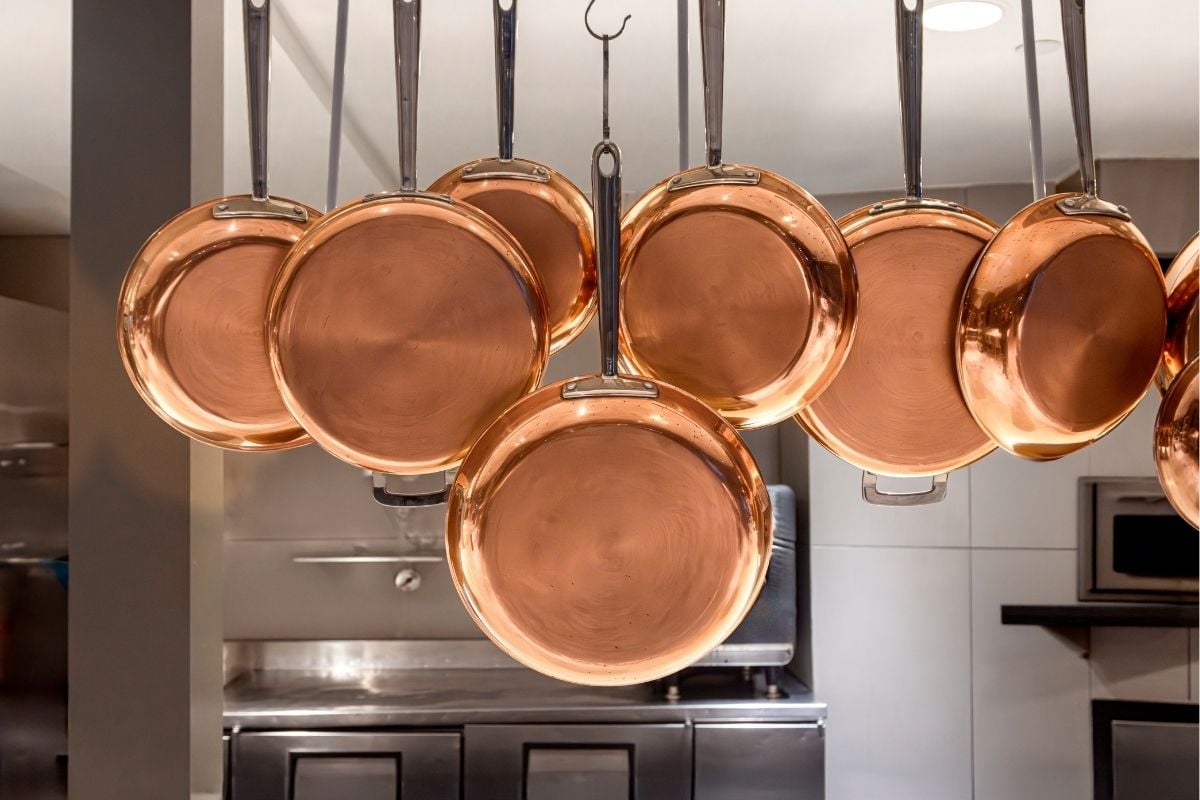
A gleaming copper bottom, a little dust and a price tag that hasn’t caught up with its reputation. Every thrift store has a shelf of tired pots that nobody looks at twice. Most of them deserve it. A few, though, were made to last for generations, and the people who know cookware can spot them from across the aisle.
The one they look for first is Revere Ware. Launched in 1939 by the Revere Copper and Brass Corporation in Rome, New York, the line paired stainless steel pots with a bright copper-clad bottom that spread heat evenly. It became a fixture of American kitchens for decades, and it still turns up secondhand, where it can sometimes be found for around $10 to $20 a piece.
Why the Year 1968 Matters So Much
Not all Revere Ware is equal, and collectors draw the line at 1968. That year, the copper cladding and the stainless steel walls were made thinner, and the Bakelite handles went from two pieces to one. The pots kept working, but the older ones are heavier, sturdier and more prized.
Revere had patented its copper-cladding process in 1942. Pieces made between 1939 and 1946 carry a “Pat. Pend.” stamp, while those from 1946 to 1968 say “Made Under Process Patent.” After 1968, the patent wording disappeared.
The Mark Collectors Look For
Turn the pot over. The pieces collectors want show a “double ring” trademark: two circles framing a profile of Paul Revere, with “Copper Clad” and “Stainless Steel” inside the rings and the patent wording below. The 1968 redesign dropped the double ring, so a single simplified logo signals a later piece.
Location can help too. Early pieces from Rome, New York, usually carry no place of manufacture at all, while marks such as “Clinton, IL” or “Riverside, CA” point to the factories that opened later. That is a lot of history stamped into one small circle of copper.
What to Check Before You Buy
Start with the base. It should sit flat on a counter without rocking, and the copper should not be separating from the pan. Next, the handle: it should be tight, with no cracks. Don’t worry about dark or dull copper, because tarnish is normal and usually polishes off. One solid saucepan is a better buy than a full set with problems. And once it is home, keep it shining with the same pantry logic as this grandma trick for burnt pans. The lesson worth borrowing is to judge the stamp before the shine.
A Brand That Keeps Coming Back
Revere Ware changed hands several times. It belonged to Corning by 1985, became part of World Kitchen in 1998 and had stopped production by 2018. In 2023, the brand was bought again with plans to revive it. Meanwhile, the original pans keep doing their job in thousands of kitchens, which is the best argument for buying old things that were built well, much like the chairs Julianne Moore bought in Paris in 1995.
The Bottom Line
This 1939 copper-bottom pan still turns up at thrift stores, and collectors know exactly which mark to look for: the double ring with Paul Revere’s profile, found on pieces made before 1968. Flip the pot over before you walk past it.


