










Psychologists
reveal how choosing a paper calendar over your phone reshapes
memory, motivation and planning – and what that says about your
personality.
Your calendar habits say more about you than your star sign ever will. Picture this: it is the first of the month, your boss just dropped a product launch date, your best friend texted about a girls’ trip, and you reach either for your phone or for that satisfyingly weighty wall calendar on the fridge.
To some, the paper option screams “grandma energy.” To psychologists, it signals something entirely different. A growing stack of research suggests people who write things down in a paper calendar instead of relying only on their phone are not just being cute or nostalgic – they are using a different mental processing style altogether. Welcome to the quietly loaded world of paper calendar vs phone calendar psychology.
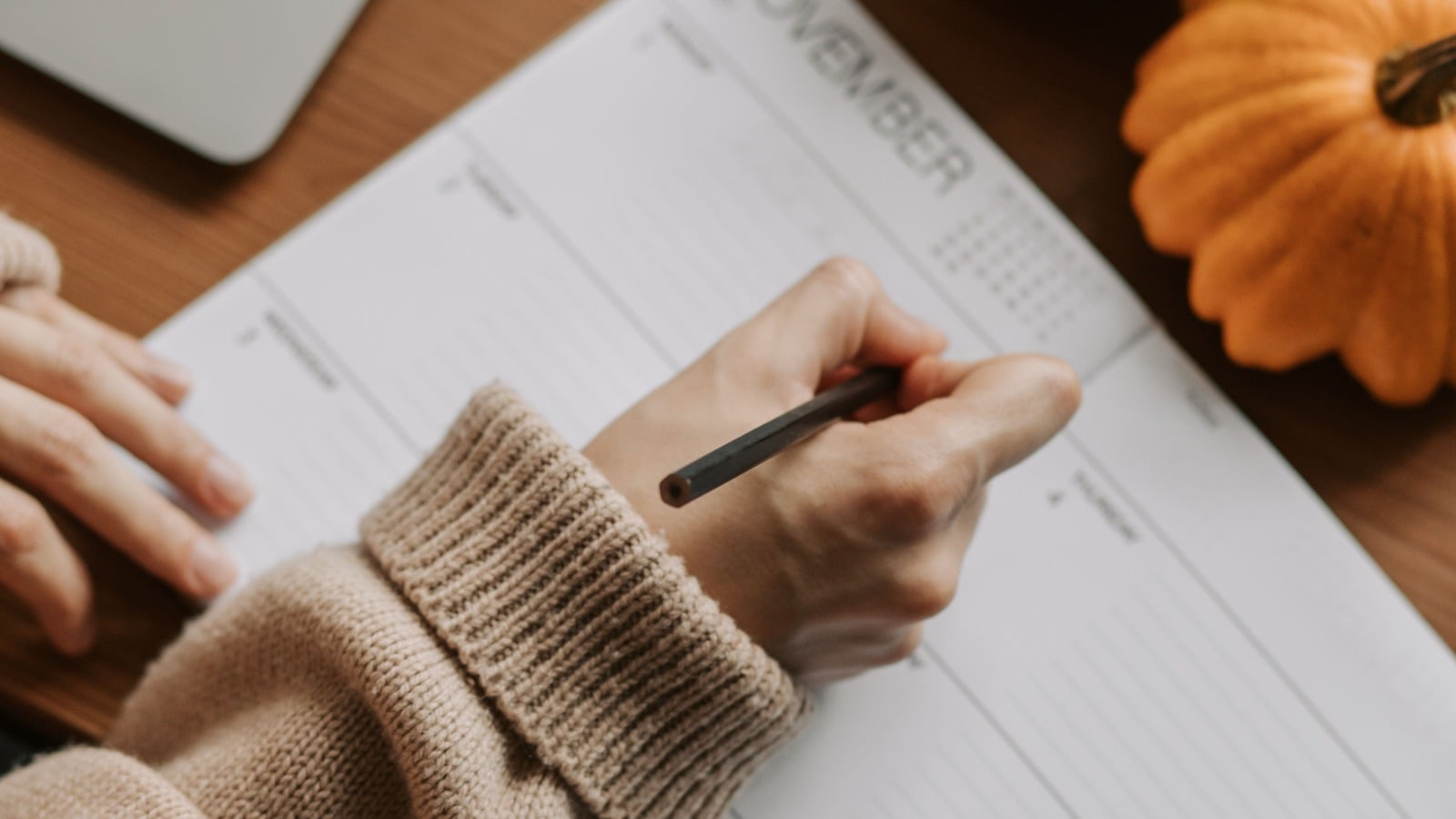
What Your Paper Calendar Says About Your Mind
Start with personality. In interviews with psychologists, people who prefer a paper planner are often described as more conscientious, reflective and creative. They like seeing their lives laid out in ink, not buried under a notification badge.
The Tactile Thinkers Why Feeling Your Plans Matters
Psychologists who study behavior say paper-calendar people tend to value the tactile experience itself. Writing by hand, flipping pages and watching empty boxes fill up creates a tangible record of a life that feels satisfying in a way a swipe never quite does.
That instinct is backed by neuroscience. EEG work from researchers like Ruud Van der Weel and Audrey Van der Meer shows handwriting activates more widespread brain networks than typing, especially those tied to learning and memory. When you drag your pen across a paper planner, your brain is literally more engaged than when you tap “Save” on a screen. Crossing off a task is not only visually pleasing – it delivers a small reward hit that keeps you coming back.
The Anticipators How Marking Dates Feeds Motivation
There is also the emotional side. If you are the person who lovingly circles vacation dates or hearts a friend’s wedding on your wall calendar, you are not just organized. You enjoy anticipation. Robert Zajonc’s classic mere-exposure theory suggests that the more we repeatedly see something, the more affection we feel for it. Every time your eye lands on that inked-in weekend away, your brain gets a tiny shot of “good things are coming.”
Psychologists find that many paper-calendar loyalists also prize simplicity. In a digital life jammed with apps and alerts, choosing a basic paper grid is a subtle rebellion – a way to manage time without inviting in the entire internet.
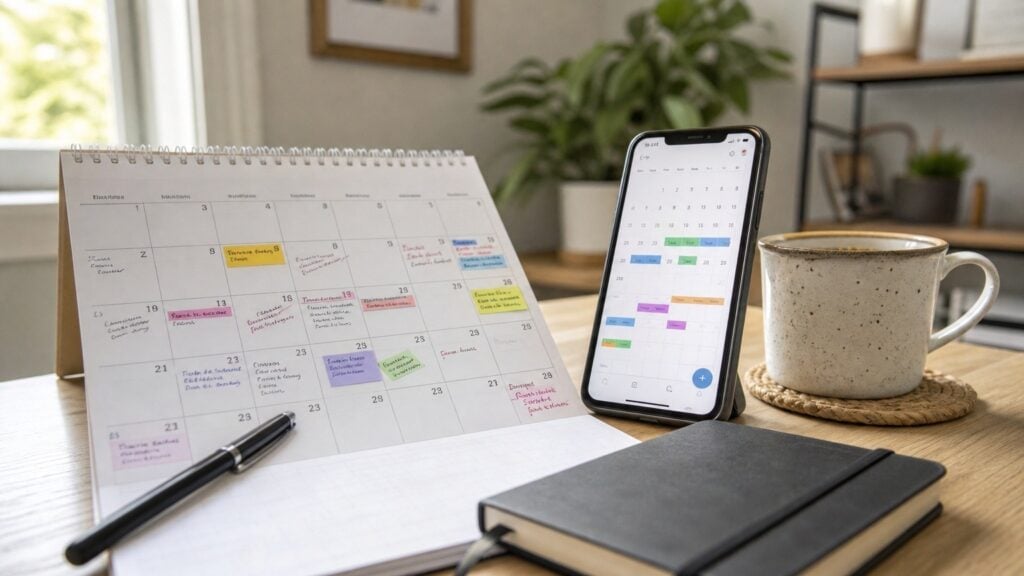
How Your Brain Handles Paper Vs Phone Calendars
More Brain Networks Light Up With Paper
Beyond vibes, there is hard data. Studies comparing paper notebooks and electronic devices show that paper triggers stronger activation in brain areas linked to memory, visual imagery and language during recall tasks. Your brain builds a richer, more three-dimensional map of information when it is anchored to a physical page.
The Calendar Study Faster Recall On Paper
A 2021 study led by researchers at the University of Tokyo asked participants to record schedule information using either paper calendars, electronic tablets or smartphones. Those using paper not only showed greater activity in memory-related regions but also recalled the details about 25% faster than the smartphone group. Translate that to real life and you get fewer “Wait, what time was that?” scrambles before yet another Zoom.
Notifications Vs Encoding The Offloading Trade Off
The American Psychological Association has described humans as “cognitive misers” – we conserve mental energy by offloading tasks onto tools. Phone calendars are built for offloading. You plug in a meeting, forget about it, then obey the notification when it pings. Efficient, yes, but also passive.
With a paper calendar, there are no pop ups. Remembering depends on how deeply you encode that information when you first write it and how often you visually revisit the page. That extra mental work is exactly what strengthens prospective memory – the ability to remember to do things in the future without a digital nudge.
Paper Calendars Time Perception And Follow Through
Big Picture Planners Vs Day By Day Scrollers
Researchers summarized by Baylor University’s Keller Center found that people using paper calendars tended to create higher quality plans and to see their schedule in a broader, big-picture way. A month-on-a-page layout naturally shows sequences, clusters and breathing room.
By contrast, many mobile calendar views encourage you to look at a single day or a narrow scroll. You focus on isolated appointments rather than how the week as a whole feels. Over time, that interface nudges you toward short-term thinking and overstuffed days that only look manageable in a tiny rectangle.
Why Paper Users Often Stick To Their Plans
In experiments, participants assigned to paper planners not only planned more realistically but also completed a higher share of what they had scheduled. Seeing the whole landscape of your week helps you spot conflicts and protect white space before you promise away yet another evening.
Add in those repeated glances at the same handwritten page and you get powerful reinforcement. Your plans become part of your mental wallpaper, not just buried inside an app you only open when you are already late.
What Goal Research Really Says About Writing Things Down
Beyond The “42 Percent” Myth
You have probably seen the viral claim that you are “42% more likely” to achieve goals if you write them down, based on work by psychologist Gail Matthews. Careful reanalysis shows that headline number comes from self ratings, not a clean change in odds, and the study was never formally peer reviewed.
The sturdier takeaway across goal-setting research is more modest but still useful: writing goals and checking in on them with some accountability tends to improve progress. Not miracle-level, but meaningful.
Calendars As A Natural Home For Goals
A paper calendar is where that science quietly becomes lifestyle. When you schedule “run three miles” on Tuesday and “French class” on Thursday, you are not just listing dreams – you are assigning time, in ink. Handwriting deepens encoding, the calendar view shows how goals fit around real life, and repeated exposure each time you flip the page keeps those intentions emotionally alive.
Should You Ditch Your Phone Calendar
When A Paper Calendar Is Your Secret Weapon
Lean into paper if you are easily hijacked by notifications, need to visualize an entire month at once, or simply love the ritual of pens and pretty layouts. People in creative roles, or anyone juggling big personal goals alongside work, often benefit from that tactile, big-picture planning space.
When Digital Still Completely Makes Sense
Keep your phone calendar close for what it does best: complex logistics, shared family schedules, constant travel and time-sensitive alerts. If your executive functioning is hanging by a thread, those reminders are not a crutch – they are a lifeline.
Try A Hybrid 30 Day Planner Experiment
For the next 30 days, treat your phone as the alarm system and your paper calendar as mission control. Put all fixed appointments in both. But plan your weeks, block focus time and write one or two key goals per week only on paper. At the end of the month, notice what changed – memory, stress levels, follow through.
If you find yourself remembering more without obsessively checking your phone, that is not you being quirky. That is your brain quietly confirming what psychologists have been saying all along: people who write things down on a paper calendar are processing time, goals and life in a deeper, more engaged way.


