










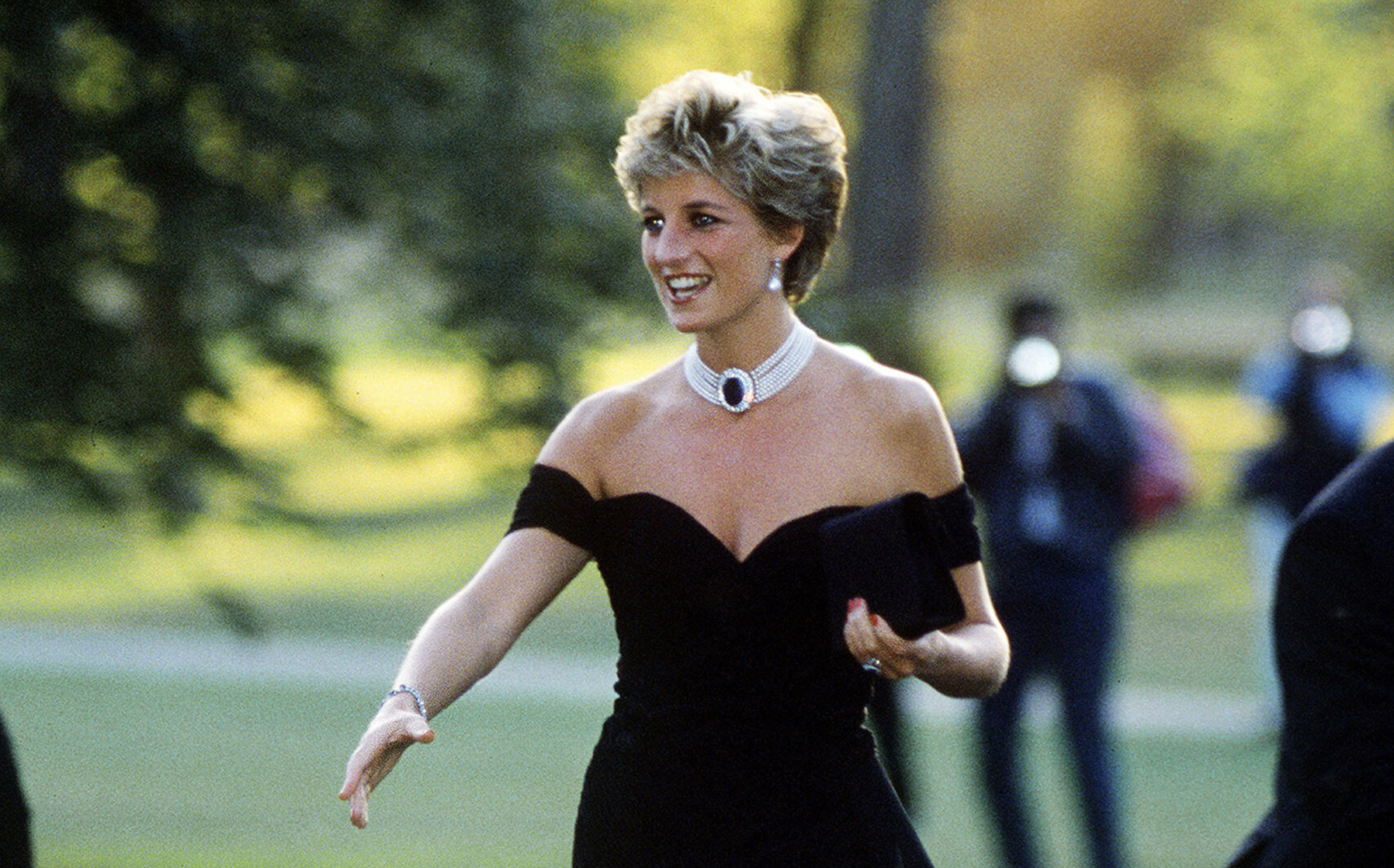
Some dresses are remembered for who designed them. One is remembered for what was on television that night. On June 29, 1994, Diana, Princess of Wales, stepped out of a car in Hyde Park in a short, off-the-shoulder black silk dress, at almost exactly the moment her husband was telling an interviewer, and roughly fourteen million viewers, that he had been unfaithful. The photographs were on every front page by morning. The dress had a name by lunchtime. Thirty-two years later, it went back on public display today at Sotheby’s in London, the first stop of a world tour that ends under the hammer in New York on December 9, with an estimate of $150,000 to $300,000 and a good chance, given what Diana’s wardrobe has fetched lately, of leaving that figure well behind.
The night the dress got its name
The occasion was a dinner hosted by Vanity Fair at the Serpentine Gallery, the small art museum in Kensington Gardens of which Diana was patron. The date was not an accident. Earlier that evening, ITV aired a two-hour documentary on Prince Charles by the broadcaster Jonathan Dimbleby, in which the heir to the throne, asked whether he had been faithful to his wife, said that he had been, until the marriage had “irretrievably broken down”. The couple had been formally separated since December 1992. Everyone knew what the answer meant.
Diana could have stayed home. Instead she arrived at the Serpentine in a dress that broke, at a glance, most of the unwritten rules she had lived by for thirteen years: black, which royal women then reserved for mourning; short, cut above the knee; shoulders bare; the hem asymmetric. She wore it with sheer black tights, scarlet nails, her hair swept back, and a multi-strand pearl choker with a large sapphire at its center, a piece reportedly made from a brooch given to her as a wedding present by the Queen Mother. The next morning’s papers carried two pictures side by side, the prince in an armchair and the princess on the steps, and the caption wrote itself. The Telegraph noted, drily, that the Princess of Wales had not needed to dine out in front of the cameras in order to avoid watching her husband bare his soul on the box. Fashion editors called it several things in the days that followed. The one that stuck was “the revenge dress”.
Three years in a closet, and a last-minute change of plan
The dress itself was not new. It had been made by Christina Stambolian, a Greek-born designer working in London, around 1991, and Diana is said to have found it too daring and left it hanging unworn. The plan for the Serpentine dinner, according to accounts published since, was a gown by Valentino; when word of that choice leaked ahead of the evening, she is reported to have switched at short notice to the black dress she already owned. If the story is accurate, the most famous fashion decision of her life was made in a hurry, from her own wardrobe, on the strength of a leak.
It is worth pausing on how unlikely all of this was. Diana was 32 years old, still technically a member of the royal family, still photographed more than any woman alive, and she chose, on the evening designed to humiliate her, to look not wounded but spectacular. Fashion historians have spent three decades reading the dress as a statement of confidence and independence, and Sotheby’s, in announcing the sale, described it in almost exactly those terms. Whatever she intended, the effect was to change the subject. Nobody talked about the interview for long.
Where the dress went after that
Diana wore the Stambolian dress in public only once. Three years later, in June 1997, she sold it. That summer, at Christie’s in New York, she auctioned 79 of her evening gowns to raise money for AIDS and cancer charities, an idea reportedly suggested by her son William. The black dress went for a reported £39,098 to a Scottish couple who intended to use it to raise funds for children’s causes, and it did: for years it was lent to charity events around Scotland. It surfaced publicly in 2017 as the centerpiece of a Diana exhibition at the Museum of Style in Newbridge, Ireland, and then, by most accounts, disappeared from view. Two months after that 1997 sale, Diana died in Paris.
Which is why today matters. Sotheby’s will offer the dress in New York on December 9, in a dedicated evening sale during its Luxury Week, and before that it is touring: London from September 18 to 24, then Hong Kong, then Geneva. The lot comes with the catalogue from the 1997 auction, signed by both Diana and Christina Stambolian. Part of the proceeds will go to NHS Lothian Charity on behalf of the Royal Edinburgh Hospital, which keeps the dress, thirty years on, doing what its first buyers wanted it to do.
Why $300,000 may turn out to be the floor
The estimate looks cautious against recent results. In January 2023, a strapless aubergine Victor Edelstein gown that Diana wore for an official portrait sold at Sotheby’s for $604,800, five times its high estimate. That September, her red “black sheep” sweater, a knit she wore in 1981 before the wedding, fetched $1.1 million. Three months later, a ballerina-length Jacques Azagury dress from 1985 set a new record for any Diana garment at Julien’s, at more than $1.1 million. None of those pieces has a story attached to it that a stranger could recite from memory. This one does. As CNN reported when the sale was announced, auction officials expect the dress to have “endured beyond the circumstances” of that night, and the December room will decide by how much.
A phrase that outlived the marriage
The dress gave English a phrase. “Revenge dressing” is now shorthand for the outfit worn after a breakup, the one chosen for the cameras rather than the ex, and it has been applied since to everyone from pop stars to prime ministers’ wives, usually without anyone remembering where it came from. The original was a black silk cocktail dress a princess had been too shy to wear, pulled out of a closet on a bad evening because the other option had leaked. Thirty-two years later it is behind glass in New Bond Street, waiting for a buyer, and still doing exactly what it did on the night: making everyone look at Diana instead.


