









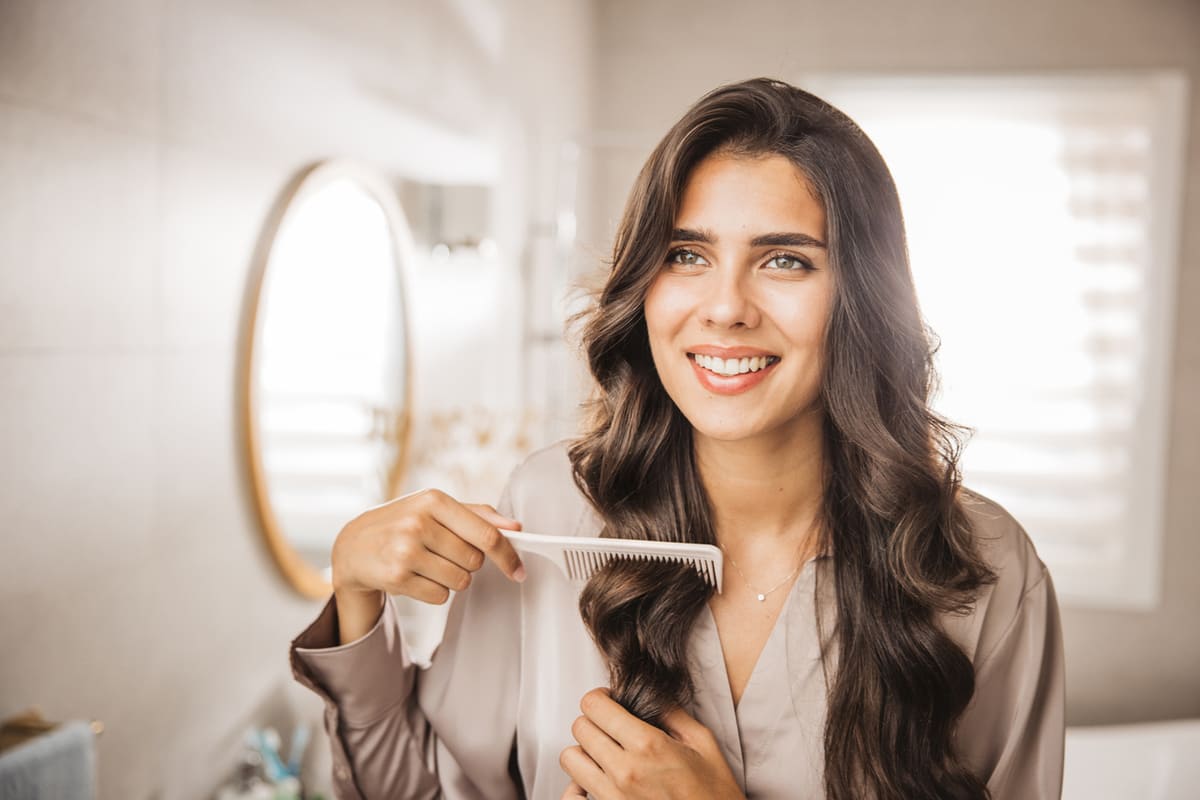
You know that moment when you catch someone’s hair in direct sunlight and it looks almost liquid – like it could reflect your face back at you? You probably assumed it was genetics, or an expensive blowout, or maybe just really good lighting. But in 2026, that impossibly polished finish has become the single most coveted hair look across runways and social feeds alike. And the secret behind it is far more accessible than you might think.
Why your hair goals now mirror your skincare routine
If the past few years taught us anything about beauty, it is that the obsession with radiant, dewy skin was never going to stay confined to our faces. According to Miriam Johannes, Oribe educator for the Nordics, the glass hair movement is a direct response to the growing focus on healthy hair in recent years. We have collectively been striving for strands that look their absolute best, and the glossing product category has exploded as a result.
Emma Gouteva, hairdresser at Bangerhead Studio, frames it as part of the same philosophy that gave us the glass skin phenomenon. She describes both trends as belonging to one overarching mindset – beauty from within – where a flawless, radiant finish is the end goal whether we are talking about complexion or hair. Think vintage Cher or the liquid-looking locks Kim Kardashian has made her signature. The polished camp is growing, and at-home glossing treatments are the fastest way to join it.
So what exactly does an at-home hair gloss do? Unlike traditional dyes, these treatments are ammonia-free and deposit color without penetrating the hair shaft, making them significantly gentler on your strands. They work by sealing the hair cuticle – the outermost protective layer of each strand – which reduces frizz and adds a reflective sheen. The result is smoother, more vibrant hair that catches light the way a polished mirror does.
The formulas worth knowing about
Not all glosses are created equal, and the range on the market right now spans luxury in-shower essences to budget-friendly drugstore finds. Oribe’s Mirror Rinse Glass Hair Treatment is a clear gloss – no pigment, no peroxide – that smooths the hair shaft and amplifies reflectivity. It can last up to 15 washes and mimics the afterglow of an in-salon treatment without adding weight or disrupting your color. Johannes specifically highlights this product as a way to achieve a glossy, smooth look at home in minimal time.
On the more affordable end, L’Oréal Paris’s Elvive Glycolic Gloss 5-Minute Lamination uses glycolic acid to smooth and seal the cuticle, replicating a lamination treatment in five minutes flat. It works on its own or as part of a three-step system. Then there is the Maria Nila Mirror Gloss Bundle, a complete three-step routine featuring a shampoo (350 ml), conditioner (300 ml), and treatment mask (250 ml) that together smooth the cuticle, boost luminosity, and leave hair sleek from root to tip.
For those who literally cannot spare more than a minute, Amika’s Flash Instant Shine Mask smooths and seals the cuticle with amino acids and UV filters in under 60 seconds. It is silicone-free, color-safe, and cruelty-free. Meanwhile, Gisou’s Honey Gloss Ceramide Therapy Hair Mask takes a slightly different approach – it is technically a barrier-repair mask, but ceramides and honey leave hair silky, soft, and light-reflective, making it ideal for color-treated, coarse, or dry hair.
Ouai’s tinted in-shower gloss delivers hydration through rice protein and hibiscus extract while enhancing tone and controlling frizz. Kevin Murphy’s Cool.Angel targets a more specific concern with grey pigment that cools warm undertones in blonde and silver hair, doubling as a conditioning treatment with mirror-like results – a particularly strong pick for beige and honey blondes. And for a styling-step addition rather than a shower treatment, ColorWow’s Dream Coat Supernatural Spray forms a heat-activated, humidity-proof, high-shine barrier that earns its place in the glass hair conversation despite not being a traditional gloss.
How to pick the right gloss for your hair
Choosing the best option comes down to a few practical questions. If maintaining your color between salon visits is the priority, a tinted gloss can refresh your hue. If brassiness is your nemesis, a neutralizing formula will help keep unwanted warmth at bay. And if shine is the sole objective, a clear version will do the trick without altering your shade at all.
Your hair texture matters, too. For thicker or coarser hair, Johannes recommends choosing glosses with moisturizing properties and pairing treatments like the Oribe Mirror Rinse with a conditioner for added hydration. Time is the other variable: some glosses need only a few minutes while others require longer processing. Gouteva is honest about the limits – she emphasizes that intensive salon treatments remain key to truly healthy, good-looking hair and that there are no real shortcuts. At-home glossing, however, is the smartest way to stretch the results between those appointments.
What this means for your routine
The glass hair movement is not asking you to overhaul your entire regimen. It is asking you to add one targeted step – a glossing treatment – that seals the cuticle, tames frizz, and turns your strands into something closer to a light-catching surface. Whether that step takes 60 seconds or five minutes, the payoff is visible and immediate.
Gouteva sums up the shift simply: healthy, shiny hair is a lifestyle now, and glossing products deliver shine, frizz control, and a healthy appearance without requiring intensive effort. You already have a serum for your skin. Your hair has been waiting for the same kind of attention.


