










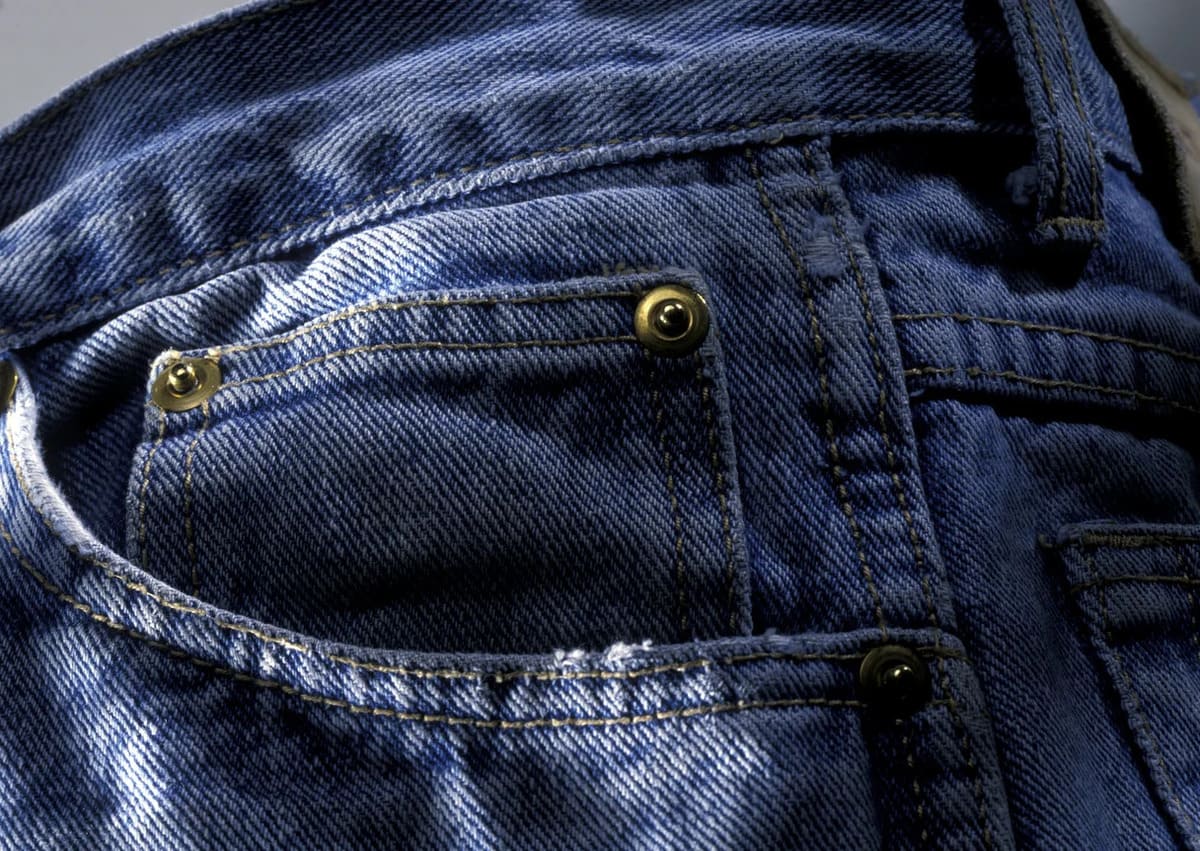
You have probably slipped your hands into your jeans pockets thousands of times without giving it a second thought. But have you ever paused to wonder about those small, round metal studs sitting right at the corners? Most of us assume they are decorative – a stylistic quirk that brands keep reproducing out of habit. The truth is far more practical, and the story behind them stretches back exactly 153 years, to 1873, and to a time when denim pants were literally falling apart on the bodies of the workers who needed them most.
When denim just wasn’t strong enough
To understand why those tiny metal pieces exist, we need to travel back to the early 1870s. Working conditions at the time were grueling for the miners, laborers and lumberjacks of the American West, who wore denim canvas pants day in and day out. The demanding physical tasks they performed every day required clothing that was tough and exceptionally durable, yet no pair of pants on the market lived up to those expectations.
Workers found themselves forced to replace their trousers on a regular basis. Seams ripped, pockets tore away, and the fabric gave out precisely where stress was greatest – at the points subjected to repetitive movement. It was a costly, frustrating cycle, and nobody seemed to have a solution. So what changed?
The answer came from an unexpected request. The wife of a laborer reached out to Jacob Davis, a tailor based in Reno in the state of Nevada, asking him to craft a pair of work pants that could actually withstand her husband’s daily demands. Davis took the challenge seriously and, after some thought, landed on an idea that would reshape an entire industry.
A tailor’s ingenious fix – and the birth of the rivet
Jacob Davis’s insight was deceptively simple. He decided to add small metal buttons – cylindrical pins flattened at the tip – to the parts of work pants that were most prone to coming undone or tearing over time. Specifically, he fastened them at the corners of pockets, where hands and tools were constantly being shoved in and pulled out, as well as at the base of the fly. These permanently fixed metal reinforcements joined and held pieces of fabric together, making the pants significantly stronger and far more durable. The rivet was born.
Confident in his invention but short on funds, Davis turned to a man from whom he already purchased denim canvas for his work pants – a certain Levi Strauss. At the turn of the twentieth century, that name would become world-famous, but at the time Strauss was simply a dry goods retailer based in San Francisco. He sold tent canvas, tarpaulins, and brown denim fabric while running his own business and representing his family’s company on the West Coast of the United States.
Eager to patent his rivets, Davis wrote a letter to Strauss laying out the concept and proposing a deal: if Strauss financed the patent, the two men would share the profits from sales. Strauss saw the potential immediately and agreed to partner with the American tailor. On May 20, 1873, the two associates patented the riveted jean, effectively giving rise to what we now know as the Blue Jean – and to the legendary Levi’s brand. The men who reportedly bought the first pairs were exactly the ones the design had been made for: miners and other laborers of the Gold Rush West, who needed pants that would outlast the work.
From workwear staple to worldwide standard
The success was nothing short of global. The partnership between Davis and Strauss quickly propelled both men into the spotlight, and competitors wasted no time following their lead. Gradually, brands around the world adopted the same manufacturing method for their pants, embedding those same small metal rivets into the stress points of every pair of jeans they produced.
Not every rivet survived the journey, and that is a small story of its own. The rivets on the back pockets reportedly drew complaints for scratching saddles, chairs and school desks; in the 1930s, Levi’s is said to have begun hiding them beneath the fabric, and by the 1960s they had given way to dense bar-tack stitching. The rivet at the base of the fly disappeared too, during the Second World War, when metal was rationed. The front-pocket rivets stayed. A century and a half of trial and error left exactly the ones that matter.
What began as a targeted fix for overworked laborers became a universal feature of denim construction. Those rivets you see today on your favorite pair serve exactly the same purpose they did 153 years ago: they reinforce the areas of the fabric most likely to come apart due to repeated motion. Far from being merely aesthetic or a nod to tradition, they remain a genuinely indispensable structural element. Many debates have emerged over the years about whether these metal studs are about looks or practicality, but the historical record is clear – they were designed for durability, plain and simple.
A small detail with a big legacy
Next time you reach into your jeans pocket, take a closer look at those unassuming metal dots. You now know they are not random hardware. They are rivets, conceived by a resourceful tailor in Nevada and brought to market through a visionary partnership with a San Francisco merchant. Together, Davis and Strauss did not just patent a stronger pair of pants – they created one of the most enduring design features in fashion history. And every single pair of jeans you own carries that 1873 innovation right at your fingertips.


