

Newsfeed


Grace, it turns out, isn’t reserved for the stage. When Yousra Mohsen appears on screen, she’s dressed with effortless practicality: a sports bra, leggings and an oversized linen shirt left open to catch the Mediterranean breeze (she is currently in her almost-finished house in Sicily that she and her fiancé are building from the ground up). Yet she carries herself with the unmistakable poise of someone who has spent a lifetime training every movement. Between bursts of laughter and animated conversation, she gestures with the precision of a dancer, her warmth immediately dissolving the distance of a video call. Yousra is effervescent, endlessly expressive and disarmingly candid.
We spend the first few minutes not talking about Yousra at all. Instead, she’s asking about me – where I’m from, how long I’ve lived in Dubai, what I’m up to this summer. Her warmth is immediate. I steer the conversation back to her, asking about her upbringing, and, almost seamlessly, she pivots to the subject that underpins so much of who she is: women’s rights. She grew up in Beirut to conservative parents whose divorce would come to define much of her childhood.
“Being a woman is hard, especially in Arab countries. You don’t really have rights,” she says matter-of-factly. “This was the first time I saw my mum struggle, because we do not have civil marriage in Lebanon, so my mum spent seven years in religious courts, which means I also spent seven years in religious courts.” It’s a striking place to begin an interview with one of the region’s most accomplished dancers, but it explains almost everything that follows. For Yousra, dance was never just an art form. From the very beginning, it became a language of autonomy.
But despite all the conservatism that defi ned her upbringing, Yousra credits one person with giving her the freedom to imagine a different future: her mother. Raised in Beirut but educated in the north of England, she brought a broader worldview back to Lebanon – one that made space for curiosity, creativity and, eventually, her daughter’s unconventional ambitions. “My mum was very educated. She reads a lot. She did her studies in Leeds in the UK, so she’s more open,” Yousra explains. “This part of my family – my mother’s side – is more open to life.” It wasn’t that becoming a professional dancer was ever an obvious path. “Where I come from in Lebanon, or even in Arab countries, you don’t tell your parents, ‘I want to be a professional dancer’ – especially not to conservative parents.” But, caught between two opposing influences, she learnt an invaluable lesson early on: “You have to know what you want and just stand for it.” It is a philosophy that has followed her from a Beirut dance studio to the stages of Paris – and one that continues to underpin every decision she makes.
Convincing conservative parents that dance is a career is one thing. Convincing them when one of the Arab world’s most prestigious dance companies sees your potential is another. Before long, Yousra had earned a place at Caracalla Dance Theatre, the internationally acclaimed Lebanese company that has spent decades blending classical ballet with Middle Eastern storytelling. For a teenager who had trusted her instincts, it was the first sign that those instincts had been right all along.
“Caracalla changed everything,” she reflects. “What they do is extraordinary. Th ey take Lebanese folklore and blend it with the Martha Graham technique to create something entirely their own.” Joining the company at just 14, Yousra was selected from its school to perform with the professional troupe, an opportunity that introduced her to the stage – and, before long, the world.
“We toured China, Bahrain and performed at Expo Milano. I was still at school, trying to balance rehearsals, international tours and my exams. I’ll always be grateful for my time there because that’s what introduced me to performing. That’s when I realised this is what I want to do with my life. I don’t want to sit behind a desk… I want to travel, I want to dance, I want to meet new people and explore new cultures.”
At just 17, Yousra then left Lebanon for dance school in the French capital, trading Mediterranean summers for grey Parisian skies and the certainty of home for the uncertainty of reinvention. “I knew I had no future there,” she says of leaving Beirut. “Nothing could save me except that plane that was going to take me to Paris. It was take it or leave it.” The transition wasn’t seamless. Despite speaking fluent French, she found herself fighting to keep up with classmates who had trained within Europe’s rigorous conservatoire system from childhood. There were moments she felt like an outsider, not just because of her technique, but because of where she came from. “I had to fight for my spot. I had to fight for my dream from the very beginning, the moment I stepped foot in that school.”
It was there, almost by accident, that her career took another unexpected turn. A heels instructor suggested she had the look and presence for cabaret – a world Yousra knew almost nothing about. Curious, she persuaded her mother to spend a day touring Paris’ legendary venues, from the Lido to the Moulin Rouge, before arriving at Crazy Horse. “I fell in love,” she beams. “The lights, the bodies… something in me said, ‘There’s something here.’” An audition was taking place just days later. She applied, was invited in, and secured a place on her very first attempt. It was a watershed moment that would redefine not only her career, but how she was perceived back home. A subsequent interview on French television made headlines in Lebanon, prompting criticism from those who couldn’t reconcile her conservative upbringing with one of Paris’ most iconic stages. Yousra, characteristically, never looked back. “I guess I stood my ground,” she says. “This is happening. This is going to be my life now.”
You may also know Yousra Mohsen as Laila Liberty, the name bestowed upon her before she ever stepped onto the Crazy Horse stage. Every dancer is given an alter ego moments before their debut, a name they don’t choose themselves. “Right before the curtain opens, the artistic director comes in and says, ‘I have this name for you,’” she recalls. “Mine was Laila Liberty.” She accepted without hesitation, only later discovering the alternative had been something along the lines of Scarlet Sunshine. She laughs. “No, I’m definitely a Laila Liberty.”
The name, she tells me, couldn’t have been more fitting. Laila means ‘night’ in Arabic, while Liberty speaks for itself. Together, they describe not only the woman audiences came to know under the Parisian spotlights, but the version of Yousra she found there. “I become a different person when I’m on stage,” she says. “When you step into Crazy Horse and start doing your makeup – the big lashes, the body makeup, the wig, the costume – something changes.” It isn’t an escape from herself so much as an extension of her. Off stage, she’s warm, chatty and infectiously curious; on it, Laila Liberty is fearless. For Yousra, the alter ego isn’t about becoming someone else; it’s about accessing a side of herself that the stage allows her to reveal.
The conversation naturally turns to women who, much like Yousra, have built careers by refusing to fit neatly into other people’s expectations. The women who polarise opinion, who are celebrated and criticised in equal measure, often occupy the same uncomfortable space: publicly judged, yet privately more powerful than the narratives written about them. For Yousra, one such figure is Mia Khalifa – a comparison she received often after joining Crazy Horse, though not necessarily as the insult it was intended to be. “I remember people comparing me to Mia Khalifa, and she’s a multi-millionaire now,” she says. “I love Mia Khalifa. I used to tell them, ‘Girl, I wish I was Mia Khalifa. She’s amazing.’”
It is a response that often surprises people, but Yousra sees the power in embracing the unexpected. “When you say these things, people are like, ‘What? Are you completely insane?’” she laughs. “But that’s also part of who I am.” For her, the point is not provocation for the sake of it, but refusing to let other people dictate which women are worthy of respect. She admires the way Khalifa has built a platform, stood by her beliefs and used her voice publicly, particularly in support of causes she believes in. “She’s built an empire for herself – her social media presence, what she stands for. She’s not afraid to stand for the Palestinian cause, for example, and neither am I.”
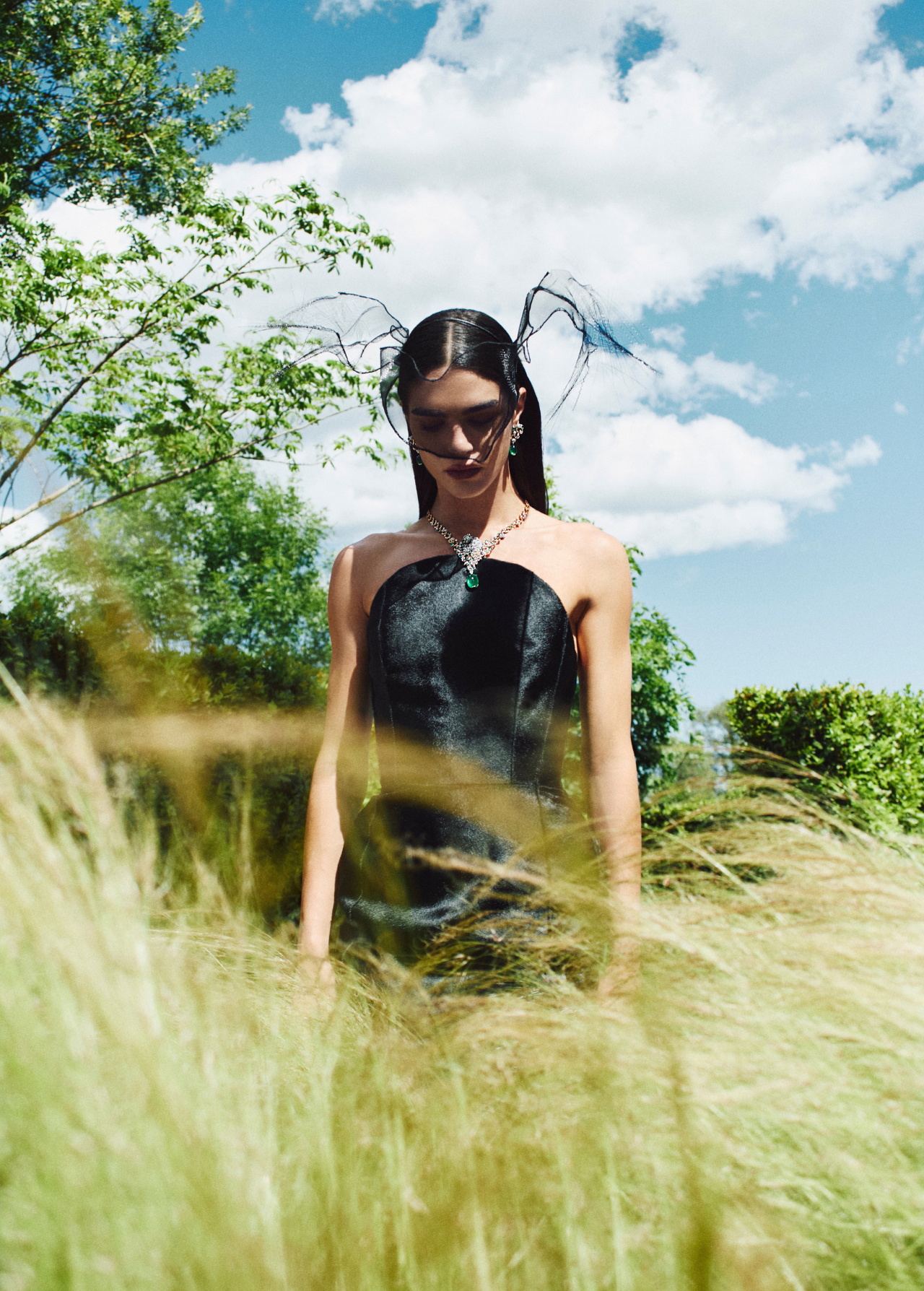
That same instinct to challenge perceptions has shaped Yousra’s own work. When she began teaching heels classes in Lebanon in 2018 and 2019, the style was still unfamiliar and often misunderstood. Today, many of the women she taught have gone on to teach internationally and create their own careers through the discipline. For Yousra, that is the real measure of change: not winning everyone over, but creating enough space for the next woman to step through.
As for what’s next, Yousra is building more than one future. Alongside planning her dream wedding, she’s also planning to continue working at Crazy Horse, as well as preparing for a move to Dubai, where she hopes to open a dance studio of her own – a space for the next generation of performers to train, create and, perhaps most importantly, feel seen.
Her engagement, fittingly, happened here in Sicily, where she and her fiancé are now building their home from the ground up. After seven years together, she admits she’d dropped more than a few hints. “I was sending him Instagram Reels of cute engagements and rings,” she laughs. “I think he got the memo.” Still, he managed to surprise her completely, convincing her they were shooting a campaign for a Sicilian guesthouse. “He told me they wanted me to wear white, so I did my nails, bought this beautiful dress in London and genuinely thought we were going to get paid.” Instead, after a photographer asked her to turn towards the sun, she spun back around to find him on one knee. “Christian is always so calm and composed, so when I saw him shaking, I knew something was happening. He was crying, I was crying – actually I completely lost it.”
For now, though, the spotlight still calls. “I’m not ready to say goodbye to that stage just yet,” she says. “I’m not ready to say goodbye to dance either. My body hurts. My back hurts, my knees hurt. But I just love the stage so much. I love the thrill of being in front of hundreds of people – or being on stage alone for six minutes at Crazy Horse, naked, free, dancing. I’m not ready to leave that.”
For a woman who has spent her life refusing to let other people define her story, it feels like exactly the ending you’d expect: not a curtain call, but an intermission. As we say our goodbyes, she’s already thinking ahead – to Dubai and Paris, to Lebanon and Sicily, to rehearsals, clients, and a wedding that, by her own admission, she’s had little time to plan. It seems to be the only pace Yousra Mohsen knows: always building, always moving, and always on to the next act.
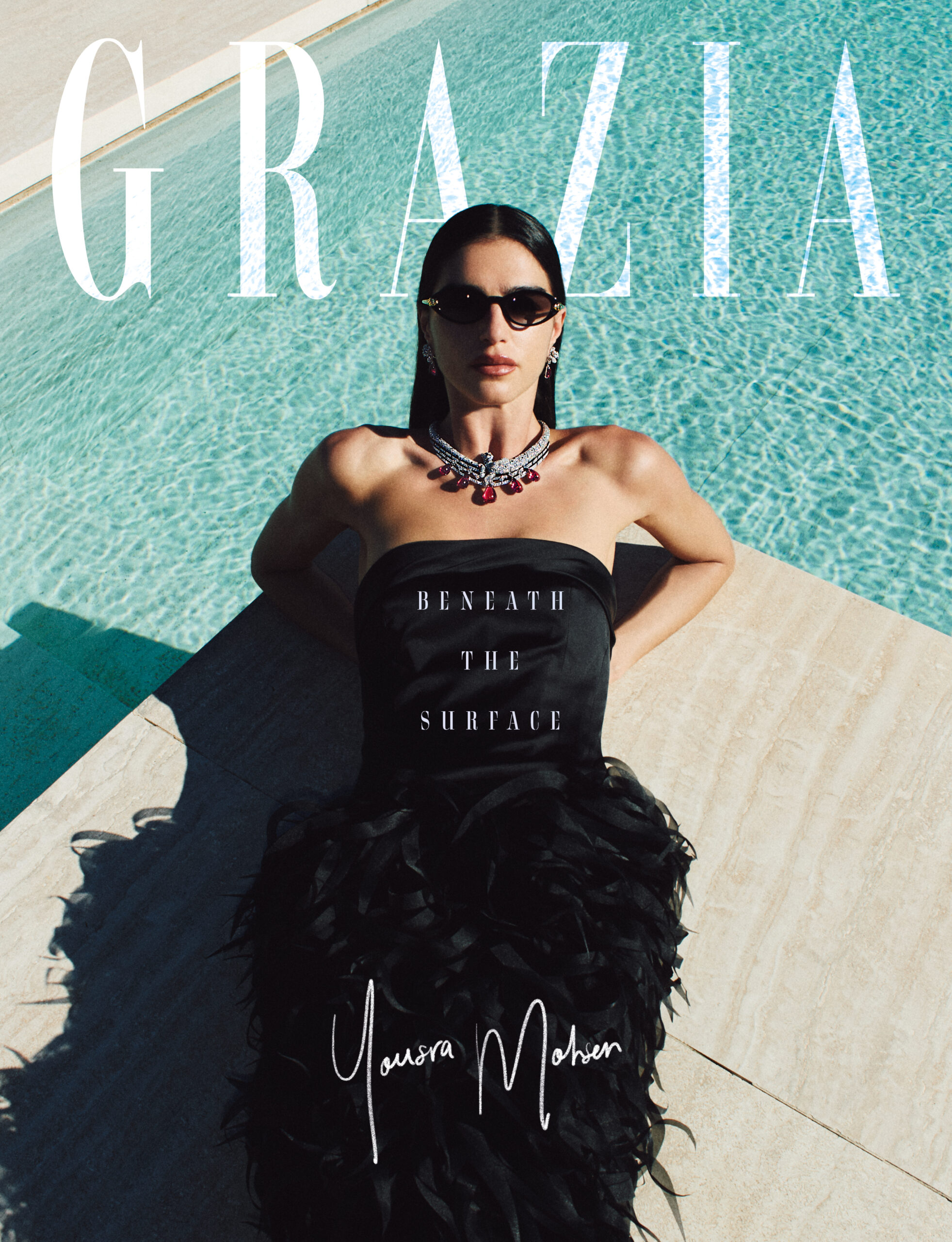
This cover story IS PUBLISHED IN THE 19th EDITION OF GRAZIA Middle East. ORDER YOUR COPY HERE.


