



Newsfeed


Touching down in Mumbai for the first time, I was struck by its contradictions. There is extraordinary beauty here, and extraordinary chaos. Traffic moves in every conceivable direction, rickshaws race past centuries-old architecture, and on the next corner another skyscraper is rising. Life unfolds at a pace that feels relentless to a visitor, yet entirely natural to the approximately 22 million people who call the city home. It is also the setting for one of fashion’s most compelling stories of the past year.
For anyone who spends their time scrolling on Instagram or TikTok, Diya Joukani is likely to be a familiar face. Her oversized silhouettes, intricate embroidery, sharply tailored jackets and the backing track of Frank Ocean’s ‘Nights’ have become a visual and sound signature. For the uninitiated, Diya has become somewhat of a viral sensation throughout 2026, becoming known for moving through the streets of Mumbai with a nonchalant confidence in her videos, turning everyday scenes into fashion moments which have gone far beyond the Bandra area of the city, largely where she films and where the social media star grew up.
Interestingly though, in the online age of visibility when visibility is often mistaken for intimacy, Diya has achieved something rather unusual – being entirely recognisable, without being revealing, and it’s entirely intentional.
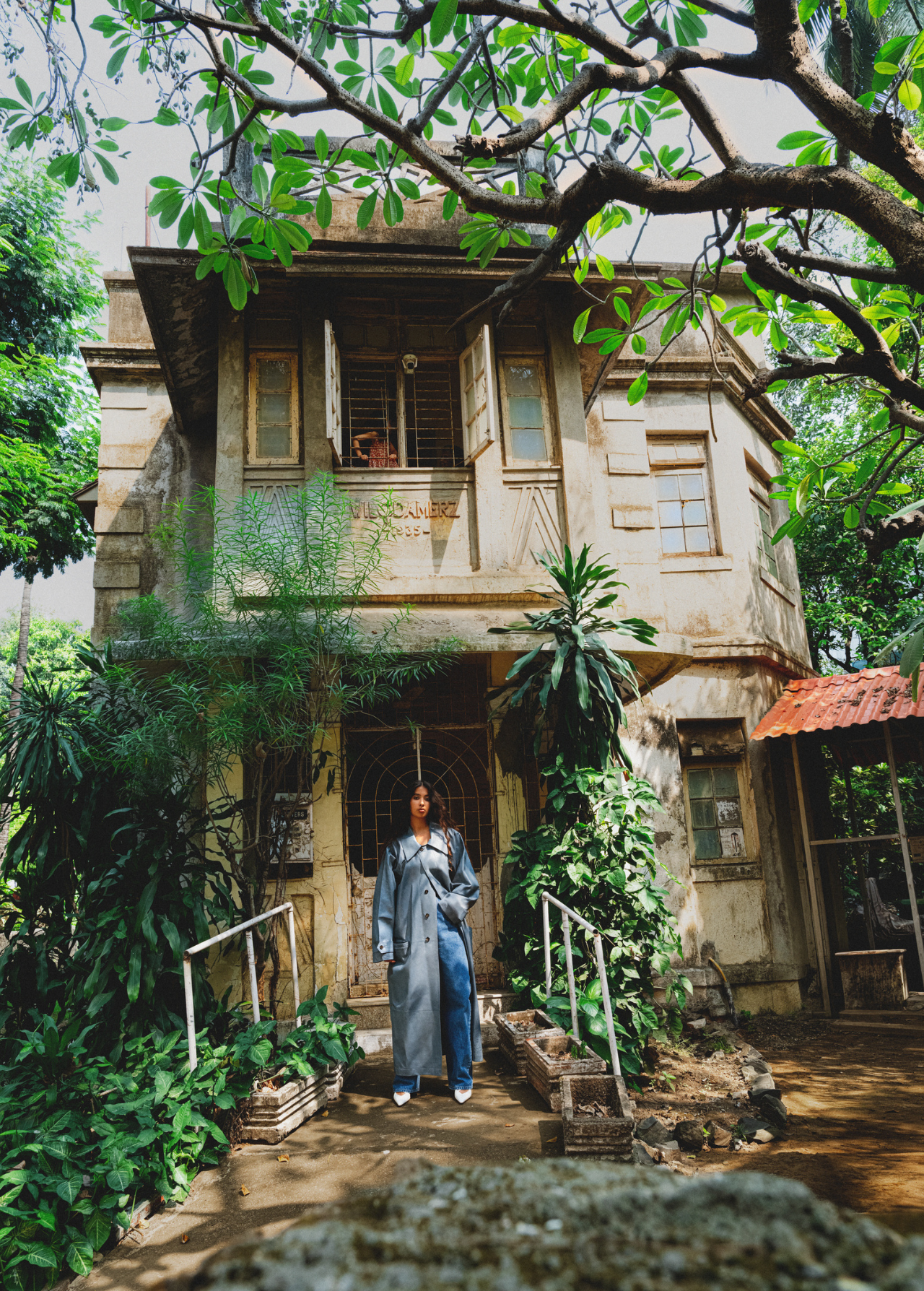
In fact, the now 26-year-old “knew” her first video was going to “blow up”. There was – and still is – no elaborate production, no monologue, no invitation into her morning routine. And there is absolutely no talking; millions are watching.
“I like my designs and clothes and videos to speak for themselves,” she tells GRAZIA. “Anything else I gotta say can be written.”
She means it. The follow-up questions after our shoot came back in writing, typed in the easy shorthand she might use when texting with a friend. But spend a day shooting with her, flitting around the city by car, edging through Mumbai traffic and a different Diya emerges: quick, warm and funny, pointing out the street where she buys her fabric and the lanes behind her house where some of her most viral videos were shot. This is the voice the videos hold back. Has she ever been tempted to turn to the camera and chat? “Not really,” she says. “I’m very chatty around my people but other than that I’m pretty quiet, I would say.”
It’s rare, though – really rare. With so much of online fame wrapped up in, well, talking to their audience whether it’s the confessional, the tutorial, the get-ready-with-me – Diya has reached millions and no one has ever actually heard her voice. Her walk, her hair, her clothes and designs are instantly recognisable; the way she sounds, however, is not.
But perhaps that silence actually does more work than you initially think. It lets the music set the mood; the city she’s from and is so passionate about becomes the main character and, of course, the clothes carry her message. It also keeps something back. Nobody watching knows what she thinks, which is precisely why so many people want to.
It does raise the question, though: how much of what we see is instinct and how much is design? The videos look effortless, almost accidental sometimes. Yet, Diya has always been candid about her vision for herself and her brand, DiyaDiya. “I’m a very firm believer in manifestation,” she says. “If I want something, I get it.” And even when she quit her job to become a designer, she adds, “I knew it was going to be big.”
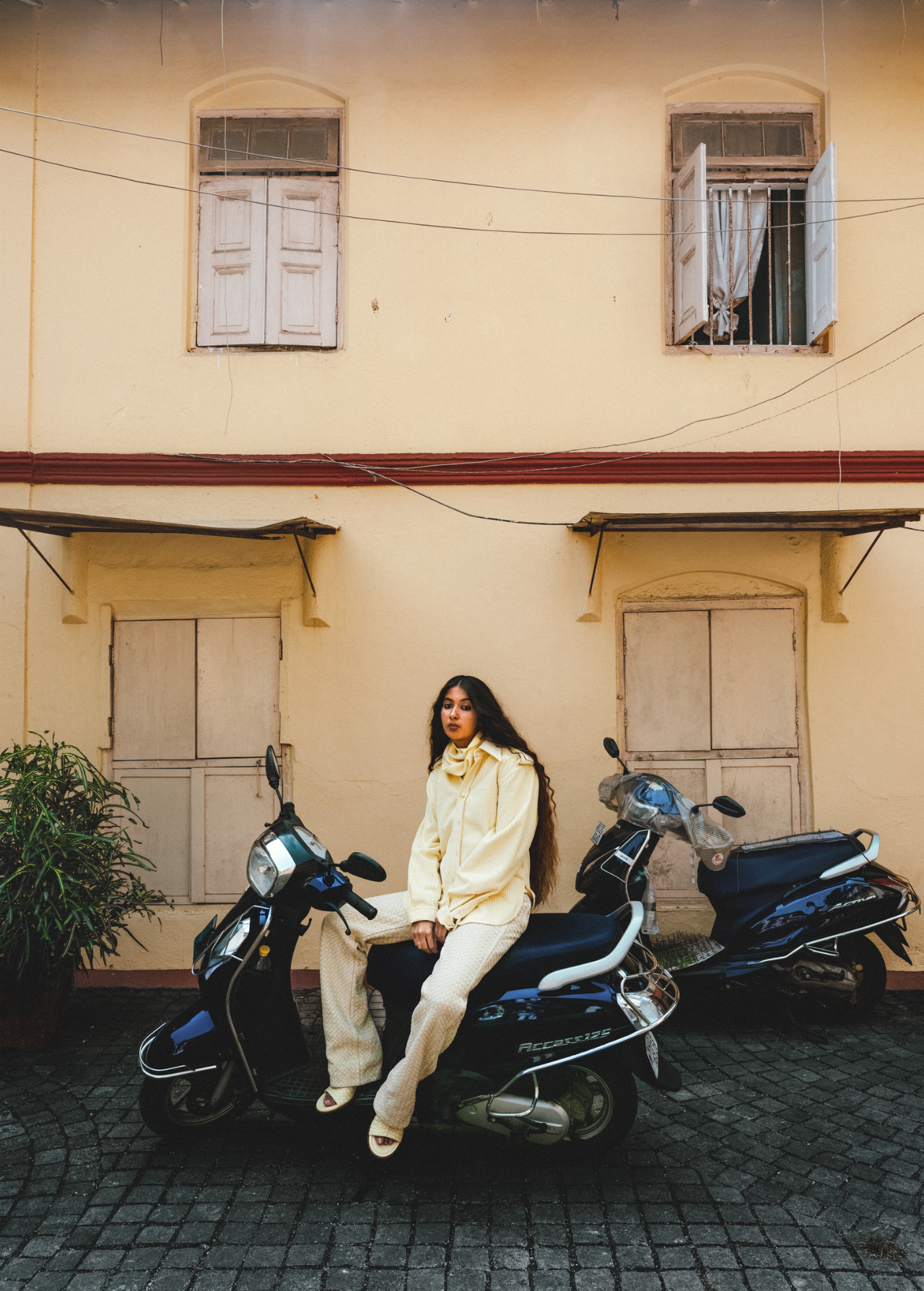
Authenticity online has always, arguably, to some degree, had an element of performance; what matters is whether it holds true to the person giving said performance. Diya’s is built from the things that are genuinely hers – her clothes, her neighbourhood, her favourite music.
But to understand how she got here, albeit in a very short space of time, you have to look beyond the Diya you’ve seen online. Before the virality, she was studying international relations, politics and sociology in New Zealand. While her academic path was far from where she’d find her footing career-wise, the then university student gained her fashion education through vintage shops, first in Auckland, then in London, where she also began styling. “I just felt like I was wasting my potential,” she says, so she decided to make clothes of her own.
With no formal training, she turned to YouTube tutorials, teaching herself the fundamentals of cutting, stitching and construction from her London apartment. One of her first pieces, a bronze faux-leather jacket, took about three weeks of trial and error. “I put it on and went downstairs to go find my friends to have a drink,” she recalls. “I got stopped by about six people in the 10-minute walk to the bar, asking where the jacket was from.”
It was at the end of 2024 that she decided to quit her job and London. “I think everyone around me was questioning why I quit my job and also thinking I was insane for wanting to launch a fashion brand when I hadn’t even studied fashion,” she says. “I never doubted myself even once and proving everyone wrong was fun, I guess.” It’s interesting, though: there is no retrospective admission of sleepless nights, no neatly packaged lesson about learning to believe in herself. Diya just appears to have always had that quiet confidence that it would happen for her.
Returning to Mumbai was a chance for her to hone her craft professionally, but it was also a personal one. “I knew if I really wanted to do this, I needed to be in India to have my own studio and everything,” she explains. “And also, I just didn’t see the point of living outside of India anymore.” There was a simpler reason too: “I just didn’t really like the cold.” Touché.
Diya’s decision also inadvertently goes against the traditional geographic route in the world of fashion, in which success meant proximity to the four fashion capitals: London, Paris, Milan and New York, all of which are, of course, Western-centric cities. But with the internet democratising so many aspects of culture, including fashion, it meant Diya could build something in Mumbai and show it to the world without waiting for anyone’s permission.
And so she did. Six months after building a collection, which was funded by modelling work, she began posting in late 2025 (just over 12 months ago at the time of publishing), with her posts gaining momentum by the beginning of 2026. But why was there the need to post at all? “Because I wanted to launch my brand,” she says. “I was just trying to find a way to show my clothes and my city to the world in a way that hadn’t been done before.” The aim was to “do the opposite of what every other single person was doing.”
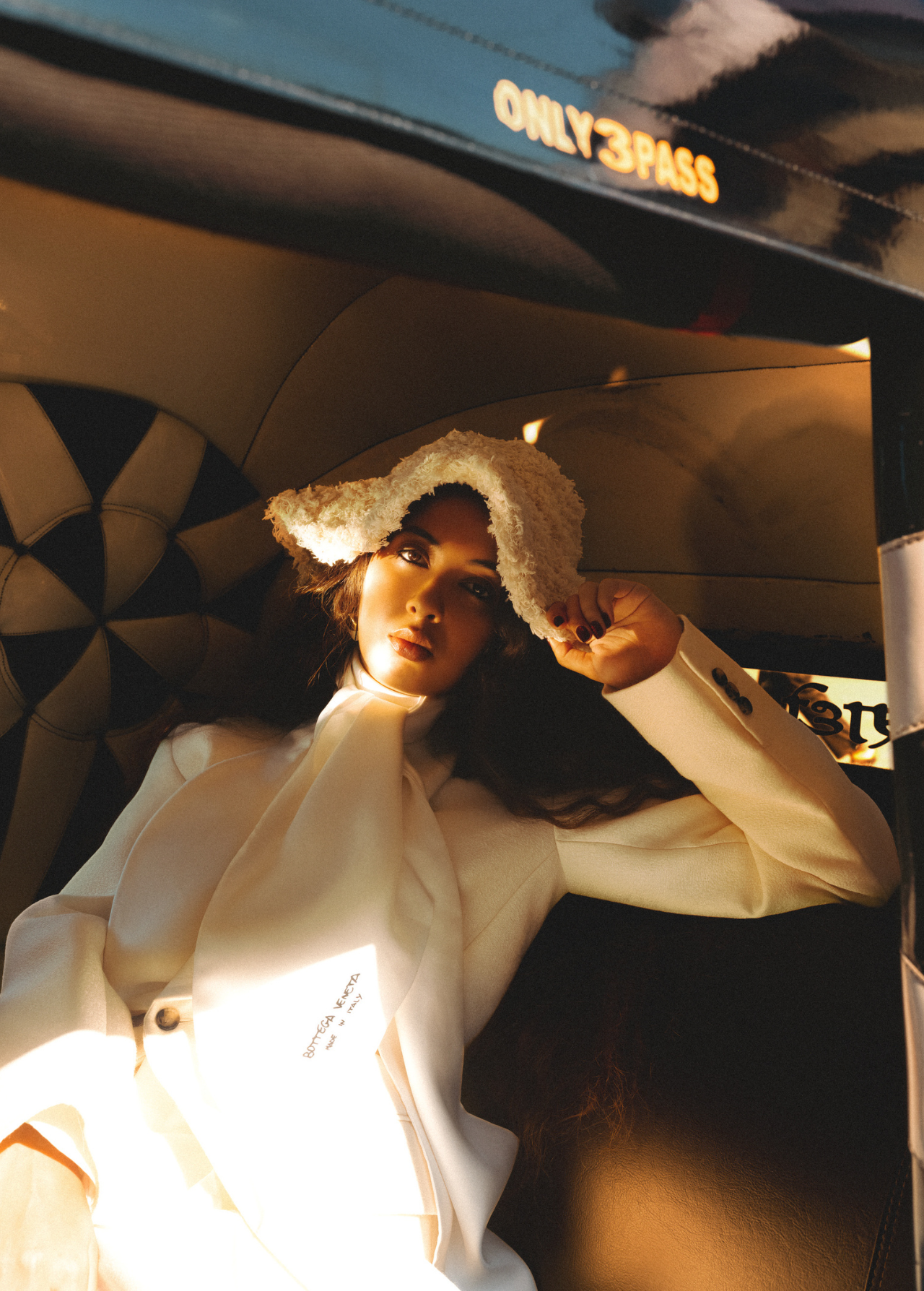
Her very first post went viral. “I was in my bedroom,” she remembers. “My best friend called me and was like girl, wtf.” The formula was deceptively simple: Diya, her clothes and the city around her, set to music by her favourite artist, Frank Ocean.
(Side note: Has he seen them? “I’d love to think that he’s seen it,” she says. If they ever met, she knows what she would ask: “if he wanna be my friend and hang out.”)
With fashion stories largely set against Western capitals, there was something refreshing not only about Diya, but about seeing her present her beloved city without apology or explanation. The streets and its people (and even some animals) became part of the story and much of the point of the content. Soon, videos appeared from Beirut, Almaty, Tbilisi, Dubai, Bangkok, and beyond, as fellow creators borrowed the same visual language to celebrate their own cities and neighbourhoods. “I think it was a combination of all these cities around the world that you never really see online and people showing off their neighbourhoods, community and fashion,” she says. “Made my heart so full.”
What began as marketing for a fledgling label became something bigger. “I was kind of just doing it to put India on [the map],” she says. “But it just kind of showed that we can decentre the West. Which has been needed for a long time, to be honest. You can just be whoever you want to be wherever you are.”
But such visibility can raise the question of whose version of a place is being seen. Mumbai, one of the most populous places in the world, holds vast wealth and real hardship, often on the same street. The rickshaw drivers, local trains and roadside stalls that give the videos their texture belong to a working city, while the pieces she wears, mostly priced in the hundreds of dollars, are made for a far smaller audience. Is everyday life being turned into a backdrop for fashion?
It is a fair question and one that applies well beyond Diya herself. Fashion has long borrowed the energy of the street while selling to people far removed from it. What sets her apart is that the city is not merely scenery. Neighbours wander into frame and ask to be in the next video, and the clothes are made by hand by a team rooted in the city – and Diya insists what we see is real. Case in point: our cover shoot, shot right on the very streets where she shoots her own content, with many stopping either out of interest or to be a part of the story themselves.
“Until you actually come here, you’re not going to understand that it’s not staged,” she insists. “It’s actually like this. I feel like my videos have kind of communicated that.”
This is arguably exactly what her eponymous brand, DiyaDiya, stands for. It’s a question of how traditional Indian craft can live inside a contemporary fashion vocabulary. “I just take the best tailoring possible that I really like, and then I take all of the traditional embroidery techniques and I mix both my worlds together,” she says. “Which a lot of people are doing, but I like to think I do it really well.” The result is neither a rejection of heritage nor a straightforward reinterpretation of it. It is alchemy in the truest sense: familiar materials and traditions transformed into something unexpected.
Diya now oversees a team of around 50 to 60 people across two studios in Mumbai – one for design and one for embroidery – and her relationship with her craftspeople is central, and occasionally combative. “Almost every piece I make, I go back and forth with my team on how exactly we are going to bring the embroidery to life,” she says. Leather is the sticking point, as it is notoriously difficult to embroider. “I don’t take no for an answer, so I always win.”
It turns out, not always, though. When she is away, her team sometimes improvises with the embroidery colours. “I can’t understand why,” she says, though she admits the results are “more often than not” happy mistakes. And some of those pieces have even gone on sale anyway, and been successful. “I’ve learned that just because I don’t love something, it doesn’t mean that somebody else won’t.”
It also raises the question of who holds the authority in the room, given the largely male-dominated nature of tailoring in India. Sewing at home has long been seen as women’s work, something learned from mothers and grandmothers. As a trade, though, tailoring and embroidery are overwhelmingly led by men, many of whom have spent decades mastering their craft. Fashion often carries the same double standard: when men build it, it is an industry; when women do it, it is too easily dismissed as something softer.
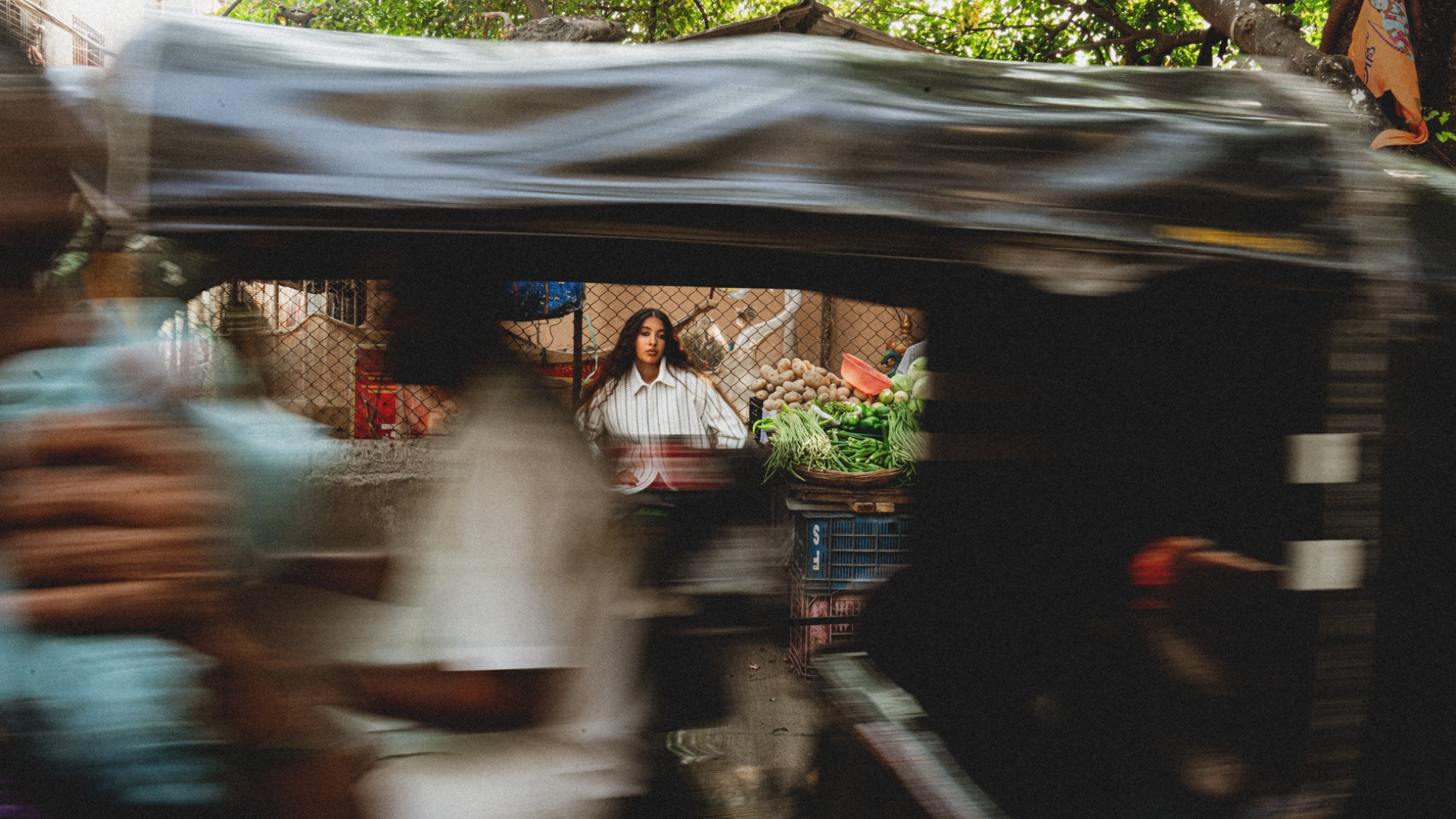
It’s something Diya walked straight into when she first brought her designs to an experienced master tailor; she was young, self-taught and a woman telling a man how to approach work he had done for decades. “I got laughed at,” she says simply, “but he respected my determination and eventually agreed to help me.”
It is something she’d like to shift. “I would love to eventually change things in the embroidery and stitching industry in India and have a studio of entirely women, which is something I’m working towards,” she says. She is quick to credit the women already beside her. “I also want to shout out the three incredible women that run my studio with me and handle all my logistics and production.”
There was a fitting parallel on GRAZIA’s cover shoot, where almost everyone calling the shots, from photographer and stylist to creative direction and editorial, was a woman, as were those representing the fashion house. Diya noticed. “I felt so blessed to be around such an incredible team and work alongside so many talented women… best feeling in the world.”
For all the collective work behind it, the public face of DiyaDiya remains its founder, which was never quite the plan. “I’m a designer, and I have my own brand, but somehow in the middle of this, I’ve also turned into a public figure,” she says. “You just wake up every morning and you pick one thing. Like, today I picked this.”
It is an interesting admission from someone so open about her ambition. While Diya describes becoming a public figure as something that happened “somehow in the middle of this,” almost by accident, she is equally candid that when she quit her job, she “knew it was going to be big.” Both can be true: she may have planned for the brand to take off without expecting that she, personally, would become the story. But it adds to the sense that, with Diya, the line between instinct and intention is harder to draw than it first appears.
“You don’t need to be someone to get somewhere, you know? You can just build it yourself.”
There is a similar tension in who she now works with. She set out to put Mumbai on the map, yet her rise has brought collaborations with Nike and Diesel, alongside invitations to fashion events abroad. The recognition, too, keeps arriving from the same direction. In November, TIME named her to its first-ever TIME100 Next India list of 100 emerging figures shaping the country’s future.
And she has done it without a manifesto, a speech or a single word to camera. In an industry that has always rewarded those who talk the loudest, her authority has been built almost entirely in silence.
She hopes the message travels. “I just hope that the other kids in India see it,” she says. “I always say this. You don’t need to be someone to get somewhere, you know? You can just build it yourself.”
The challenge now is handling that recognition without losing what earned it. So far, her answer is to be careful. “I say no to most things but only because I’m very intentional and like the focus to be on DiyaDiya more than other things,” she says. “I’ll usually only say yes if it’s collaborative in some way.”
Of course, recognition is now a part of everyday life and in a quiet moment between locations in Bandra West, she is more candid than her content lets on. “It’s definitely overwhelming,” she admits. “Sometimes there’s just heaps of people around. Sometimes there’s nobody around.” Then, almost in the same breath: “But I’m grateful… it’s all love.”
But abroad, it’s even more intense. A recent pop-up in Sydney for DiyaDiya drew in crowds in the thousands. “I actually couldn’t even fathom that because Australia is so far away from India,” she says. “The love was so overwhelming.” On one airport layover, she was spotted despite her best efforts. “I was wearing a stupid outfit and had my hair hidden,” she recalls. “Someone came up to me and told me they recognised me from my tattoos and that was crazy to me.” She had always assumed it was the clothes. “But, no matter what I wear,” she says. “So that was kind of shocking to me.”
It is a peculiar type of fame, though. Strangers know her by her walk, her hair, even her tattoos, but very few know her voice.
Her private world, meanwhile, remains firmly rooted in Mumbai. Diya grew up with around 200 relatives in the same building, six cousins raised alongside her like siblings, and a younger sister. “They are my biggest fans and couldn’t be more supportive,” she says of her cousins. “Since day one too.”
Her father sometimes films her videos, though she is quick to correct any idea that he directs them. “He’s not a director. I just show him how to hold the phone and he walks backwards; it’s really sweet.”
Her mother is the one person she always shows a new design to. “She’s got a really good eye,” she says. “I think she just really understands my brain. I don’t know why I do that, because I don’t like to listen to people. But I just do it anyway.” Her mother never tells her a piece is wrong, only how to make it better. “Mamma always knows best,” she says. Does she take the advice? “I hate to admit it, but yes, I almost always listen. Except for pants and jeans. Pants, I don’t listen to anyone.”
It is a wonderfully ordinary admission from someone whose online presence can feel almost untouchably composed. These glimpses of humour and family life reveal a different side of her, without dismantling the privacy she has so carefully maintained. But she keeps returning to the work, and to Mumbai.
If the last year of getting to know “that cool girl from India” is anything to go by, what is actually “cool” no longer needs to be certified in Paris or New York. It can be made in a Mumbai studio, worn down a Mumbai street and recognised, eventually, by the very institutions that once decided such things.
“I keep trying to communicate this through interviews,” she says as we drive. “This whole city is just built on people helping each other.” In writing, she puts it even more simply: “People show me love and kindness every day. That’s why it’s my favourite city in the world.”
It is evident, though, that Diya has built an entire visual language around the contradictions of Mumbai as a city – the beauty in the imperfect, the extraordinary in the seemingly ordinary.
Which leaves one question: what happens when the internet moves on? After all, this rapid rise has all happened within less than a year, not to mention virality is unpredictable and fashion has a habit of celebrating its newest discoveries before turning elsewhere. But Diya seems far more interested in building something that outlasts a simple viral moment. “I like to think people could wear my pieces 20 years ago and also 20 years from now. They’re pretty timeless,” she says. “Most of all, I want them to look at the piece and feel the love that was put into the craftsmanship and be proud to wear something that was handmade in India.”
If the last year of getting to know “that cool girl from India” is anything to go by, what is actually “cool” no longer needs to be certified in Paris or New York. It can be made in a Mumbai studio, worn down a Mumbai street and recognised, eventually, by the very institutions that once decided such things.
As for the mystery surrounding Diya Joukani? I would say that doesn’t need solving. In a world obsessed with knowing everything about everyone, there is something outwardly refreshing about a creative who would rather be understood through what she makes and where she makes it.
Mumbai is a city that keeps moving, indifferent to the millions of screens through which its streets have become oh-so familiar. In between it all, Diya is still making her clothes, and, for now, she seems content to let them do the talking.
PHOTOGRAPHY: AVANI RAI
FASHION DIRECTION: KIM PAYNE
HAIR: UMANG THAPA
MAKEUP: ELENI CHATZINIKOLIDOU
EXECUTIVE PRODUCER: STEFF HAWKER
LOCAL PRODUCTION: ERNEST GEORGE, SALIM SHAIKH / ATISUTO CREATIVES
PRODUCTION COORDINATOR: REBECCA VINCENT
TALENT MANAGEMENT: WIRED PR
PHOTOGRAPHY ASSISTANT: HARMAN
TALENT: DIYA JOUKANI
WORDS: OLIVIA MORRIS


