










Photo: Oriol Tarridas
Art Basel Miami Beach and more than 20 satellite fairs make the Magic City the ultimate December playground for global art collectors. Yet a decade ago, when Argentine hotelier Alan Faena first welcomed these moneyed snowbirds to his five-star Faena Miami Beach on Collins Avenue, he did something unusual: Through his Buenos Aires–based nonprofit, Faena Art, he placed ambitious site-specific projects directly on the sand, beyond the resort’s gilded walls. Land artist Jim Denevan’s illuminated mandala Solar Light Geometry inaugurated Faena Art’s use of the public beach as a plein-air gallery, and the following year 30,000 spectators turned out for Tide by Side, a parade featuring South Florida cultural groups—from the Little Haiti Cultural Center to the Miami Gay Men’s Chorus—marching alongside international artists such as Los Carpinteros and Ernesto Neto. “Nobody was doing any exhibitions on the beach—it was only to take sun or to walk,” Faena recalls. “We were the first to use that amazing wide stretch of sand to make art accessible to everyone.”
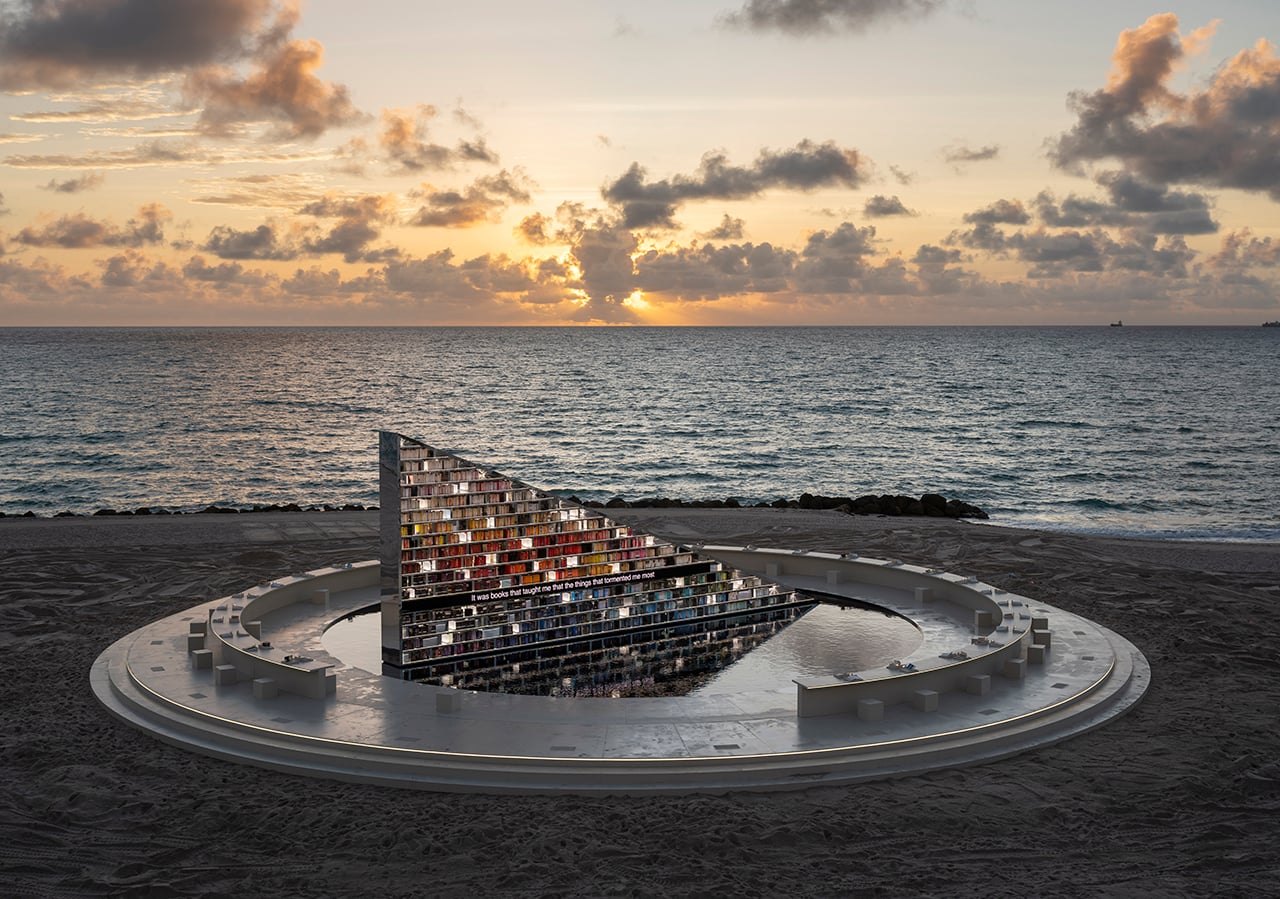
Since then, Faena Art has collaborated with established names like Derrick Adams and Studio Drift, alongside local talents including Alexandre Arrechea and Kelly Breez, commissioning installations that address urgent social and ecological questions. Highlights include Faena Prize for the Arts winner Paula de Solminihac’s Morning Glory (2022), a topographic installation of wooden decks shaped like the dune-stabilizing beach vine, and Alaska Native artist Nicholas Galanin’s Seletega (2024), a 40-foot sculpture of a shipwrecked Spanish galleon that brought colonial and Indigenous histories into conversation. “That was a big start,” Faena reflects. “Ten years later, we are here to continue pushing boundaries.” To mark this milestone, Faena Art has invited British artist and stage designer Es Devlin—whose large-scale work includes immersive installations and show sets for Chanel and Dior—to create Library of Us, a monumental library of 2,500 books.
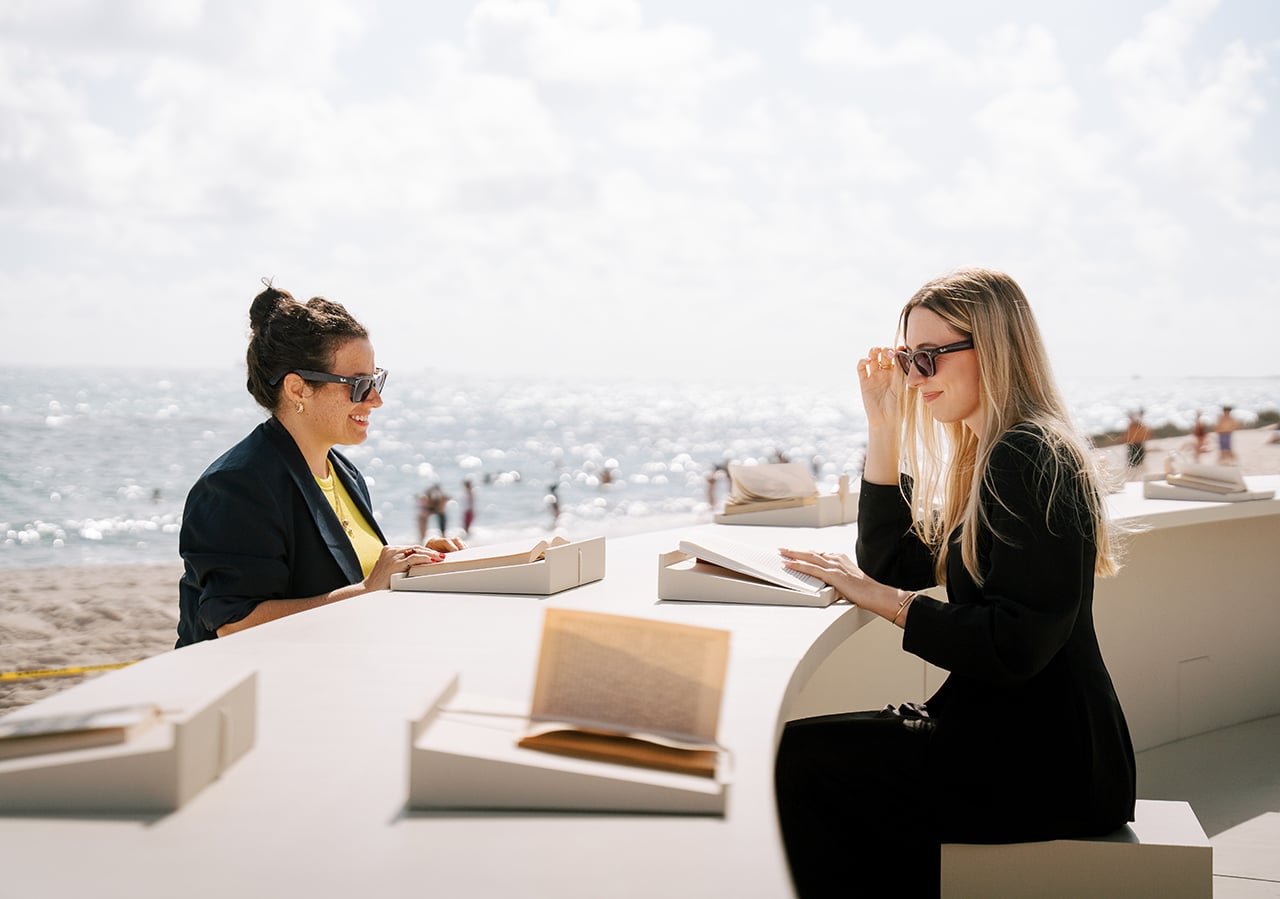
Photo: Sunn Studio
“I wanted to offer a response to the question I had been asked again and again by students and young artists: ‘Where do your ideas come from?’” Devlin says. “Over time I have offered a range of answers, often quoting Jorge Luis Borges: ‘I am not sure I exist actually. I am all the writers that I have read.’” Devlin first connected with Faena’s founder over their shared love of reading. She discovered his writings on architecture, and the two had wide-ranging discussions about their favorite texts (his span from Carlos Castaneda’s The Teachings of Don Juan: A Yaqui Way of Knowledge to Hardy Boys mysteries). The idea for Library of Us grew from her determination to promote close reading in a world of distraction and builds on earlier kinetic installations in London and Milan that drew thousands into focused encounters with books. “My immersion in the text had become constantly interrupted by the phone in my pocket, calling me with its dopamine promise,” she says.
Library of Us opens December 2 and runs through December 7, transforming a day at the beach into an immersive literary experience. A triangular bookshelf at the center slowly revolves, surrounded by a donut-shaped reading table with stools on the inside turning in sync with the shelves, allowing 60 visitors to have an impromptu book club. LED text lines appear in both the beachfront installation and its companion Reading Room inside the hotel’s Juan Gatti–muraled Faena Cathedral. Texts are displayed in English, Spanish, and Haitian Creole, with the voice track supporting visually impaired visitors. “Es’s piece is a reflection on how we lose our connection with the history of humanity if we lose our connection with books,” Faena says. Devlin’s selections—including Rachel Carson’s Silent Spring, Mary Shelley’s Frankenstein, and Ocean Vuong’s On Earth We’re Briefly Gorgeous—engage with themes central to Faena Art. After the run, all books will be donated to Miami public libraries and schools, extending the project’s impact beyond the shoreline.


