










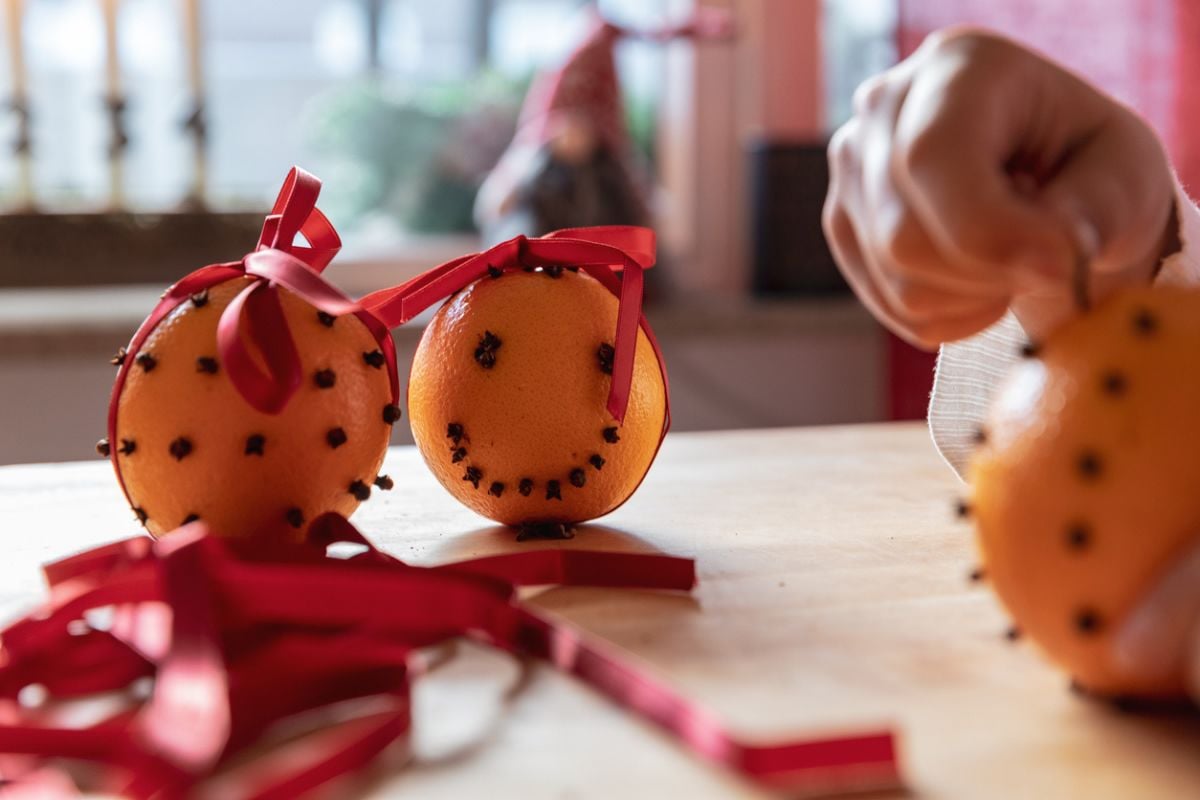
An orange, a handful of cloves and a few centuries of history: the simplest holiday decoration is also one of the most fragrant. Maybe you remember it from your grandmother’s kitchen: an orange covered in tiny cloves, sitting in a bowl or hanging from a ribbon, filling the room with a warm, spicy smell. It looked a little odd, and nobody quite explained it. It was just part of the holidays.
That studded orange has a name: a pomander. And according to Barbara H. Smith, a horticulture agent with Clemson University’s Home and Garden Information Center, it has a much longer history than most of us realize.
Where the Tradition Comes From
Pomanders date back to the late Middle Ages, when people carried them to guard against illness or to mask bad smells. The name comes from the old French “pomme d’ambre,” or “apple of amber.” In 1700s America, citrus was a luxury, but wealthier colonial homes still used pomanders to cover unpleasant odors.
The holiday connection came later. In the mid-1800s, the Victorian era, Prince Albert helped popularize live greenery and Christmas trees. Over time, the clove-studded orange became a common holiday decoration in many American homes, hung on trees, tied to garlands or tucked into centerpieces.
How to Make One
You need very little: oranges, lemons or limes, whole cloves, a wooden skewer or toothpick, a marker and paper towels. Draw your design on the fruit first, from simple lines to swirls or stars. Then use the skewer to poke shallow holes along the lines, just deep enough to pierce the peel, and push a whole clove into each one. If you plan to hang the pomander, tie the ribbon around the fruit before you start, so it does not sit on top of the cloves. Expect a little juice and keep paper towels nearby. Children love helping, and a toothpick is easier for small hands.
How to Make It Last for Years
A fresh pomander lasts about a week. To keep it longer, Clemson recommends rotating it often, refrigerating it at night and discarding any that grow mold. To make one that lasts for years, dry it. The fastest way is a food dehydrator on low to medium heat, about 100 to 115°F, until the fruit is hard. The traditional way is to place each pomander in its own paper bag with 2 to 3 tablespoons of ground orris root, shake gently to coat and let it cure for about 3 to 6 weeks, checking for mold. A dried pomander feels light and sounds hollow when tapped, and it can be brought out year after year.
Simple, hands-on projects like this are good for the mind too, as these mentally stimulating hobbies show. And many women have learned to value small, meaningful traditions over expensive ones, one of the quiet signs a Gen X or Boomer woman is hard to impress. The lesson worth borrowing is that the most memorable holiday decorations are often the ones you make by hand.
The Bottom Line
Sticking cloves into an orange creates a pomander, a fragrant decoration that dates back to the late Middle Ages and became a Victorian-era holiday favorite. Make one in an afternoon, then dry it with a dehydrator or orris root so it lasts for years.


