










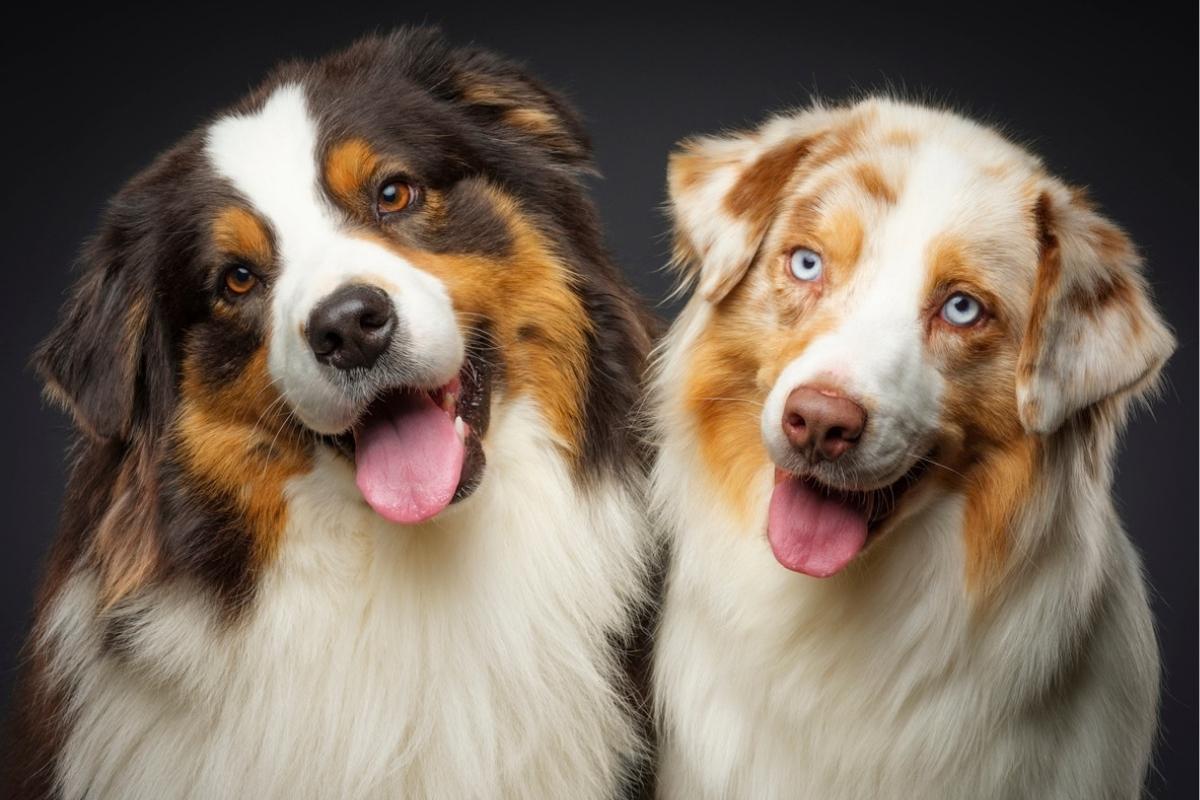
You say your dog’s name and there it is – that irresistible sideways cock of the head, ears perked, eyes locked on yours. Most of us assume it is just an adorable quirk, maybe a sign they are confused or simply reacting to a funny sound. But what if that tiny tilt actually reveals something deeper about what is going on inside your dog’s brain? A group of Hungarian researchers set out to study how dogs learn words and accidentally uncovered a fascinating connection between head-tilting and canine intelligence.
What scientists were really looking for – and what they found instead
The discovery was not even the original goal of the experiment. Andrea Sommese, an animal science researcher at Eötvös Loránd University in Budapest, and his team were studying dogs’ ability to learn and recall the names of objects. During the process, they noticed something unexpected: dogs frequently tilted their heads while listening to their owners speak. That observation led them to formally investigate the frequency and direction of the behavior in response to specific human verbal commands. Their findings were published in the journal Animal Cognition.
Despite the centuries-long bond between humans and dogs, surprisingly little scientific attention had been paid to head-cocking behavior before this study. So what does it actually mean when your pup gives you that quizzical look?
The researchers divided dogs into two categories. “Gifted” dogs were those with an exceptional ability to memorize toy names, while “typical” dogs represented the average canine learner. The setup was straightforward: owners asked their dogs to retrieve a specific toy from another room by name – a command along the lines of asking them to bring a rope, for instance. Most dogs in the typical group struggled to memorize the names of even just two toys. The seven gifted dogs – all of which happened to be border collies – could remember at least ten different toy names that researchers had taught them.
The numbers that separate gifted dogs from the rest
When the team compared how often dogs tilted their heads upon hearing a retrieval command from their owner, the gap was striking. Gifted dogs cocked their heads 43 percent of the time, while typical dogs did so just 2 percent of the time. That is not a subtle difference. It is a dramatic behavioral split that suggests something meaningful is happening cognitively in that moment of tilting.
Scientists concluded that a dog’s head tilt may be a sign of heightened attention or, even more intriguingly, an indication that the dog is matching a spoken name to a visual image stored in its memory. In other words, when your border collie tilts its head after you say the name of its favorite ball, it might literally be picturing that ball in its mind before trotting off to find it.
The study also revealed a curious consistency. Dogs tended to cock their heads in the same direction every time, regardless of where their owner was standing in the room. Some were habitual right-tilters, others were confirmed left-tilters, and the researchers believe this may come down to individual preference. Earlier studies have shown that the right side of dogs’ brains tends to be more active when processing positive words and praise, as reported by Alexis Nedd for Mashable. That hemispheric difference could play a role in determining which direction a dog favors when it tilts.
Where the research goes from here
Monique Udell, a human-animal interaction researcher at Oregon State University who was not involved in the study, noted that the next logical step is to dig deeper into what the head tilt truly signifies. She raised the possibility that head-tilting could eventually be used as a predictor of word-learning aptitude, attention span, or memory capacity in dogs. If that turns out to be the case, a simple behavioral cue we have always found charming could become a genuine diagnostic tool for understanding canine cognition.
The study authors themselves acknowledge that research into this area is still in its early stages. We do not yet have a definitive answer about why some dogs tilt and others do not, or whether this behavior can be trained or enhanced. But the preliminary evidence is compelling enough to warrant further investigation, and the connection between a seemingly simple gesture and complex mental processing is exactly the kind of finding that reshapes how we think about animal intelligence.
What you can take away from this
The next time your dog tilts its head while you are talking, you might be witnessing more than just cuteness. That small movement could be a window into active mental processing – your dog concentrating, recalling, and possibly visualizing the very thing you are describing. We are still far from fully decoding what goes on behind those attentive eyes, but one thing is becoming clearer: the dogs who tilt the most may genuinely be working harder to understand us. And honestly, that only makes the gesture more endearing.