










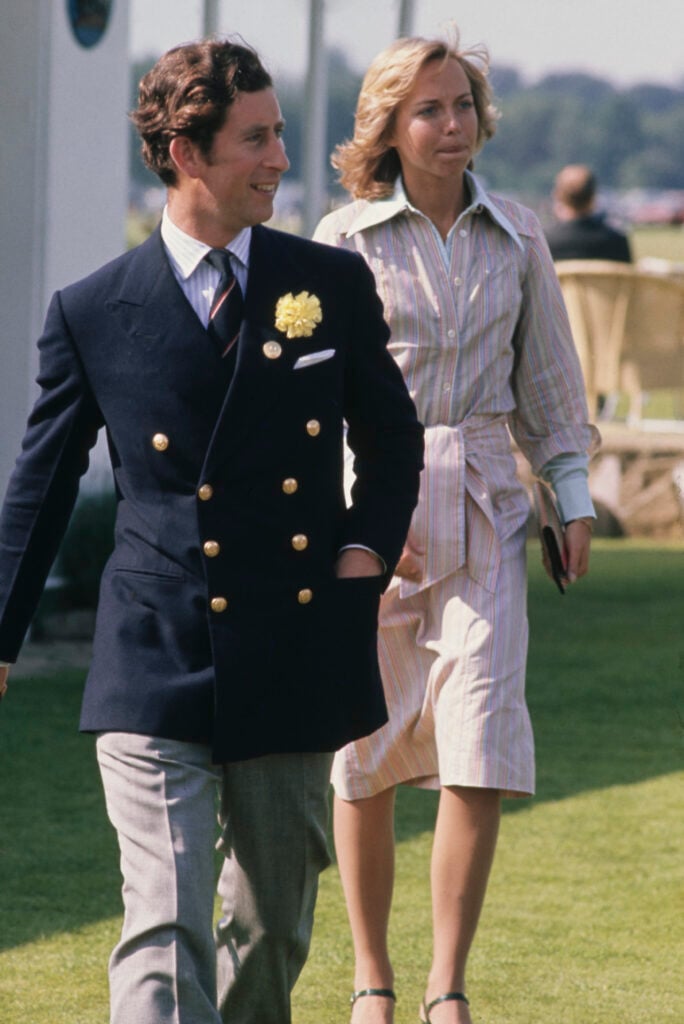
A year before Diana Spencer said yes, another young woman was asked the same question by the same man, and she said no. She had every reason to accept. Her grandfather had spent a decade arranging it. The Duke of Edinburgh approved. She and the Prince of Wales were second cousins who had known each other since childhood, and by all accounts they genuinely liked each other. But Amanda Knatchbull had grown up close enough to the throne to understand exactly what marrying into it would cost, and in 1980, at 23, she decided the price was too high. Forty-six years later, she is one of the very few people alive who can say what it looks like to have turned down the crown, and to have been right.
The bride her grandfather chose
Amanda Knatchbull was born in London in June 1957, the daughter of John Knatchbull, Lord Brabourne, a film producer, and Patricia Mountbatten, the elder daughter of Earl Mountbatten of Burma, the last Viceroy of India, Prince Philip’s uncle and, in the phrase Charles himself used, his “honorary grandfather.” Mountbatten was the most influential figure in the young prince’s life, and he had a plan for it. As early as 1974, according to Jonathan Dimbleby’s authorized biography, Charles wrote to Amanda’s mother, who was also his godmother, to raise the question of marriage. Patricia was sympathetic, but pointed out that her daughter had not yet turned seventeen and that the subject should wait.
It waited, but not far. Through the second half of the 1970s the two spent time together, on and off, at Broadlands, the Mountbatten estate in Hampshire, and on family holidays, and the royal press began to describe her, with the confidence of people who had been briefed, as the likeliest future Princess of Wales. Mountbatten made no secret of his hopes. He had, by some accounts, planned to take the two of them on an official tour of India together in 1980, a trip designed to be as romantic as it was diplomatic. That trip never happened.
The summer everything changed
On August 27, 1979, an IRA bomb hidden aboard Mountbatten’s fishing boat exploded off Mullaghmore, on the coast of County Sligo. It killed the 79-year-old earl instantly. It also killed Amanda’s grandmother, the Dowager Lady Brabourne, who died of her injuries the next day; a fifteen-year-old local boy, Paul Maxwell, who was crewing; and Amanda’s younger brother Nicholas, who was fourteen. Her parents and Nicholas’s twin, Timothy, survived, badly hurt. The attack was one of the most devastating single blows the royal family suffered in the twentieth century, and for the Knatchbulls it was the loss of three generations in a single morning.
Charles was shattered. His journals from that autumn, quoted by his biographers, describe a grief he could barely put into words. And it was in the months that followed, with the man who had engineered the match now gone, that he asked Amanda to marry him.
Why she said no
She turned him down, politely and, it seems, without drama. The reason she gave has been reported consistently for forty years by the people closest to the story. According to the royal biographer Sarah Bradford, Amanda “refused him” because she was “unwilling to step onto the royal treadmill.” The historian Robert Lacey put it more fully in his book Battle of Brothers: what joining the royal family demanded, in her view, was a surrender of self to a system, and a loss of independence far greater than marriage usually asks. She had watched her grandfather live inside that system for sixty years, and had just buried him because of it. She knew precisely what she was declining.
What makes her decision remarkable is what happened next. Charles was 31 and under mounting pressure from his family to marry. Within a year he had proposed to a nineteen-year-old kindergarten assistant who had none of Amanda’s inside knowledge of royal life and all of the enthusiasm Amanda lacked. Diana Spencer said yes in February 1981. Amanda Knatchbull was among the guests at St Paul’s Cathedral that July, watching another woman walk into the life she had turned down. Everything that followed for Diana, the scrutiny, the loneliness, the marriage that could not survive it, is the case for what Amanda had understood at 23.
The life she chose instead
She did not disappear, and she did not marry into another great house. She went to work. Amanda trained as a social worker and spent the early part of her career in children’s services and child protection, the least glamorous and most demanding corner of the field, and later moved into a portfolio of board and chairing roles at charities working with vulnerable people, particularly children. On October 31, 1987, she married Charles Ellingworth, a novelist and property entrepreneur, and they have three children, now adults. She is styled Lady Amanda Ellingworth, a courtesy title from her mother’s earldom, and she uses it about as often as she uses the story of the proposal, which is to say almost never. She has given no interviews about it.
She did not lose the friendship, either. Lacey notes that the mutual respect between the two cousins has lasted to the present day, and the Knatchbulls remain among the families closest to the King. But she has spent forty-six years on the outside of the fence she chose not to climb, raising children, running charities and living a life that, by the standards of the family she was almost part of, is almost entirely private. At 69, that is not a footnote to the story. It is the story.
The one who said no, and the one who couldn’t
Every royal generation has one of these women, it turns out. Chelsy Davy walked away from Prince Harry for reasons Amanda Knatchbull would have recognized instantly, and Charles’s own earlier romances, from Davina Sheffield to Lady Sarah Spencer, ended on the same rocks. What sets Amanda apart is that she was the one the family actually wanted, and the one who knew enough to decline. History has been unusually kind to her judgment. The woman who said yes instead became the most famous person in the world, and paid for it in every way a person can. The woman who said no is, by every available account, content. Sometimes the most radical thing a woman can do with a crown is hand it back.


