










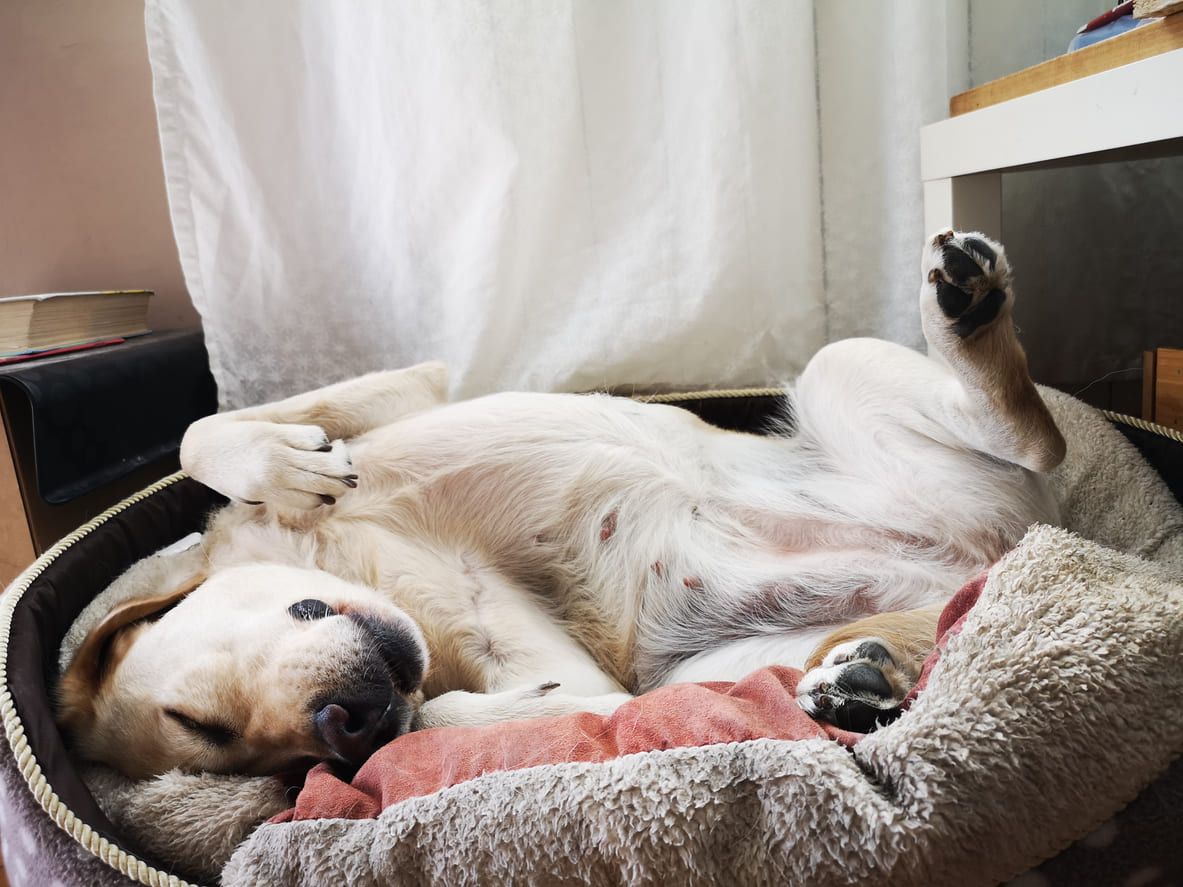
You have probably watched it a hundred times. Your dog approaches the bed, the couch, or that favorite corner of the rug – and then starts spinning. One rotation, two, sometimes three or more, followed by a dramatic flop. It looks quirky, maybe even a little neurotic. Most of us laugh it off or scroll past the cute video. But what if that nightly pirouette is far more purposeful than it appears? The truth is, your dog is not being dramatic. That pre-sleep dance is coded deep into canine DNA, and its origins tell us something genuinely fascinating about survival in the wild.
Why your dog cannot simply lie down like you do
Unlike us, dogs do not just collapse onto a mattress after a long day. They invest real time and energy preparing their sleeping spot, and sleep seems to elude them until the routine is complete. Dog behaviorists believe this circling ritual is inherited directly from canine ancestors such as wild wolves. Domestic dogs retained this genetic predisposition even though they now live in climate-controlled homes with plush pet beds.
So why does a behavior rooted in wilderness survival persist in an animal that sleeps on your sofa? Evolutionary behaviors aimed at self-preservation are remarkably strong influences. They persist for generations across the animal kingdom, long after the original threat has disappeared. Your golden retriever may never encounter a predator in the living room, but the instinct remains fully intact.
The survival logic behind the spin
One key explanation is threat detection. Some wildlife biologists believe that wolves sleep with their noses oriented to the wind so they can quickly pick up a threatening scent. Circling allows the wolf to determine wind direction and position itself for the best possible early warning system. A single whiff of danger is enough to trigger an alert for a potential attack. The dog may innately understand that positioning matters, even if the modern version of that positioning happens on a memory-foam cushion.
Pack dynamics add another layer. Wild canids – wolves, foxes, and coyotes – travel in family groups. The pack is protective of its members and constantly on the lookout for stragglers. Turning around before settling down helps group leaders assess the pack and survey the area for anyone who has fallen behind. It also provides one last scan for potential predators before the group goes to sleep. Every pack operates within an established hierarchy, with some members more dominant and others more submissive. The bedtime turning routine may even serve as a ritual that reinforces a wolf’s place in the pecking order.
Then there is the most practical reason of all: comfort. Wild dogs did not have manufactured beds and pillows. They made their own sleeping quarters in nature by patting down tall grass, pushing aside prickly underbrush, and rooting out rocks and fallen tree branches. In colder climates, they circled to reposition snowbanks. This nesting procedure also flushed out unwanted inhabitants such as snakes or insects. On top of that, rearranging grass, snow, or leaves signaled to other wild dogs that the spot was claimed for the night.
Temperature control and the tight tuck
Weather was another powerful motivator. Wild dogs had no thermostat to turn down when it was hot and no blanket to grab when it was cold. They adapted through a process sometimes called denning to moderate the temperature of their sleeping quarters. In hotter climates, outdoor dogs scratched at the ground to clear away topsoil and grass that retained and radiated the sun’s warmth, exposing cooler soil underneath. Scratching and turning helped them find a more comfortable temperature for rest.
In colder climates, the strategy reversed. Wild dogs circled to wind themselves into tight balls, conserving personal body heat – the tighter the tuck, the warmer the dog. Pack members also gathered closely together in a tight circle to share warmth. Whether the environment was scorching or freezing, dogs had a genuine biological reason for turning around before bedding down. Our pet dogs still circle before lying down to get their beds just the way they want them. A quick fluff of the pillow simply will not do for a species that spent millennia perfecting a sleep-prep ritual under open skies.
There is, however, a moment when amusement should shift to attention. Dogs that are in pain will circle excessively as they struggle to find a more comfortable position. They may also crouch and rise several times before completely reclining. If your dog has difficulty settling down even after making several revolutions, it is worth consulting your veterinarian. Orthopedic disorders like arthritis, and neurological disorders such as spinal cord or back problems, can turn routine nighttime circling into a painful experience. With proper evaluation and therapy, bedtime can become comforting and comfortable once again.
What that nightly spin really tells you
The next time your dog launches into the pre-sleep twirl, you are watching something ancient. That little dance is a compressed replay of survival strategies honed over thousands of years – threat detection, pack communication, nest building, and temperature regulation, all rolled into a few seconds of spinning. Your dog is not being quirky. It is honoring an instinct that once kept its ancestors alive. And now you know: if the spinning seems excessive or painful, it could be a sign worth investigating with a professional. Otherwise, sit back and appreciate the tiny evolutionary performance happening right on your living room floor.


