










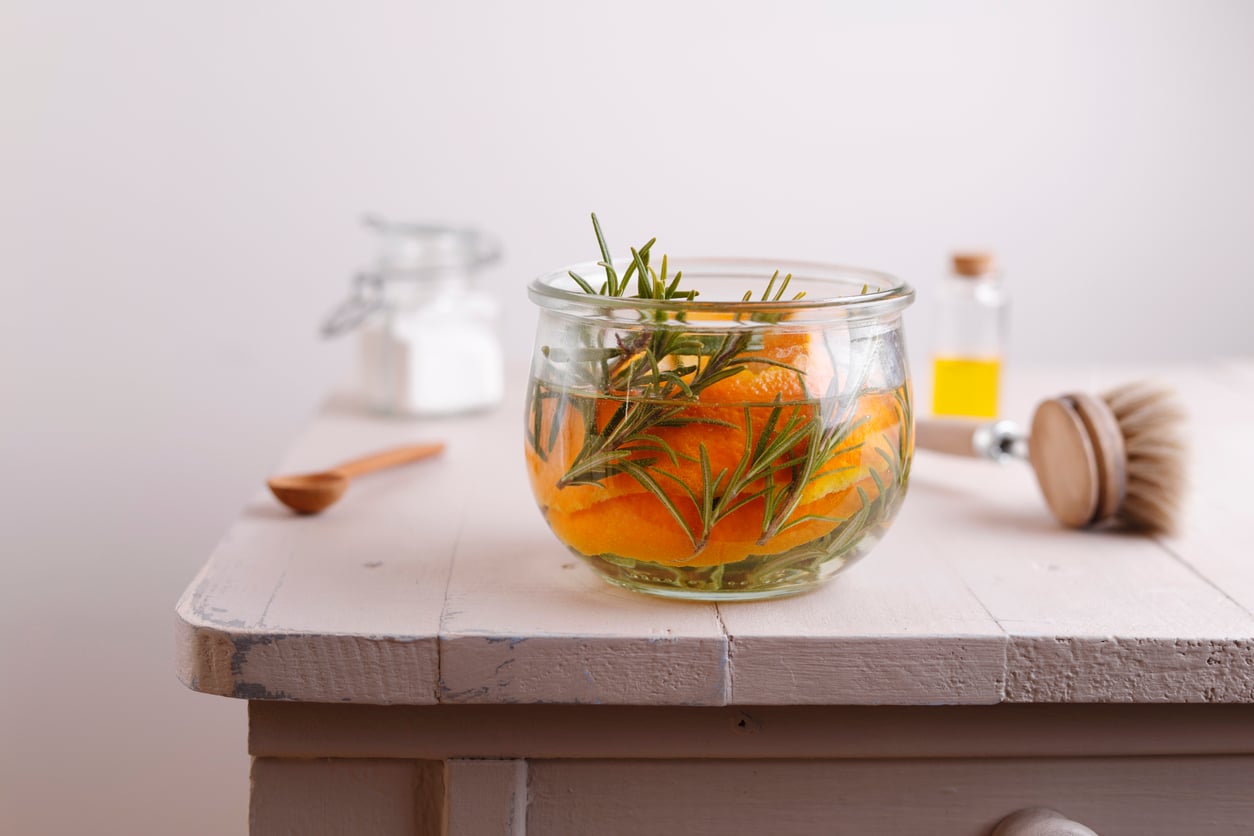
You walk through the front door after a long day and the first thing that hits you is last night’s stir-fry, the faint mustiness of a coat closet, or simply that vague staleness no amount of window-cracking seems to fix. Most of us reach for a scented spray or light a candle without thinking twice. But what if the very products we use to freshen the air are quietly releasing compounds we would rather not breathe? A surprisingly low-tech ritual – nothing more than a pot of water, three fresh ingredients, and a gentle simmer – might be the cleaner, more elegant answer we have been overlooking.
Why the air inside your home deserves more attention
Research from the OQAI and ANSES, two French agencies dedicated to indoor air quality, reminds us that we spend close to 85% of our time in enclosed spaces. Inside those walls, volatile organic compounds (VOCs), dust, and lingering cooking odors quietly accumulate. The same agencies note that certain commercial air fresheners can release benzene or formaldehyde – chemicals most of us would never knowingly invite into our living rooms.
So what happens when you want your home to smell like a pristine hotel suite or a chic hammam, without layering on synthetic fragrances? A simple decoction of eucalyptus leaves, lemon, and rosemary emerges as an almost low-tech alternative. The entire trick lies in this trio and in how gently you let it simmer.
The science behind each ingredient
Eucalyptus sits at the heart of the blend. Herbal specialists, including the French house Herbonata, point out that Eucalyptus globulus is rich in 1,8-cineole, a compound that activates TRPM8 receptors in the nasal mucosa – the same receptors triggered by menthol. Your brain reads a freshness signal, even though the actual room temperature has not changed at all. That instant sensation of cleanliness you associate with a luxury spa? It starts right there, at the receptor level.
Lemon completes the aromatic picture through d-limonene. International toxicological data sheets describe this molecule as highly volatile, with a flash point around 48 °C and a boiling point near 178 °C. That means it disperses into the air quickly as soon as the water heats up. D-limonene also binds easily to greasy particles responsible for stubborn odors, partially neutralizing them. And then there is rosemary, which contributes a warmer, herbaceous note thanks to its phenols, including rosmarinic acid. This prevents the scent from veering too medicinal and nudges it toward that botanical-spa impression instead.
Together, the three ingredients create a layered fragrance: cool and clearing on top, warm and grounding underneath. No essential oils required – just fresh plant material and a large pot of water.
How to do it right (and what to watch out for)
The method is as simple as it sounds, but the details matter. Place your eucalyptus leaves, lemon slices, and rosemary sprigs in a large pot of water. Bring it just to a gentle simmer, then immediately lower the heat so you maintain a steady wisp of steam rather than a rolling boil. If the water bubbles too aggressively, the tannins in the eucalyptus take over and the scent shifts toward a bitter herbal-tea smell – not exactly the vibe you are going for. Let the pot diffuse for 30 to 45 minutes, keeping an eye on the water level and topping it off with warm water as needed so the bottom does not scorch.
A few important caveats deserve your attention. ANSES emphasizes that indoor air quality depends as much on ventilation as it does on pollution sources. This mixture smells wonderful, but it does not purify or depollute your home. You should still open your windows for about ten minutes every day, even in winter. The steam rising from the pot also raises indoor humidity, and the US EPA recommends keeping relative humidity ideally between 30 and 50%, and below 60%, to prevent condensation and mold growth.
Sensitive individuals should proceed with extra care. ANSES notes that concentrated essential oils contain active substances that can irritate the respiratory tract, which is exactly why sticking with whole plant material here is the safer choice – skip the temptation to add drops of eucalyptus essential oil to the boiling water. Pet owners, take note as well: the ASPCA classifies eucalyptus as toxic to dogs and cats if ingested. Keep the simmering pot well out of reach, and avoid leaving an animal in a small, scent-saturated room.
A comfort ritual, not a miracle cure
Think of this three-ingredient simmer pot as a small act of everyday luxury rather than a comprehensive air-quality solution. You now know that its magic is grounded in real chemistry – 1,8-cineole tricking your brain into sensing freshness, d-limonene latching onto greasy odor particles, and rosmarinic acid softening everything into a warm, spa-like bouquet. The entire setup costs practically nothing and avoids the synthetic compounds flagged by air-quality agencies. Just remember to ventilate, monitor your humidity, and keep curious pets at a safe distance. Sometimes the most satisfying upgrade to your home is nothing more than a quiet pot on the stove.


