









You have probably scrolled past a dozen reels of the Amalfi Coast this week alone. Tuscany? You could navigate its wine roads blindfolded. But mention Calabria – the toe of the Italian boot – and even seasoned travelers draw a blank. That gap between reputation and reality is exactly what makes this southern region so compelling right now, a place where ancient myth lives in everyday gestures and a gelato shop in a town you have never heard of can deliver one of the best scoops of your life.
Where myths still breathe and children build giants for fun
In the coastal town of Pizzo, painter and ceramist Antonio Montesanti can make modern traffic dissolve into antiquity. Local fishermen, he explains, still scratch a crosshatched pattern with their nails into the cheeks of every swordfish they land. The ritual is meant to release the souls of the Myrmidons, the loyal warriors of Achilles who, according to legend, were transformed into these silver-blue fish after their commander’s death. It is the kind of detail that sounds like a museum placard until you realize people are doing it right now, on boats you can see from the harbor.
A short drive south in the ramshackle town of Nicotera – chosen in 1957 as one of the earliest data-collection sites for what would become the Mediterranean diet – three boys, roughly 10 or 11 years old, were spotted reenacting the early-medieval legend of Mata and Grifone. Normally these figures appear as giant papier-mâché puppets during local feast days. But this was no feast day. The kids had fashioned their own towering Giganti from cardboard boxes, dishwashing gloves, and wooden chairs, parading them uphill while a third boy hammered a drum. No screens, no agenda – just the sheer joy of living inside a story.
The coast of the gods and beyond
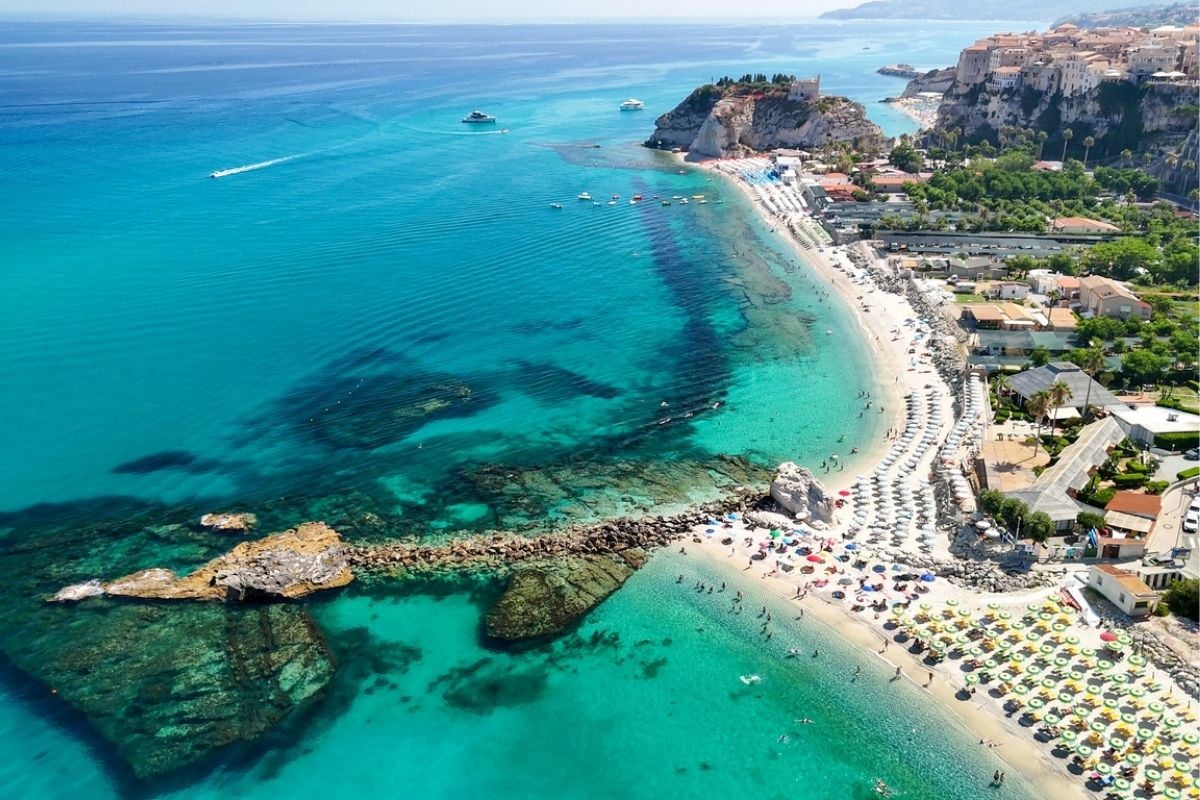
The stretch of Calabria that international visitors do occasionally find is the Costa degli Dei, or Coast of the Gods, a 34-mile ribbon of Tyrrhenian shoreline running from Pizzo to Nicotera. White beaches trade off with sheer cliffs and rocky coves, and Tropea sits at its heart – the only municipality in the entire region where foreign visitors outnumber Italians. Sandstone palazzi line its narrow streets, a medieval cathedral houses a 12th-century altar painting of the Virgin Mary, and from the steep seaward edge of the old town you can watch the sun drop behind Stromboli, roughly 30 nautical miles to the west.
Tropea is an hour’s taxi ride from Lamezia Terme International Airport, also reachable by train from Rome or Naples. But the deeper rewards of Calabria require a car and a willingness to wander. At the tip of the regional toe sits Reggio Calabria, the most populous city, facing Sicily and Mount Etna across the Straits of Messina. Its archaeological museum holds the Riace Bronzes, two fifth-century BCE Greek warrior statues pulled from the seabed in 1972 – works of such physical authority they make you involuntarily straighten your posture.
Head east along the Ionian coast and the scenery shifts again. Near the marine reserve of Capo Rizzuto, the 32-room Praia Art Resort in Praialonga offers barefoot luxury with hammocks suspended above the surf. Luxury travel outfitter Authentic Explorations, led by Gary Portuesi and Calabrian native Marco Palermo, launched itineraries here in summer 2025. Their six-night journey, called Savoring & Unveiling Calabria, threads through swordfish tastings, Calabrian chiles, cipolla rossa onions, and the iconic Tartufo di Pizzo, a ball of gelato encased in chocolate or hazelnuts. They recommend at least five nights between April and October.
Silk, gelato, and the restaurants only locals know
Calabria’s Ionian side rewards the curious. In the hilltop hamlet of Martone, chef-owner Pino Trimboli at La Collinetta serves organic pasta on terra-cotta roof tiles – farmworker style – including tagliolini with porcini mushrooms. In the hill town of San Floro, a cooperative called Nido di Seta, founded in 2013, has planted more than 3,000 mulberry trees and revived organic-silk production. Some 20,000 silkworms consume over a thousand pounds of leaves each month to yield roughly 90 pounds of silk per year. The cooperative produces its own scarves and dresses and in 2023 began supplying silk to Gucci – a milestone for a region better known for exporting talent like Gianni Versace, who was born in Reggio Calabria and started out at his mother’s dressmaking atelier.
Then there is the food. At a gelateria called K2 in the unassuming town of Cutro, the stracciatella delivers creamy fior di latte packed with dark chocolate chunks, and the coffee flavor tastes as though someone froze a fresh espresso and dusted it with hazelnut crumble. In Pizzo, Franco di Iorgi at Bar Gelateria Ercole – rival to Bar Dante across the Piazza della Repubblica – serves a standout strawberry granita alongside the classic tartufo. And Calabria has moved well beyond gelato: Michelin-starred Dattilo, on the Ceraudo family’s organic winery a 30-minute drive north of Crotone, opens its tasting menu with a fried phyllo sfogliatella filled with caciocavallo podolico cheese and sardella, a spicy paste of whitebait, peperoncino, and wild fennel seed sometimes called the caviar of the poor.
Just inland from Tropea, a rural property called Le Breste in the village of Brattirò serves fileja pasta with Tropea onions and pours wines from regional producers working with native grape varieties. Its guest rooms were restored using le breste, local adobe bricks made from mud and wheat husks. Even the hotel industry insider who recommended it seemed unsure outsiders would appreciate it – a telling sign that Calabria still harbors places frequented almost exclusively by locals.
What you should take away
Calabria occupies a rare position in Italian travel: ancient enough to carry myths in its daily rituals, undiscovered enough that you can stand alone in a hilltop piazza that would be overrun with selfie-takers in Tuscany. Gary Portuesi of Authentic Explorations compares it to Sicily two decades ago, before high-end tourism reshaped that island – he helped launch that wave when he founded what was then called Authentic Sicily in 2002. The infrastructure is growing, the Michelin stars are multiplying, and the silk is heading to Gucci. If you have been waiting for the right moment to explore the toe of Italy’s boot, the window between hidden gem and open secret is closing fast.


