









You probably have a jewelry box at home filled with rings, bracelets, maybe a locket or two. You know what’s inside those lockets – a tiny photo, perhaps a dried flower petal. Now imagine opening one and finding a carefully woven braid of human hair. Unsettling? Maybe. But for an entire era of history, that was the ultimate expression of love, grief, and devotion. And thanks to film, fashion, and a growing fascination with the macabre, this hauntingly intimate tradition is creeping back into the cultural spotlight.
Why the Victorians turned human hair into wearable art
We tend to think of the Victorian era as buttoned-up and reserved, but when it came to expressing emotion, these people went all in. Romanticism and the rise in Spiritualism at the time created the perfect conditions for deeply personal tokens of affection. Hair work – the craft of turning human hair into jewelry – was enormous among lovers, friends, and family members. The Victorians were, by all accounts, an extremely romantic folk.
The tradition most commonly began as a form of mourning. Mourning rings were decorated with small strands of hair taken directly from the corpse of a deceased loved one. These rings symbolized the closeness one felt to the person they had lost. They were not exclusive to any particular gender or class, which meant the practice spread quickly and opened the door to far more intricate designs. By wearing someone’s hair on your person, you were making a public announcement of your love – even in death.
So how did a grief ritual become a full-blown fashion movement?
From mourning tokens to must-have accessories
Hair work as an industry reached its peak around the 1860s, and by that point it had evolved well beyond mourning. The hair of a lover – secret or official – of a soldier heading off to war, of a child, or of a mother, could all be fashioned into braids, twists, and even images designed to adorn the arm, neck, finger, or blouse of the wearer. The process was originally called table worked hair, and it involved weaving the strands much like lace. Once the hair was prepared and shaped to the wearer’s taste, a goldsmith would manufacture custom fittings so it could be worn like jewels.
What made this trend truly democratic was its affordability. The process was relatively inexpensive, making it extremely attainable for those of lower and middle classes. That accessibility meant the fashion reached far and wide. Even Queen Victoria herself wore hair jewelry. When royalty embraces a trend, you know it has arrived.
Today, examples of this craft are held in some of the world’s most distinguished art institutions, including The Metropolitan Museum of Art, the UK’s Royal Collection, and the Cincinnati Museum of Art. The MET alone carries hair jewelry sourced from England, America, China, and even Japan – proof that the impulse to carry a piece of someone you love is not limited to one culture or one century.
The Brontë connection – and a red carpet revival
Perhaps no artifact captures the intimacy of Victorian hair work quite like a small bracelet housed in the Brontë Parsonage Museum in Haworth. Composed of six light brown braids belonging to each of the three sisters – Emily, Charlotte, and Anne – it remains one of the most talked-about pieces of hairwork in existence. The bracelet is technically unwearable now; the clasps are open and one of the braids has come loose. Its power lies not in its intricacy, as the braids themselves are simple up close, but in the identity of its owners. The fact that the Brontë sisters belonged to a lower-middle class family only reinforces how universal the practice was.
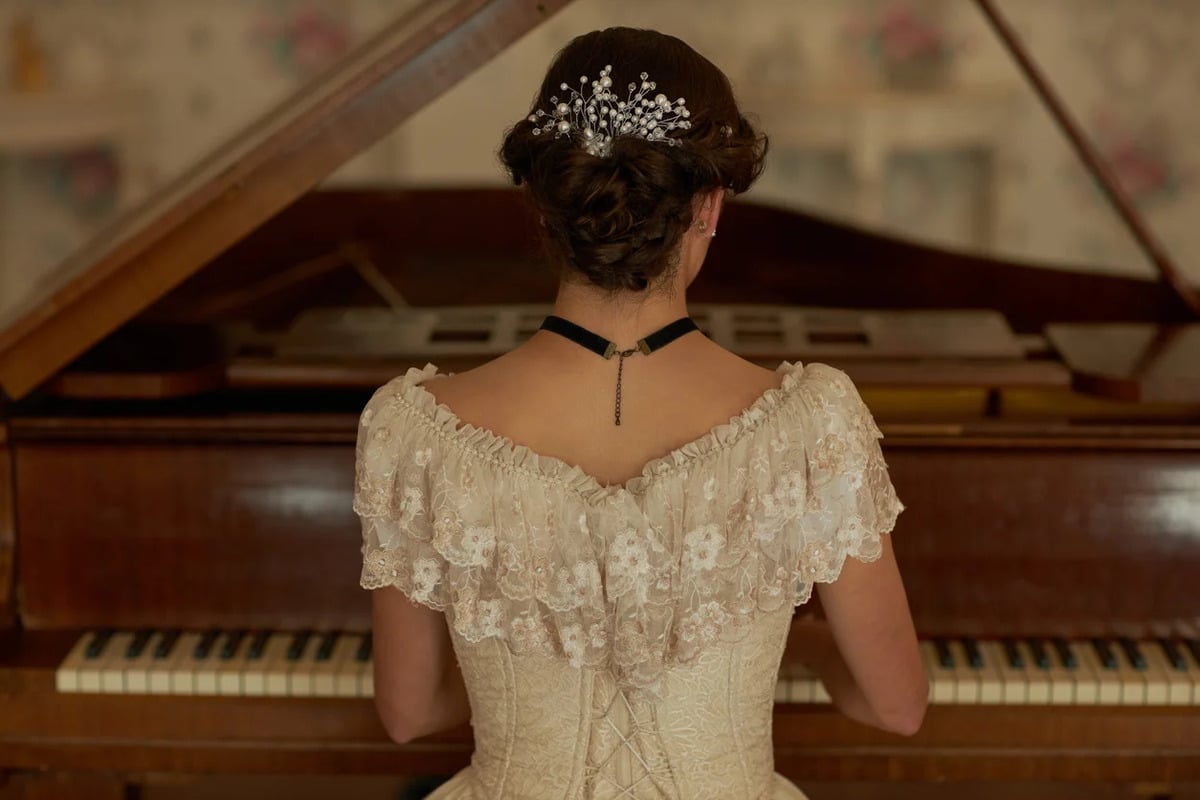
This very bracelet recently found its way back into popular culture. When Margot Robbie attended a London premiere of Emerald Fennell’s take on Wuthering Heights, she wore a dress adorned with light brown braids inspired by the Brontë piece. Robbie even accessorized her look with a replica of the bracelet itself – a gesture that bridged Victorian sentimentality and contemporary red-carpet fashion in one deliberate styling choice.
Hair charms also appear in the literature the Brontës produced. In Emily Brontë’s Wuthering Heights, Heathcliff removes a lock of Edgar Linton’s hair from Cathy Earnshaw’s corpse’s locket and replaces it with his own, sending a piece of himself and their love off with her spirit. The plan unravels when Nelly, the housemaid and narrator of the novel, entwines Linton’s hair with Heathcliff’s. Scholar Deborah Lutz described this act as opening up the possibility of a postmortem storm of jealousy between the two men. Though it is the only Brontë novel to directly reference mourning jewelry, the scene underscores how central hair work was to Victorian emotional life.
The bottom line
Hair is something profoundly personal. It comes from us, and it so often defines the kind of people we are or want to be. The Victorians understood that carrying someone’s hair on your body was hauntingly intimate – a grand yet discreet show of love. Whether you find the idea beautiful or slightly eerie, there is no denying that this centuries-old craft is resurfacing in film, museum exhibitions, and fashion. You may not be ready to weave a loved one’s locks into a bracelet just yet, but now you know why an entire era considered it the most meaningful gift anyone could give.


