



News feed

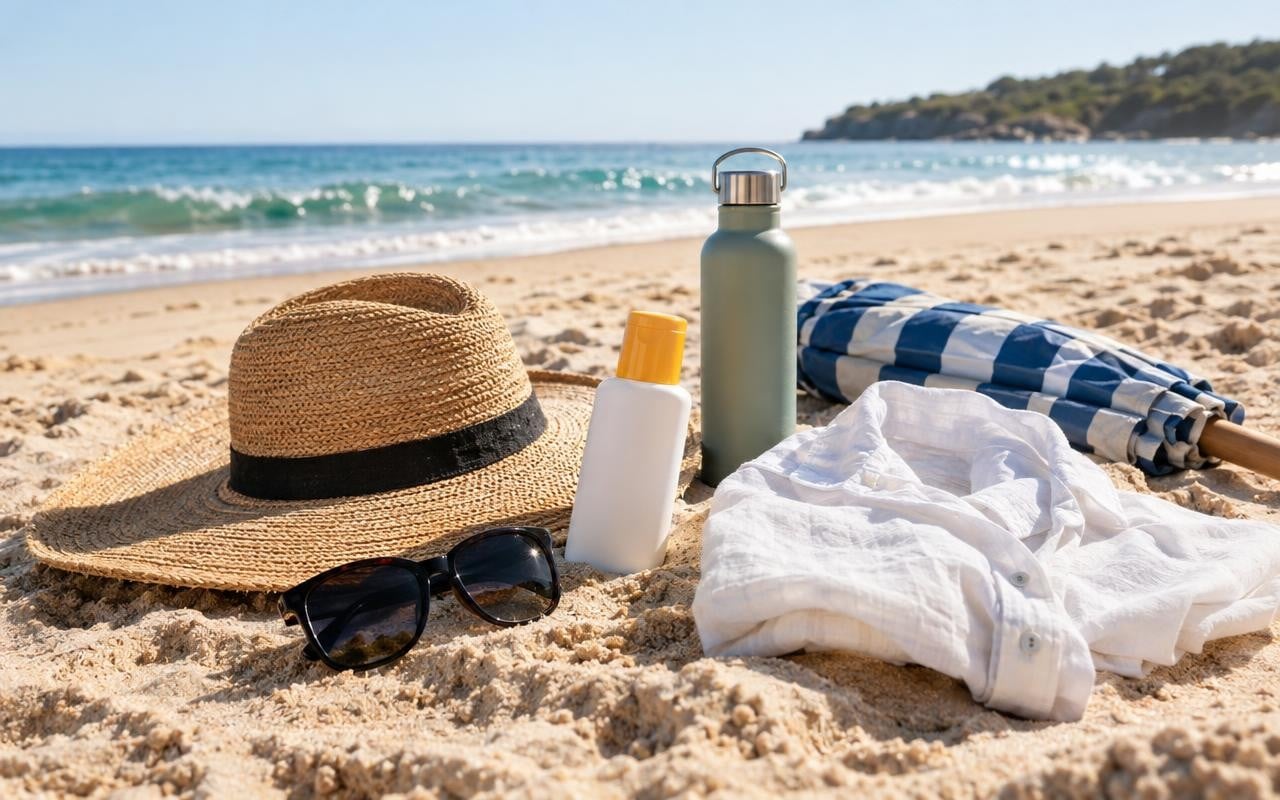
There is an unspoken coastal ritual that unfolds every Australian summer: packing an expansive raffia tote with a linen towel, an insulated water bottle, and a solitary tube of SPF 50+. It feels organised, responsible, and thoroughly prepared for a languid afternoon perched above the surf at Bronte or Cottesloe. Yet relying on a single topical lotion to carry the entire weight of dermal defence under a fierce Southern Hemisphere sun is a precarious oversight.
According to Cancer Council Australia, sunscreen is simply not a “suit of armour”. When coastal UV indices routinely climb past 11 into extreme territory between December and February, a topical chemical or mineral film can only accomplish so much on its own. Treating sunscreen as an invulnerable shield leads to premature photoageing, deep DNA cellular damage, and heightened skin cancer risks. To genuinely safeguard the skin, your beach tote requires an intelligent, multi-layered defensive system.
The Dosage Dilemma: Why Your Sunscreen Tube Falls Short
The foremost vulnerability of topical protection is the sheer volume required for it to work as advertised. Cancer Council Australia advises that an average-sized adult requires approximately seven metric teaspoons – roughly 35 mL – of broad-spectrum, water-resistant SPF 50 or SPF 50+ for a single full-body application. That breaks down strictly to one teaspoon for the head and neck, one for each limb, and one each for the front and back of the torso.
In practice, most beachgoers apply less than half that recommended quantity, drastically diminishing the nominal protection level. Factor in the non-negotiable rule to reapply every two hours, as well as immediately after swimming or heavy perspiring, and a chic 50 mL lotion will barely survive lunchtime. Topical formulas rub off on towelling, break down under sweat, and leave microscopic coverage gaps. Without physical textile reinforcement, relying solely on a tube of lotion becomes an exercise in false security.

Structural Defence: Hats, Wraparound Frames, and the 98 Percent Shield
True sun safety requires structural architecture. While high-fashion baseball caps and straw visors may complement a resort look, they are dermatologically inadequate for Australian conditions. Caps leave the delicate skin of the neck, temples, and ears entirely exposed – areas that consistently rank among the most common sites for basal cell carcinomas and melanomas. The solution is unapologetic scale: broad-brimmed hats, structured buckets, or legionnaire cuts that cast a wide perimeter of physical shadow across the face and neckline.
When paired with verified eyewear, this protective barrier becomes formidable. Cancer Council Australia notes that wearing a broad-brimmed hat alongside close-fitting sunglasses can reduce ultraviolet radiation exposure to the eyes by up to 98%. Eye protection is far more than an anti-squint aesthetic; unshielded ocular exposure contributes directly to cataracts, pterygiums, and delicate orbital skin damage. Opt for frames compliant with the Australian Standard AS/NZS 1067, favouring wraparound or generous profiles that prevent peripheral UV rays from sneaking around the lenses.
Physical Cover-Ups and Ambient Shade: Defeating Reflected UV
Lounging beneath a striped parasol or beach tent offers immediate thermal comfort, but shade alone does not eliminate the risk of sunburn. Ultraviolet radiation does not travel solely in direct overhead beams; it scatters in the atmosphere and bounces aggressively off ambient surfaces. Sand can reflect up to a quarter of ambient UV radiation directly under your cabana, creating a diffuse glow of radiation that easily bypasses overhead canopies.
This optical reality makes physical clothing the true backbone of coastal protection. Slipping into densely woven, long-sleeved garments provides an impenetrable boundary that neither sweats off nor demands rigorous reapplication. Look for lightweight collared resort shirts bearing a verified Ultraviolet Protection Factor (UPF) rating, which guarantees the proportion of solar UV radiation blocked by the weave. A collared design adds vital physical shade to the nape of the neck, an area notoriously missed during hasty sunscreen top-ups.
Whenever the UV Index reaches 3 or above – which occurs for most daylight hours across the Australian summer – protection must be approached as an ensemble cast. By uniting therapeutic SPF with AS/NZS 1067 frames, broad-brimmed headwear, portable shade, and breathable UPF layers, the beach bag transforms from a cosmetic pouch into an authoritative summer toolkit.